
Algyroides fitzingeri
Fitzinger's algyroides (Algyroides fitzingeri) is the smallest and most slender member of its genus, native to Corsica and Sardinia. This lizard is distinguished by the sharp demarcation between its side and underside scales and the absence of pale lines above its eyes. It inhabits a variety of temperate and Mediterranean environments, from sea level to high altitudes.
Key Facts
- ›Smallest and most slender member of the Algyroides genus.
- ›Native to the islands of Corsica and Sardinia.
- ›Distinguished by scale patterns and hind leg length compared to related species.
- ›Inhabits diverse environments including forests, shrublands, grasslands, and rocky areas.
- ›Reproduction is oviparous, with clutch sizes of 2-4 eggs.

Pygmy Algyroides, Pygmy Keeled Lizard
Corsica, Sardinia
- Up To 130mm In Length.
- Smallest and Most Slender Member of the Genus Algyroides.
- Sharp Demarcation Between Scales On the Sides and Underside.
- Absence of Pale Lines Above the Eyes.
- Short Hind Legs In Comparison To Greek Algyroides.
- Unreduced Scales On Its Flanks.
- Flattened Head With A Reduced Layer of Osteoderms.
- Supraciliary Laminae Are Only Partly Ossified.
- No Teeth On the Pterygoid.
- Hemipenis With Epithelium On the Crown .
About Algyroides fitzingeri
Fitzinger's Algyroides (Algyroides fitzingeri)
Fitzinger's algyroides, also known by common names such as the pygmy algyroides and pygmy keeled lizard, is a small lizard species native to the Mediterranean islands of Corsica and Sardinia. It holds the distinction of being the smallest and most slender member of the genus Algyroides. This species is formally recognized by its scientific name, Algyroides fitzingeri, and was first described in 1834.
Physical Characteristics and Distinctions
Measuring up to 130mm in length, Algyroides fitzingeri possesses several unique physical traits that set it apart from its relatives. A key identifying feature is the sharp contrast between the scales on its sides and those on its underside, a demarcation not present in all related species. Furthermore, it lacks the pale lines above the eyes seen in some other Algyroides species and has relatively short hind legs. Anatomically, it features a flattened head with reduced osteoderms and partially ossified supraciliary laminae, with no teeth on the pterygoid.
Habitat and Distribution
The geographic range of Fitzinger's algyroides is strictly limited to the islands of Corsica and Sardinia. It thrives in a variety of temperate and Mediterranean habitats, demonstrating adaptability to diverse environments. Its natural homes include temperate forests, shrublands, grasslands, and rocky areas, as well as more human-influenced landscapes such as arable land, pastures, and rural gardens. This species can be found from sea level up to elevations of 1,800 meters, showcasing its ability to inhabit a broad altitudinal spectrum.
Reproduction and Classification
Fitzinger's algyroides reproduces oviparously, laying clutches of 2 to 4 eggs. It belongs to the family Lacertidae, commonly referred to as African and Eurasian 'typical lizards'. The specific name, fitzingeri, honors the Austrian herpetologist Leopold Fitzinger, who contributed significantly to the field of herpetology.
Source: Wikipedia ↗
Frequently Asked Questions
What is Fitzinger's algyroides?
Fitzinger's algyroides, scientifically known as Algyroides fitzingeri, is a species of lizard belonging to the Lacertidae family. It is recognized as the smallest and most slender species within the Algyroides genus.
Where does Algyroides fitzingeri live?
This lizard species is exclusively found on the Mediterranean islands of Corsica and Sardinia. Its natural habitats range from sea level up to altitudes of 1,800 meters.
What are the distinguishing physical features of Fitzinger's algyroides?
Algyroides fitzingeri can be identified by a sharp demarcation between the scales on its sides and underside, and the absence of pale lines above its eyes. Its hind legs are also notably shorter compared to the Greek algyroides.
What kind of environments does Algyroides fitzingeri inhabit?
Its natural habitats are diverse and include temperate forests, temperate shrublands, Mediterranean-type shrubby vegetation, temperate grasslands, rocky areas, arable land, pastureland, and rural gardens.
How does Algyroides fitzingeri reproduce?
Algyroides fitzingeri is oviparous, meaning it lays eggs. A typical clutch size consists of 2 to 4 eggs.
What is the scientific classification of Fitzinger's algyroides?
It is classified in the genus Algyroides, which is part of the family Lacertidae, commonly known as African and Eurasian 'typical lizards'. The species was first described in 1834.
Related Lizards
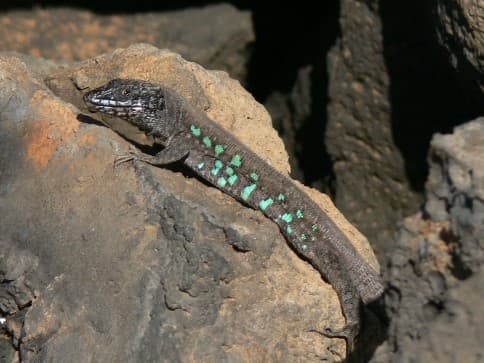
Atlantic lizard
The Atlantic lizard (Gallotia atlantica) is a species of lizard belonging to the family Lacertidae. It is native to the eastern Canary Islands, specifically Lanzarote and Fuerteventura, and their associated smaller islands. Its natural habitats are diverse, ranging from temperate forests and shrublands to rocky shores and sandy areas, as well as agricultural and garden environments.

Spanish psammodromus
The Spanish psammodromus (Psammodromus hispanicus) is a small, slender lizard known for its distinctive patterns and rough appearance, characterized by keeled, overlapping scales. Primarily found across the Iberian Peninsula and the Mediterranean coast of France, it inhabits dry, open Mediterranean areas with stone cover and sandy soil. This species feeds mainly on insects and spiders, and when threatened, it flees into vegetation, though it may squeak if caught, but never bites.
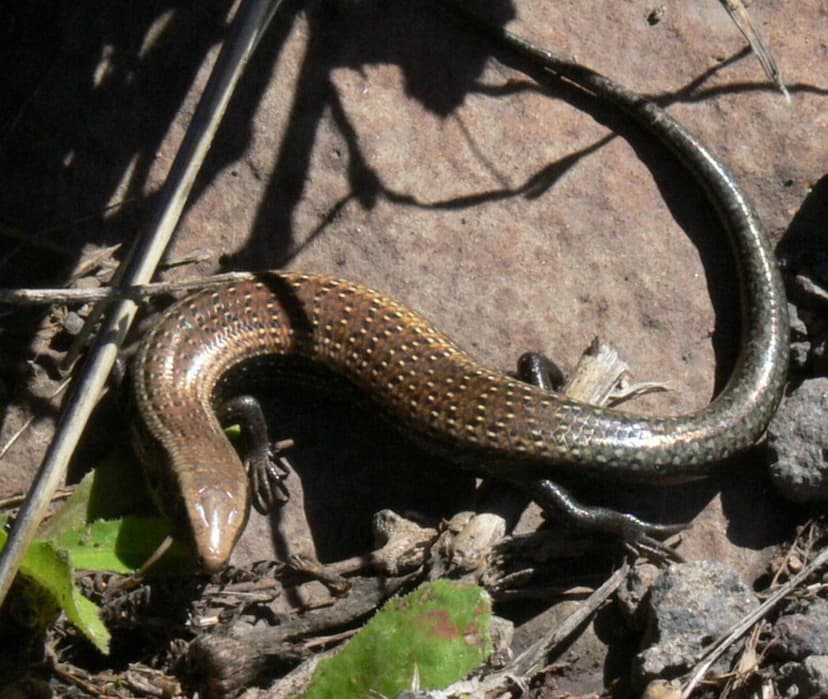
Chalcides viridanus
The West Canary skink, scientifically known as Chalcides viridanus, is a species of lizard endemic to the Canary Islands. This skink inhabits a diverse range of environments, from temperate forests and grasslands to urban areas, and can be found at elevations up to 2,000 meters. It is characterized by its cylindrical body and can reach a total length of approximately 18 cm.