
Atlantic lizard
Gallotia atlantica·Lacertidae
The Atlantic lizard (Gallotia atlantica) is a species of lizard belonging to the family Lacertidae. It is native to the eastern Canary Islands, specifically Lanzarote and Fuerteventura, and their associated smaller islands. Its natural habitats are diverse, ranging from temperate forests and shrublands to rocky shores and sandy areas, as well as agricultural and garden environments.
Key Facts
- ›Found exclusively in the eastern Canary Islands: Lanzarote and Fuerteventura.
- ›Inhabits a variety of environments, including forests, shrublands, rocky areas, and shores.
- ›Also found in human-modified landscapes like arable land, pastures, and gardens.
- ›Belongs to the Lacertidae family of lizards.
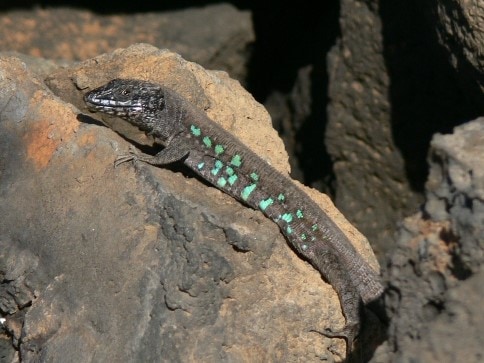
Atlantic Lizard
Lanzarote, Fuerteventura, Eastern Canary Islands
About Atlantic lizard
The Atlantic lizard, scientifically classified as Gallotia atlantica, is a species of lizard that belongs to the family Lacertidae. This species is notably endemic to the eastern Canary Islands, with its natural range primarily encompassing Lanzarote and Fuerteventura, along with the smaller islands situated around them.
Natural Habitats and Distribution
The Atlantic lizard thrives in a diverse array of natural environments. Its preferred habitats include temperate forests, temperate shrublands, and Mediterranean-type shrubby vegetation. Furthermore, it is well-adapted to rocky areas, rocky shores, and sandy shores, demonstrating its ability to colonize varied coastal and terrestrial landscapes. The species also extends its presence into human-influenced environments, being found in arable land, pastureland, and rural gardens, which suggests a degree of adaptability to human-modified landscapes.
Source: Wikipedia ↗
Frequently Asked Questions
Where does the Atlantic lizard live?
The Atlantic lizard is endemic to the eastern Canary Islands. Its primary locations are Lanzarote and Fuerteventura, along with the smaller islands that surround them.
What kind of habitats does the Atlantic lizard prefer?
This species is found in a wide array of natural habitats. These include temperate forests, temperate shrublands, Mediterranean-type shrubby vegetation, rocky areas, and both rocky and sandy shores.
Does the Atlantic lizard live in areas with human activity?
Yes, the Atlantic lizard has adapted to environments influenced by humans. It can be found in arable land, pastureland, and rural gardens, indicating a degree of tolerance for human-modified landscapes.
What is the scientific classification of the Atlantic lizard?
The Atlantic lizard is scientifically known as Gallotia atlantica. It belongs to the family Lacertidae, which comprises a diverse group of lizards.
Related Lizards

Algyroides fitzingeri
Fitzinger's algyroides (Algyroides fitzingeri) is the smallest and most slender member of its genus, native to Corsica and Sardinia. This lizard is distinguished by the sharp demarcation between its side and underside scales and the absence of pale lines above its eyes. It inhabits a variety of temperate and Mediterranean environments, from sea level to high altitudes.
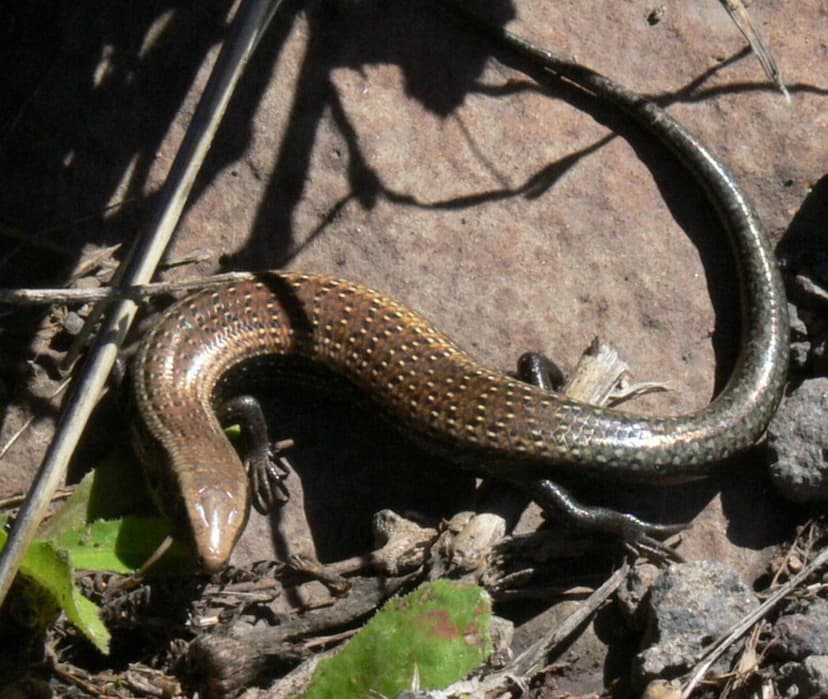
Chalcides viridanus
The West Canary skink, scientifically known as Chalcides viridanus, is a species of lizard endemic to the Canary Islands. This skink inhabits a diverse range of environments, from temperate forests and grasslands to urban areas, and can be found at elevations up to 2,000 meters. It is characterized by its cylindrical body and can reach a total length of approximately 18 cm.

West Canary skink
The West Canary skink, also known as the Canaryan cylindrical skink, is a species of lizard endemic to the Canary Islands. It inhabits a variety of environments, from temperate forests to urban areas, and can be found at altitudes up to 2,000 meters. This viviparous lizard is active during the day and at dusk, reaching a total length of about 18 cm.