
Spanish psammodromus
The Spanish psammodromus (Psammodromus hispanicus) is a small, slender lizard known for its distinctive patterns and rough appearance, characterized by keeled, overlapping scales. Primarily found across the Iberian Peninsula and the Mediterranean coast of France, it inhabits dry, open Mediterranean areas with stone cover and sandy soil. This species feeds mainly on insects and spiders, and when threatened, it flees into vegetation, though it may squeak if caught, but never bites.
Key Facts
- ›The Spanish psammodromus is one of the smallest lizards in France.
- ›Its natural habitats include Mediterranean-type shrubland, grasslands, and sandy areas.
- ›They primarily feed on small insects and spiders.
- ›Breeding occurs in spring after hibernation, with females laying 2 to 8 eggs per clutch.
- ›The average lifespan is only 2 to 3 years, with many dying after their first mating season.
- ›They are active during the day and flee into vegetation when disturbed.

Spanish Psammodromus
France, Portugal, Spain
- Slender and Long-Bodied With A Small, Pointed Head.
- Very Long, Slender Tail, Approximately 1.5 Times the Body Length.
- Keeled, Overlapping Scales Resulting In A Rough Appearance.
- Coloration Varies From Dark Brown, Olive-Brown, Or Dark Red With Irregular Lighter Blotches, Streaks, and Small Lines.
- Belly Is Typically Yellowish.
- Young Hatch At Around 20-25 mm Long.
- Adult Total Length Can Reach Around 120-130 mm.
Small Insects, Spiders
Active By Day ., Flee Into Close-By Vegetation When Disturbed., May Squeak When Caught, But Do Not Bite., Breeding Occurs In Spring After Hibernation.
Birds, Large Insects, Snakes, Other Mammals
Habitat Loss
About Spanish psammodromus
The Spanish psammodromus, scientifically known as Psammodromus hispanicus, is a diminutive lizard belonging to the Lacertidae family. Its name derives from Greek roots meaning 'sand' and 'to run,' with 'hispanicus' indicating its Spanish origin. This species is notable for its slender, long-bodied form, small pointed head, and a strikingly long, slender tail that can be about 1.5 times its body length. Its scales are keeled and overlapping, giving it a characteristically rough texture. The coloration typically ranges from dark brown to olive-brown or dark red, often adorned with irregular lighter blotches and streaks, while its underside is a pale yellow.
Habitat and Distribution
Found primarily across the Iberian Peninsula, with the exception of the northern coast and the Pyrenees, the Spanish psammodromus also extends its range along the Mediterranean coast of France. Its preferred natural habitats are dry, open Mediterranean environments, including shrubland, temperate grasslands, sandy shores, and even arable land, pastureland, and rural gardens. They can be found at elevations up to 1500 meters, often favoring areas with stone cover and loose, sandy soil.
Biology and Behavior
Spanish psammodromus are diurnal, meaning they are active during the day. Their diet consists mainly of small insects and spiders. When threatened, their primary defense mechanism is to flee rapidly into nearby vegetation. If captured, they may emit a squeaking sound but are not known to bite. Breeding commences in the spring following their hibernation. Females lay clutches of 2 to 8 eggs in warm, moist locations, such as under hay piles or in rotting wood. These eggs typically incubate for around 8 weeks, and females may lay up to two clutches per breeding season. The average lifespan for this species is quite short, usually between 2 to 3 years, with many individuals succumbing after their first mating season. They reach sexual maturity within their first year of life.
Source: Wikipedia ↗
Frequently Asked Questions
What is the scientific name for the Spanish psammodromus?
The scientific name for the Spanish psammodromus is Psammodromus hispanicus. The genus name Psammodromus is derived from Greek words meaning 'sand' and 'to run', while the species name hispanicus refers to its origin in Spain.
Where are Spanish psammodromus lizards found?
Spanish psammodromus lizards are found across most of the Iberian Peninsula, excluding the north coast and the Pyrenees. In France, they are present along the Mediterranean coast. They inhabit dry, open Mediterranean areas, often found at altitudes up to 1500 meters.
What does the Spanish psammodromus eat?
The diet of the Spanish psammodromus consists mainly of small insects and spiders. They are insectivorous and hunt for their prey within their habitat.
What are the physical characteristics of the Spanish psammodromus?
Spanish psammodromus are slender and long-bodied with a small, pointed head and a very long, slender tail. They have keeled, overlapping scales, giving them a rough appearance. Their coloration is typically dark brown, olive-brown, or dark red with irregular lighter blotches and streaks, and their belly is yellowish.
What is the lifespan and reproduction of the Spanish psammodromus?
The average lifespan for the Spanish psammodromus is short, typically only 2 to 3 years, with many not surviving past their first mating season. They reach sexual maturity in their first year. Breeding occurs in spring, and females lay 2 to 8 eggs, potentially up to two clutches per season, which incubate for about 8 weeks.
How does the Spanish psammodromus defend itself?
When disturbed, the Spanish psammodromus will quickly flee into nearby vegetation. If caught, they are known to squeak but do not bite their predators.
Related Lizards

Algyroides fitzingeri
Fitzinger's algyroides (Algyroides fitzingeri) is the smallest and most slender member of its genus, native to Corsica and Sardinia. This lizard is distinguished by the sharp demarcation between its side and underside scales and the absence of pale lines above its eyes. It inhabits a variety of temperate and Mediterranean environments, from sea level to high altitudes.
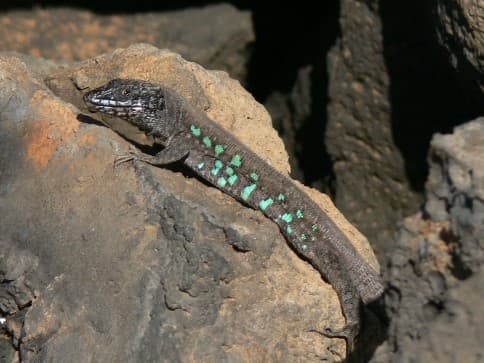
Atlantic lizard
The Atlantic lizard (Gallotia atlantica) is a species of lizard belonging to the family Lacertidae. It is native to the eastern Canary Islands, specifically Lanzarote and Fuerteventura, and their associated smaller islands. Its natural habitats are diverse, ranging from temperate forests and shrublands to rocky shores and sandy areas, as well as agricultural and garden environments.

Maltese wall lizard
The Maltese wall lizard (Podarcis filfolensis) is a species of lizard found in Malta and the Pelagian Islands of Italy. It inhabits Mediterranean-type shrubland, rocky areas, shores, arable land, pasture, and rural gardens. Distinguishing features vary by subspecies, with males generally exhibiting brighter colors than females and juveniles.