
Amphisbaena tragorrhectes
Amphisbaena tragorrhectes is a species of worm lizard native to Brazil. As a member of the Amphisbaenidae family, it shares the characteristic limbless, snake-like body of other worm lizards, adapted for burrowing. Little specific information is publicly available regarding its distinct physical features, habitat preferences, or behavior beyond its classification.
Key Facts
- ›Native to Brazil.
- ›Belongs to the Amphisbaenidae family of worm lizards.
- ›Characterized by a limbless, burrowing lifestyle.
- ›Limited detailed information is publicly accessible about its specific traits.

Brazil
Limbless, Snake-Like Body
Burrowing
About Amphisbaena tragorrhectes
What is known
Amphisbaena tragorrhectes is a species of worm lizard recognized for its native range within Brazil. As a member of the Amphisbaenidae family, it exhibits the characteristic limbless, serpentine body plan common to worm lizards, which are highly adapted for a fossorial, or burrowing, lifestyle.
Detailed information concerning the specific physical attributes, ecological niche, or behavioral patterns of Amphisbaena tragorrhectes remains limited in publicly accessible records. Its classification places it within a group of reptiles known for their subterranean existence, often leading to less documentation compared to more surface-dwelling species.
Source: Wikipedia ↗
Frequently Asked Questions
Where is Amphisbaena tragorrhectes found?
Amphisbaena tragorrhectes is found in Brazil. Its specific distribution within Brazil is not detailed in available records.
What kind of lizard is Amphisbaena tragorrhectes?
Amphisbaena tragorrhectes is a species of worm lizard. Worm lizards are distinct from true lizards, characterized by their limbless, burrowing adaptations.
What is the scientific classification of Amphisbaena tragorrhectes?
Amphisbaena tragorrhectes belongs to the family Amphisbaenidae. This family encompasses a diverse group of burrowing, limbless reptiles.
Related Lizards

Barkudia melanosticta
The Visakhapatnam limbless skink, scientifically known as Barkudia melanosticta, is a legless skink endemic to the Visakhapatnam region of Andhra Pradesh, India. This burrowing species is characterized by its elongated body, vestigial eyes with only lower eyelids, and slit-like ear openings. It was first collected in the 1790s and later had its taxonomy clarified through subsequent collections.
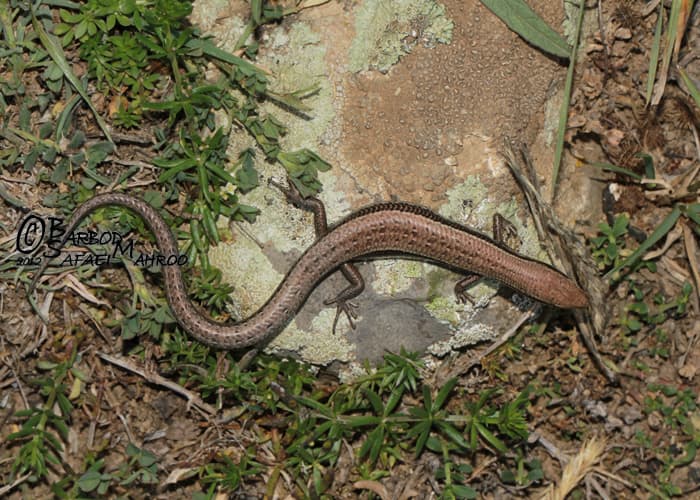
Ablepharus bivittatus
The twin-striped skink (Ablepharus bivittatus) is a species of skink found in mountainous regions of Armenia, Azerbaijan, Turkmenistan, northwestern Iran, and Turkey. It is distinguished by its habitat in high elevations, typically between 2,300 and 3,300 meters.
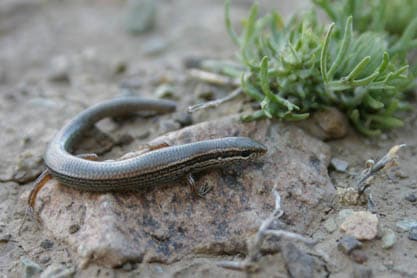
Ablepharus pannonicus
The Asian snake-eyed skink (Ablepharus pannonicus) is a species of skink native to a wide range across Asia and parts of the Middle East. It is characterized by its snake-like appearance and is found in diverse arid and semi-arid environments.