
Amphisbaenidae
Amphisbaenidae, commonly known as worm lizards, are a family of limbless reptiles characterized by their worm-like appearance due to rings of scales. These burrowing creatures possess powerful jaws and specialized sensory adaptations for detecting prey underground. They are found across South America, parts of the Caribbean, Europe, and sub-Saharan Africa.
Key Facts
- ›Limbless reptiles with a segmented, worm-like body.
- ›Possess powerful jaws and large, recurved teeth for seizing prey.
- ›Highly reduced eyes and a specialized ear structure for detecting vibrations.
- ›Adapted for a burrowing lifestyle.
- ›Carnivorous diet, primarily feeding on invertebrates.
- ›Found in South America, the Caribbean, Europe, and sub-Saharan Africa.

Worm Lizards
South America, Caribbean Islands, Europe, Sub-Saharan Africa
- Limbless Reptiles.
- Body Bears Rings of Scales, Giving A Worm-Like Appearance.
- Massively Constructed Head Used For Burrowing.
- Powerful Jaws With Large, Recurved Teeth.
- Head Shape Varies: Some Have Spade-Like Heads, Others A Narrow Keel, and Some A Rounded Skull.
- Eyes Are Highly Reduced.
- Large and Massive Ear Bone For Detecting Vibrations.
- Carnivorous
- Prey Includes Invertebrates Detected Underground.
- Burrowing Lifestyle.
- Hunt For Prey Underground By Detecting Vibrations.
About Amphisbaenidae
Amphisbaenidae: The Worm Lizards
The Amphisbaenidae, commonly known as worm lizards, represent a fascinating family of limbless reptiles. These unique creatures are characterized by their segmented bodies covered in rings of scales, which contribute to their distinctive worm-like appearance. Adapted for a subterranean existence, they possess robustly built heads and powerful jaws equipped with large, recurved teeth, ideally suited for seizing prey encountered beneath the earth's surface.
Habitat and Distribution
Amphisbaenids exhibit a wide geographic distribution, with populations found across South America, on various Caribbean islands, throughout Europe, and in sub-Saharan Africa. Their primary habitat is defined by their burrowing lifestyle, thriving in environments that allow for subterranean movement and foraging.
Physical Adaptations
Beyond their limbless form and scaled bodies, Amphisbaenidae have evolved specialized sensory organs. Their eyes are highly reduced, suggesting a limited reliance on vision. Instead, they possess a remarkably developed auditory system, featuring a large and massive ear bone, the stapes, which works in conjunction with another bone, the extracollumella, to detect vibrations. This adaptation is crucial for locating invertebrates, their primary food source, while underground. The morphology of their heads also varies among species, with some featuring spade-like structures, others a narrow keel, and some a rounded skull, all aiding in their burrowing activities.
Taxonomy
The family Amphisbaenidae encompasses a significant diversity, with 183 extant species organized into 12 genera. However, the genus Blanus, native to Europe, is sometimes considered a distinct family, Blanidae, due to its somewhat aberrant nature within the broader group. Fossil records also reveal extinct genera, indicating a long evolutionary history for this group of reptiles.
Source: Wikipedia ↗
Frequently Asked Questions
What are Amphisbaenidae?
Amphisbaenidae are a family of limbless reptiles, commonly referred to as worm lizards. They are characterized by their segmented, worm-like bodies and their adaptations for a burrowing lifestyle.
What do Amphisbaenidae eat?
Members of the Amphisbaenidae family have carnivorous diets. They use their powerful jaws and specialized hearing to detect and capture prey, which typically consists of invertebrates found underground.
Where are Amphisbaenidae found?
The geographic range of Amphisbaenidae includes South America, some Caribbean islands, Europe, and sub-Saharan Africa. One genus, Blanus, is specifically native to Europe.
How do Amphisbaenidae sense their environment?
Amphisbaenids have highly reduced eyes, indicating they rely less on sight. Instead, they possess a large and massive ear bone (stapes) that, along with another bone (extracollumella), helps them detect vibrations from prey moving underground.
What is distinctive about Amphisbaenidae physical appearance?
Their most striking feature is their limbless, segmented body covered in rings of scales, giving them a worm-like appearance. Their heads are also massively constructed for burrowing, with variations in shape among species, and they have powerful jaws with large teeth.
Related Lizards
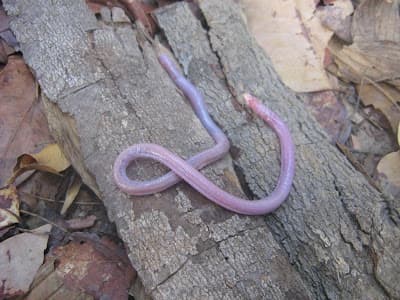
Amphisbaena bilabialata
Amphisbaena bilabialata is a species of worm lizard native to Brazil. These legless reptiles are characterized by their unique burrowing lifestyle and are part of the Amphisbaenidae family.

Amphisbaena lumbricalis
Amphisbaena lumbricalis is a species of worm lizard native to Brazil. As a member of the Amphisbaenidae family, it shares the characteristic limbless, serpentine body of its relatives, adapted for burrowing. Information regarding its specific physical traits, habitat, and behaviors is limited in available records.

Aprasia striolata
The striated worm-lizard (Aprasia striolata) is a species of legless lizard found in southern Australia. It is characterized by its slender, elongated, snake-like body and pale brown to grey coloration, often adorned with thin, dark parallel stripes. This burrowing species primarily feeds on ant brood and is oviparous, laying thick-shelled eggs.