
Aprasia rostrata
Aprasia rostrata·Pygopodidae·Not specified
Aprasia rostrata, also known as the Hermite Island worm-lizard or Exmouth worm-lizard, is a species of legless lizard belonging to the Pygopodidae family. It is endemic to a very restricted range within the Montebello Islands of Australia. This species was thought to be extinct for a period due to its limited habitat and the impact of nuclear testing, but was rediscovered in 2006.
Key Facts
- ›Endemic to the Montebello Islands, Australia.
- ›Belongs to the Pygopodidae family, commonly known as legless lizards.
- ›Was thought to be extinct following nuclear testing on the islands.
- ›Rediscovered in 2006 living under Acacia coriacea stumps with ant colonies.
- ›Its limited geographic range makes it potentially vulnerable.

Hermite Island Worm-Lizard, Exmouth Worm-Lizard
Montebello Islands, Australia
Under Acacia Coriacea Stumps, Areas With Live Ant Colonies
- Legless Lizard.
- Specimens Collected Were Found Under Acacia Coriacea Stumps With Live Ant Colonies.
Ants
Inhabits Areas Associated With Ant Colonies., Found Under Stumps.
Limited Geographic Restriction, Nuclear Testing, Introduction of Other Species
About Aprasia rostrata
Aprasia rostrata, commonly known as the Hermite Island worm-lizard or Exmouth worm-lizard, is a unique species of legless lizard belonging to the Pygopodidae family. Its existence is confined to a remarkably small geographic area: the Montebello Islands off the coast of Western Australia. This restricted distribution has long made it a subject of conservation concern.
History and Rediscovery
The species first came to scientific attention when two specimens were collected from the Montebello Islands in 1952, preceding the Operation Hurricane nuclear test conducted there. In the decades that followed, subsequent surveys failed to locate any more individuals. This lack of sightings, coupled with its highly restricted habitat, fueled fears that Aprasia rostrata might have become extinct, potentially due to the environmental impact of the nuclear testing or other introduced species.
However, these fears were allayed in 2006 when a survey successfully rediscovered the lizard. Four individuals were found living beneath the stumps of Acacia coriacea trees, specifically in areas inhabited by live ant colonies. This significant rediscovery, published in The Western Australian Naturalist in 2007, confirmed that Aprasia rostrata had survived the historical disturbances and remained a resident of the Montebello Islands, albeit a potentially vulnerable one due to its limited range.
Source: Wikipedia ↗
Frequently Asked Questions
What is Aprasia rostrata?
Aprasia rostrata is a species of legless lizard belonging to the Pygopodidae family. It is also commonly known as the Hermite Island worm-lizard or Exmouth worm-lizard.
Where does Aprasia rostrata live?
This species is endemic to a very specific and limited geographic area: the Montebello Islands, off the coast of Western Australia.
Was Aprasia rostrata affected by nuclear testing?
Two specimens were collected from the Montebello Islands in 1952, prior to the Operation Hurricane nuclear test. Concerns were raised that the species might have been negatively impacted or driven to extinction by the testing and subsequent environmental changes.
Has Aprasia rostrata gone extinct?
For decades after the nuclear tests, further specimens could not be found, leading to fears of extinction. However, the species was rediscovered in 2006, proving it had survived despite the nuclear tests and the introduction of other species like black rats.
What are the common names for Aprasia rostrata?
Aprasia rostrata is also known by the common names Hermite Island worm-lizard and Exmouth worm-lizard.
Related Lizards

Ablepharus
Ablepharus, commonly known as snake-eyed skinks, are small lizards distinguished by fused eyelids that prevent blinking, similar to snakes. They inhabit dry fields, hills, and rocky areas, often concealed within leaf litter. These skinks possess shiny, bronze scales and a characteristic dark stripe along their sides, feeding primarily on small insects and mollusks.

Acanthocercus atricollis
The black-necked agama, Acanthocercus atricollis, is a species of tree agama found across East, Central, and southern Africa. These lizards are known for forming structured colonies and are often found in high densities near human settlements due to reduced predator presence. They are primarily insectivorous ambush predators.
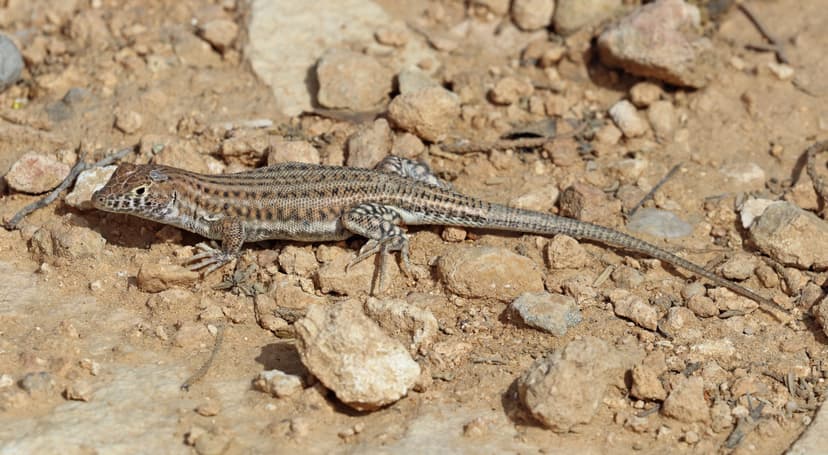
Acanthodactylus boskianus
Bosc's fringe-toed lizard (Acanthodactylus boskianus) is a medium-sized lizard found across North Africa and Western Asia. It is characterized by its olive-grey dorsal surface with dark stripes and distinctive long, fringed digits on its feet. This fast-moving lizard inhabits diverse environments, from coastal plains to oases, and is a common diurnal species within its extensive range.