
Pygopodidae
Pygopodidae, commonly known as snake-lizards or flap-footed lizards, are a family of legless geckos native to Australia and New Guinea. They possess unusually long, slender bodies resembling snakes, but are distinguished by external ear holes, flat tongues, and vestigial hind limbs. These adaptations allow some species to burrow or navigate dense vegetation, with their diet primarily consisting of insects.
Key Facts
- ›Pygopodids are legless lizards that are a type of gecko.
- ›They are native to Australia and New Guinea.
- ›Distinguishing features from snakes include vestigial hind limbs, broad tongues, and external ear openings.
- ›They possess a unique ability to hear tones higher than any other reptiles.
- ›Pygopodids produce parchment-shelled eggs, typically in clutches of two.

Snake-Lizards, Flap-Footed Lizards
Australia, New Guinea
- Unusually Long, Slender Bodies.
- Resemble Snakes.
- No Eyelids.
- External Ear Holes.
- Flat, Unforked Tongues.
- Vestigial Hind Limbs In the Form of Small, Flattened Flaps.
- Ventral Scales In A Paired Series.
- Unbroken Tails Much Longer Than the Body.
Insects
- Some Species Are Burrowing Animals.
- Adapted To Moving Through Dense Spinifex Or Other Vegetation.
- Vestigial Hind Limbs May Play A Role In Courtship.
- Vestigial Hind Limbs May Play A Role In Defensive Behavior.
- Vestigial Hind Limbs May Aid In Locomotion Through Vegetation.
- Vocalize With Sounds Like the Common Gecko 'Harsh Squeak'.
- Communal Nesting Has Been Observed.
About Pygopodidae
Pygopodidae: The Snake-Lizards
Pygopodidae, commonly referred to as snake-lizards or flap-footed lizards, constitute a distinctive family of legless geckos. These reptiles are characterized by their remarkably long, slender bodies, which lend them a striking resemblance to snakes. However, they possess key anatomical differences that set them apart from true serpents, including external ear openings, flat, unforked tongues, and the presence of vestigial hind limbs in the form of small, flattened flaps.
Native to Australia and New Guinea, Pygopodids have adapted to a variety of environments. Some species are adept burrowers, while others are specialized for navigating dense vegetation, such as spinifex. Their diet primarily consists of insects, fitting their role as active predators within their ecosystems. A notable biological trait is their exceptional hearing; Pygopodids can perceive higher frequencies than any other known reptile, demonstrating a specialized sensory adaptation.
Reproductively, Pygopodids lay parchment-shelled eggs, typically in clutches of two. While individual clutches are small, communal nesting sites have been discovered containing as many as 30 eggs, suggesting complex social or ecological factors influencing their reproductive behavior. Despite their snake-like appearance, they are readily distinguishable from snakes by their vestigial hind limbs, broad tongues, and external ears, traits that are crucial for identification and understanding their unique evolutionary path within the gecko lineage.
Source: Wikipedia ↗
Frequently Asked Questions
What are snake-lizards?
Snake-lizards, also known as flap-footed lizards, are a family of legless geckos belonging to the Pygopodidae family. They are characterized by their long, slender bodies that resemble snakes, but they possess distinct features like external ear holes and vestigial hind limbs.
How can you tell a snake-lizard from a snake?
Snake-lizards can be distinguished from true snakes by several features. They have vestigial hind limbs, broad, fleshy tongues (unlike the forked tongues of snakes), and most have external ears. Additionally, their tails are typically longer than their bodies, whereas snake bodies are usually longer than their tails.
Where are Pygopodidae found?
The Pygopodidae family is native to the regions of Australia and New Guinea. Within these areas, they inhabit various environments suited to their specialized adaptations.
What do Pygopodids eat?
Many Pygopodid species are insectivorous, meaning they feed on insects. Some species are adapted to burrowing, while others navigate dense vegetation to find their prey.
Do Pygopodidae have eyelids?
No, like snakes and most geckos, Pygopodidae do not have eyelids. They have spectacles, which are clear coverings over their eyes, and they are able to lick these clean.
What is unique about Pygopodid hearing?
Pygopodids possess an exceptional auditory range, capable of hearing tones higher than any other known reptiles. For example, some individuals can respond to frequencies significantly above the highest note on a standard piano.
How do Pygopodidae reproduce?
Pygopodids reproduce by laying parchment-shelled eggs. They typically lay clutches of two eggs, though communal nests have been found containing up to 30 eggs.
Related Lizards

Ablepharus
Ablepharus, commonly known as snake-eyed skinks, are small lizards distinguished by fused eyelids that prevent blinking, similar to snakes. They inhabit dry fields, hills, and rocky areas, often concealed within leaf litter. These skinks possess shiny, bronze scales and a characteristic dark stripe along their sides, feeding primarily on small insects and mollusks.

Aprasia striolata
The striated worm-lizard (Aprasia striolata) is a species of legless lizard found in southern Australia. It is characterized by its slender, elongated, snake-like body and pale brown to grey coloration, often adorned with thin, dark parallel stripes. This burrowing species primarily feeds on ant brood and is oviparous, laying thick-shelled eggs.
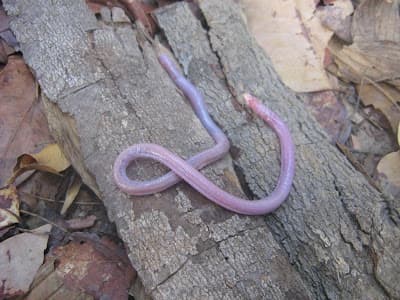
Amphisbaena bilabialata
Amphisbaena bilabialata is a species of worm lizard native to Brazil. These legless reptiles are characterized by their unique burrowing lifestyle and are part of the Amphisbaenidae family.