
Aspidoscelis marmorata marmorata
The marbled whiptail (Aspidoscelis marmoratus) is a slender, diurnal lizard found in the arid and semi-arid regions of the southwestern United States and northern Mexico. It is characterized by its grey or black coloration adorned with 4 to 8 yellow or white stripes, often with dark mottling, creating a marbled effect. This energetic species is known for its speed and wariness, darting into cover when approached.
Key Facts
- ›Found in southern New Mexico and Texas (USA), and Coahuila, Chihuahua, and Durango (Mexico).
- ›Measures 8 to 12 inches in length with a slender body and long tail.
- ›Distinctive coloration includes grey or black with 4-8 yellow/white stripes and dark mottling.
- ›Diurnal, insectivorous, wary, energetic, and fast-moving.
- ›Breeds in spring, laying up to four eggs between may and August.
- ›Hatchlings possess bright blue tails, unlike adults.

Marbled Whiptail
United States, Mexico
Semiarid Areas, Sandy Areas, Sparse Vegetation, Open Edges of Wooded Areas
- Grows From 8 To 12 Inches In Length.
- Slender-Bodied With Long Tails.
- Overall Color Is Grey Or Black.
- Features 4 To 8 Yellow Or White Stripes.
- Often Displays Dark Mottling, Giving A Marbled Appearance.
- Underside Is White Or Pale Yellow.
- Throat Has A Peach Coloration.
- Hatchlings Have Bright Blue Tails.
Insects
Diurnal, Insectivorous, Wary, Energetic, Fast Moving, Darts For Cover When Approached
About Aspidoscelis marmorata marmorata
The Marbled Whiptail
The marbled whiptail, scientifically known as Aspidoscelis marmoratus, is a distinctive lizard species native to the arid and semi-arid landscapes of the southwestern United States and northern Mexico. Its range includes southern New Mexico and Texas in the U.S., and the Mexican states of Coahuila, Chihuahua, and Durango.
Physical Characteristics
This lizard typically measures between 8 and 12 inches in total length, characterized by a slender body and a notably long tail. Its coloration is a striking combination of grey or black as the base, overlaid with 4 to 8 yellow or white stripes. These stripes are frequently interspersed with dark mottling, which gives the species its characteristic "marbled" appearance. The underside of the marbled whiptail is generally white or pale yellow, often with a peach-colored throat. A fascinating detail is that hatchlings of this species are born with bright blue tails, a feature that distinguishes them from adult individuals.
Habitat and Behavior
The preferred habitat of the marbled whiptail consists of semiarid, sandy areas that support sparse vegetation, as well as the open edges of wooded regions. As a diurnal species, it is active during the day and sustains itself on a diet of insects. The marbled whiptail is known for its wary, energetic, and fast-moving nature, quickly darting for cover if it perceives a threat or is approached.
Reproduction and Genetics
Breeding occurs in the spring, with females depositing up to four eggs between May and August. The incubation period for these eggs is approximately six to eight weeks, with hatching typically occurring in August, often coinciding with the wet season. Uniquely, the marbled whiptail exhibits facultative parthenogenesis, a form of asexual reproduction where unfertilized eggs can develop normally. This biological trait has the potential to facilitate purifying selection, allowing for the purging of lethal recessive alleles within a single generation.
Source: Wikipedia ↗
Frequently Asked Questions
What is the scientific name for the marbled whiptail?
The scientific name for the marbled whiptail is Aspidoscelis marmoratus. The article also mentions two subspecies: Aspidoscelis marmoratus marmoratus and Aspidoscelis marmoratus reticuloriens.
Where does the marbled whiptail live?
The marbled whiptail is found in the United States, specifically in southern New Mexico and Texas. It also inhabits northern Mexico, including the states of Coahuila, Chihuahua, and Durango.
What does the marbled whiptail look like?
This lizard grows from 8 to 12 inches long and has a slender body with a long tail. Its coloration is typically grey or black with 4 to 8 yellow or white stripes, often accompanied by dark mottling that gives it a marbled appearance.
What does the marbled whiptail eat?
The marbled whiptail is an insectivorous species, meaning its diet primarily consists of insects. It is active during the day and hunts for its prey in its habitat.
When do marbled whiptails reproduce?
Breeding for the marbled whiptail occurs in the spring. Females lay up to four eggs between May and August, and these eggs typically hatch in August, often during the wet season.
Do marbled whiptails have any unusual reproductive traits?
Yes, marbled whiptails exhibit facultative parthenogenesis, a process where unfertilized eggs can develop into offspring. This allows for purifying selection, potentially purging lethal recessive alleles in a single generation.
What are the young marbled whiptails like?
Hatchlings of the marbled whiptail look similar to adults but are distinguished by their bright blue tails. This vibrant coloration is a notable difference from the adult's typical coloring.
Related Lizards
Round-tailed horned lizard
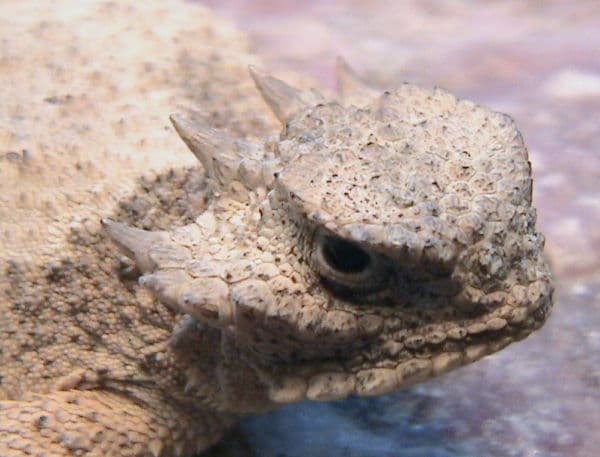
The roundtail horned lizard (Phrynosoma modestum) is a small, flat-bodied lizard native to arid regions of the southwestern United States and northcentral Mexico. It is distinguished by its short limbs, small head, and a unique crest of nearly equal-length horns, lacking the prominent lateral fringe of other horned lizards. This species typically inhabits rocky and sandy areas with sparse vegetation, often found near ant colonies which form the bulk of its diet.

Aspidoscelis laredoensis
The Laredo striped whiptail (Aspidoscelis laredoensis) is a lizard species native to southern Texas and northern Mexico. It is known for its dark green or brown coloration, distinguished by seven yellow or white stripes extending from head to tail, and a white underside. This species is parthenogenic, meaning females reproduce without fertilization, and it is a fast-moving, diurnal insectivore.
Laredo striped whiptail
The Laredo striped whiptail is a slender lizard native to southern Texas and northern Mexico, characterized by its dark green or brown coloration and seven distinctive yellow or white stripes running from head to tail. This species is known for its energetic and fast-moving nature, preferring habitats with sandy soils and sparse vegetation. A notable reproductive feature is parthenogenesis, where females lay unfertilized eggs.