
Boettger's lizard
Boettger's lizard (Gallotia caesaris) is a species of wall lizard endemic to the western Canary Islands, specifically El Hierro and La Gomera. This oviparous reptile inhabits rocky areas, shrubland, and forests, and is known for its capacity to lay multiple clutches of eggs per year. It is closely related to the Gallotia galloti species found on neighboring islands.
Key Facts
- ›Endemic to the Canary Islands, specifically El Hierro and La Gomera.
- ›Belongs to the Lacertidae family of wall lizards.
- ›Reproduces by laying eggs (oviparous).
- ›Females can lay up to three clutches per year, each with 1-5 eggs.
- ›Found in rocky areas, shrubland, and forests from sea level to 1,500 meters.
- ›Has been introduced to the Portuguese island of Madeira.
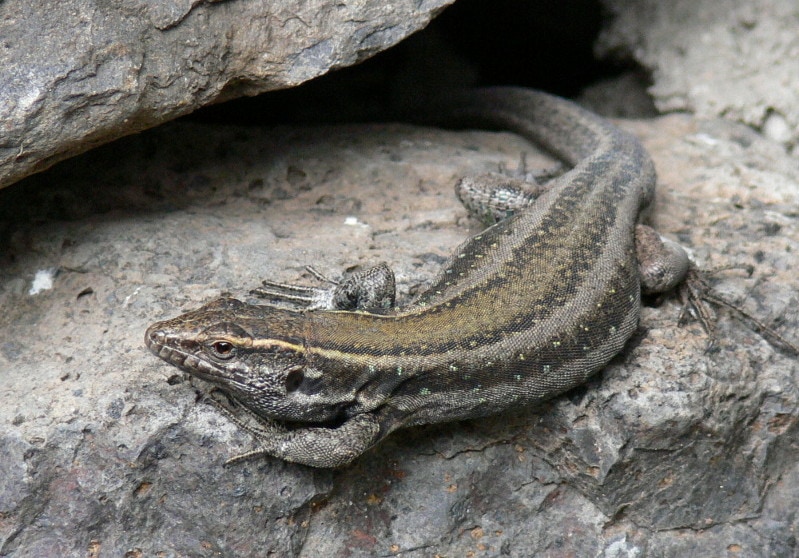
Boettger's Lizard
El Hierro, La Gomera, Madeira
About Boettger's lizard
Boettger's lizard, scientifically known as Gallotia caesaris, is a species of wall lizard belonging to the family Lacertidae. This species is native to the western Canary Islands, specifically inhabiting the islands of El Hierro and La Gomera. It is closely related to Gallotia galloti, which occupies the neighboring islands of Tenerife and La Palma, and has also been introduced by human activity to the Portuguese island of Madeira.
Habitat and Distribution
The preferred natural habitats of Gallotia caesaris are diverse, encompassing rocky areas, shrubland, and forest environments. These lizards can be found across a range of altitudes, from sea level up to approximately 1,500 meters (4,900 feet). The species is divided into two recognized subspecies: Gallotia caesaris caesaris, found on El Hierro, and Gallotia caesaris gomerae, native to La Gomera.
Reproduction
Boettger's lizard is oviparous, meaning it reproduces by laying eggs. A sexually mature female is capable of laying multiple clutches within a single year, potentially up to three. Each clutch typically contains between one and five eggs, ensuring the continuation of the species.
Source: Wikipedia ↗
Frequently Asked Questions
What are the scientific and common names for this lizard?
The scientific name for this species is Gallotia caesaris. It is commonly known as Boettger's lizard. The specific name 'caesaris' honors Caesar Rudolf Boettger.
Where can Boettger's lizard be found?
Boettger's lizard is native to the western Canary Islands, specifically the islands of El Hierro and La Gomera. It has also been introduced by humans to the Portuguese island of Madeira.
What kind of habitats does Boettger's lizard prefer?
This lizard prefers natural habitats such as rocky areas, shrubland, and forests. They can be found at altitudes ranging from sea level up to 1,500 meters (approximately 4,900 feet).
How does Boettger's lizard reproduce?
Boettger's lizard is oviparous, meaning it reproduces by laying eggs. A sexually mature female can lay up to three clutches of eggs in a single year, with each clutch containing between one and five eggs.
Are there different subspecies of Boettger's lizard?
Yes, there are two recognized subspecies of Gallotia caesaris. These are Gallotia caesaris caesaris, found on El Hierro, and Gallotia caesaris gomerae, found on La Gomera.
What is the conservation status of Boettger's lizard?
According to the IUCN Red List, Gallotia caesaris is listed as Least Concern. This designation suggests that the species is not currently facing an immediate threat of extinction.
Related Lizards
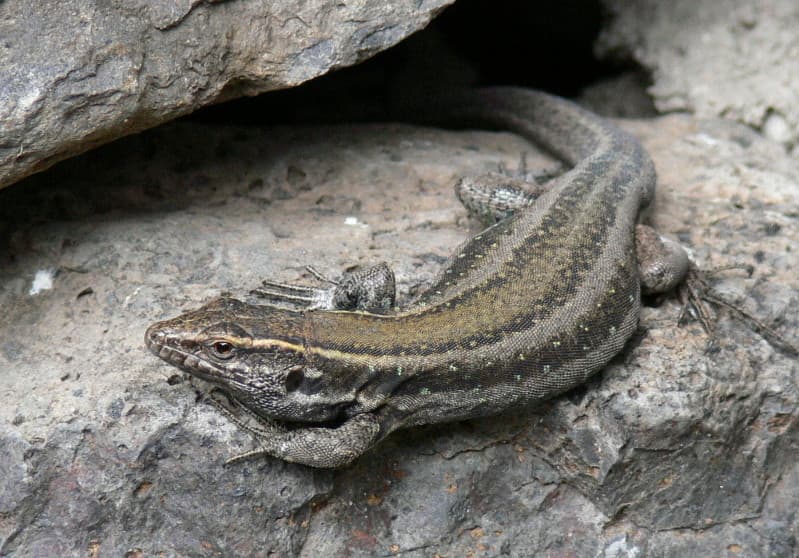
Gallotia caesaris
Boettger's lizard, scientifically known as Gallotia caesaris, is a species of wall lizard native to the western Canary Islands of El Hierro and La Gomera. Characterized by its preference for rocky areas, shrubland, and forests, this oviparous reptile is recognized by its two subspecies. It has also been introduced to Madeira, Portugal.

Anolis leachii
Anolis leachii, also known as the Antigua Bank tree anole or Leach's anole, is a lizard species endemic to the Caribbean, specifically Antigua and Barbuda. This arboreal species is characterized by its bright green coloration that fades to greyish-brown on its tail, and a grey to brown head with yellowish-orange dewlaps. It inhabits various environments, from forests and shrublands to human-disturbed areas like pastures and farms, provided vertical perching surfaces are available.

Florida worm lizard
The Florida worm lizard, also known as the graveyard snake or thunderworm, is a unique amphisbaenian species found primarily in Florida. It is characterized by its limbless, worm-like body, reduced eyes, and a shovel-shaped snout adapted for burrowing. This species inhabits forest and shrubland environments, spending most of its life underground and emerging only during heavy rains.