
Florida worm lizard
The Florida worm lizard, also known as the graveyard snake or thunderworm, is a unique amphisbaenian species found primarily in Florida. It is characterized by its limbless, worm-like body, reduced eyes, and a shovel-shaped snout adapted for burrowing. This species inhabits forest and shrubland environments, spending most of its life underground and emerging only during heavy rains.
Key Facts
- ›The Florida worm lizard is the only living species in the genus Rhineura.
- ›It possesses a shovel-like snout used for burrowing and has greatly reduced, externally invisible eyes.
- ›The species is limbless and its body is covered in ringed scales, giving it a worm-like appearance.
- ›It prefers to live underground in soil, sand, or leaf mold.
- ›Its diet consists of insects and earthworms, but it is an opportunistic feeder on small invertebrates.
- ›Reproduction occurs through egg-laying (oviparity).

Florida Worm Lizard, Graveyard Snake, Thunderworm
Florida, Georgia
- Total Length Ranges From 18–41 cm .
- Head Has A Shovel-Like Snout That Projects Forward Past the Lower Jaws.
- Eyes Are Highly Reduced and Not Visible Externally.
- Limbs Are Absent.
- Body Is Covered By Scales Arranged In Rings, Giving A Worm-Like Appearance.
Insects, Earthworms, Small Invertebrates
- Burrower, Spends Most Time Underground.
- Surfaces Only When Forced By Heavy Rain Or Plowing.
- Retreats Into Burrow Tail-First When Disturbed.
About Florida worm lizard
The Florida Worm Lizard: A Subterranean Specialist
The Florida worm lizard, scientifically known as Rhineura floridana, is a distinctive reptile that inhabits the sandy soils and shrublands of its namesake state, primarily Florida, with some populations extending into southern Georgia. This species is the sole living representative of its genus, Rhineura, and is easily recognized by its limbless, elongated body, which is covered in rings of scales, giving it a remarkably worm-like appearance. Its adaptations for a subterranean existence are evident in its highly reduced eyes, which are not externally visible, and its unique, shovel-shaped snout, perfectly designed for pushing through the soil.
Habitat and Behavior
Florida worm lizards are fossorial, meaning they spend the vast majority of their lives underground. They prefer substrates of soil, sand, or leaf mold, where they are protected from predators and the elements. These reptiles typically only emerge from their burrows when forced to do so by external factors, such as heavy rainfall or agricultural plowing. This infrequent surfacing, particularly during rain, has led to one of its common names, the "thunderworm." When threatened or disturbed, the Florida worm lizard employs a defensive strategy of retreating rapidly into its burrow, often tail-first.
Diet and Reproduction
The diet of the Florida worm lizard consists mainly of insects and earthworms. However, they are opportunistic feeders and will consume any small invertebrate that they can successfully capture. Reproduction in this species is oviparous, meaning they lay eggs. The species is classified as "Least Concern" by the IUCN, reflecting its broad distribution and stable population, suggesting it is not currently facing significant threats to its survival. Its unique morphology and specialized lifestyle make the Florida worm lizard a fascinating subject within the study of reptiles.
Source: Wikipedia ↗
Frequently Asked Questions
What are the common names for Rhineura floridana?
Rhineura floridana is commonly known as the Florida worm lizard. Other names it is called include the graveyard snake and the thunderworm.
Where does the Florida worm lizard live?
The Florida worm lizard is found primarily in Florida, with some records in Lanier County, Georgia. Its preferred natural habitats are forest and shrubland, particularly in xeric and mesic hammocks.
What does the Florida worm lizard look like?
It has a worm-like appearance due to its limbless body covered in scales arranged in rings. Its head features a shovel-like snout that extends past its lower jaw, and its eyes are very small and not visible externally. Adults range in total length from 18 to 41 cm (7 to 16 inches).
What does the Florida worm lizard eat?
The diet of the Florida worm lizard primarily includes insects and earthworms. As an opportunistic feeder, it will consume almost any invertebrate small enough for it to catch.
How does the Florida worm lizard reproduce?
Reproduction in the Florida worm lizard is oviparous, meaning they reproduce by laying eggs.
What is the conservation status of the Florida worm lizard?
The Florida worm lizard is classified as Least Concern on the IUCN Red List. This status is due to its wide distribution, presumed large population, and a stable population trend, indicating it is not declining rapidly.
Why is it sometimes called a thunderworm?
It is sometimes called a thunderworm because it tends to surface only when heavy rain or plowing forces it out of its burrow. These conditions often coincide with stormy weather.
Related Lizards

Florida wormlizard
The Florida worm lizard, also known as the graveyard snake or thunderworm, is a unique amphisbaenian species found primarily in Florida. It is characterized by its limbless, worm-like body covered in ringed scales and a shovel-shaped snout adapted for burrowing. This reclusive reptile spends most of its life underground, emerging only during heavy rains.

Anolis leachii
Anolis leachii, also known as the Antigua Bank tree anole or Leach's anole, is a lizard species endemic to the Caribbean, specifically Antigua and Barbuda. This arboreal species is characterized by its bright green coloration that fades to greyish-brown on its tail, and a grey to brown head with yellowish-orange dewlaps. It inhabits various environments, from forests and shrublands to human-disturbed areas like pastures and farms, provided vertical perching surfaces are available.
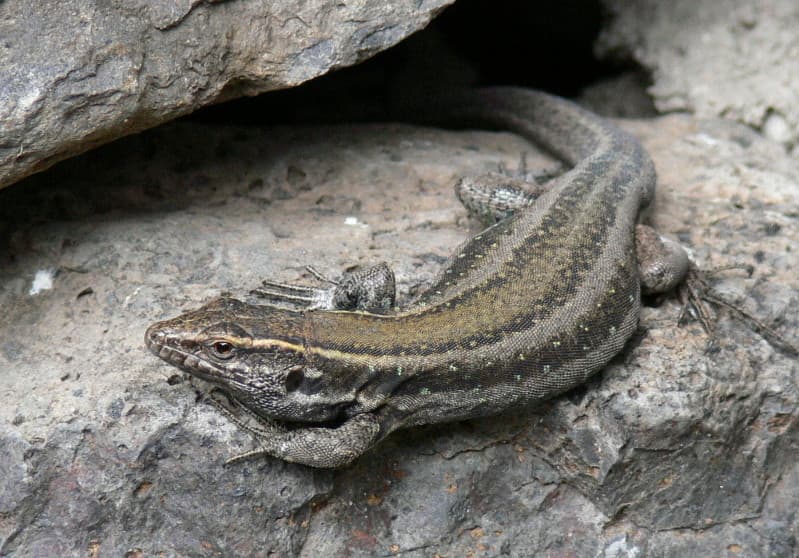
Boettger's lizard
Boettger's lizard (Gallotia caesaris) is a species of wall lizard endemic to the western Canary Islands, specifically El Hierro and La Gomera. This oviparous reptile inhabits rocky areas, shrubland, and forests, and is known for its capacity to lay multiple clutches of eggs per year. It is closely related to the Gallotia galloti species found on neighboring islands.