
Bosc's fringe-toed lizard
Bosc's fringe-toed lizard is a medium-sized lizard endemic to North Africa and Western Asia, distinguished by its olive-grey coloration with dark longitudinal stripes and fringed digits on its feet. This fast-moving and active forager inhabits diverse environments, including coastal plains, cultivated areas, saltmarshes, oases, and wadis, typically where vegetation cover is moderate on sandy or gravelly substrates. Males are territorial and generally larger than females, with reproductive success influenced by size, and females carry clutches of eggs whose number depends on abdominal capacity.
Key Facts
- ›Endemic to North Africa and Western Asia.
- ›Possesses long, slender digits fringed for locomotion.
- ›Characterized by an olive-grey dorsal surface with dark longitudinal stripes.
- ›Males are territorial and typically larger than females.
- ›Reproduction is oviparous, with clutch sizes varying based on female size.
- ›Found in a variety of habitats including coastal plains, oases, and wadis.

Bosk's Fringe-Fingered Lizard
Algeria, Egypt, Eritrea, Ethiopia, Iran, Iraq, Israel, Jordan, Kuwait, Libya, Mali, Mauritania, Niger, Nigeria, Oman, Saudi Arabia, Sudan, Syria, Turkey, Tunisia, United Arab Emirates
- Medium-Sized Lizard With Snout-To-Vent Length of 5-8 cm.
- Males Are Usually Larger Than Females.
- Feet Have Long, Slender Digits That Are Fringed.
- Dorsal Surface Is Olive-Grey With Five Longitudinal Dark Stripes.
- the Middle Dorsal Stripe Subdivides At the Neck.
- Ventral Surface Is Whitish.
- In Females, the Underside of the Tail Becomes Suffused With Red During the Breeding Season.
- In Juveniles, the Tail Is Blue.
Insects, Other Small Invertebrates
- Fast-Moving
- Active Forager
- Males Are Territorial
- Uses Chemical Communication For Sex Recognition and Courtship
About Bosc's fringe-toed lizard
Bosc's fringe-toed lizard (Acanthodactylus boskianus), also known by the variant name Bosk's fringe-fingered lizard, is a species of lizard belonging to the Lacertidae family. This species is native to a wide range across North Africa and Western Asia. It is characterized by its medium size, with a snout-to-vent length typically between 5 and 8 cm, and males are generally larger than females. A distinctive feature of this lizard is its feet, which possess long, slender digits fringed for efficient movement.
Description and Habitat
The dorsal surface of Bosc's fringe-toed lizard is typically olive-grey, marked by five longitudinal dark stripes, with the central stripe notably subdividing at the neck. Its underside is whitish, though females may develop a red suffusion on the underside of their tails during the breeding season. Juveniles are identifiable by their blue tails. The species thrives in a variety of habitats, including coastal plains, cultivated areas, saltmarshes, oases, and wadis, usually preferring locations with moderate vegetation cover on sandy or gravelly substrates. Its distribution spans numerous countries, including Algeria, Egypt, Iran, Iraq, Syria, and Saudi Arabia.
Behavior and Reproduction
Bosc's fringe-toed lizard is known for its speed and active foraging behavior. Males exhibit territoriality, with larger individuals often being more successful. Evidence suggests that chemical cues present in the skin and exudate from femoral glands play a role in chemical communication, aiding in sex recognition and courtship rituals. This species is oviparous, meaning it reproduces by laying eggs. Females typically lay clutches of around four eggs, with the number potentially ranging from two to seven, influenced by the female's abdominal capacity.
Source: Wikipedia ↗
Frequently Asked Questions
What is Bosc's fringe-toed lizard?
Bosc's fringe-toed lizard, scientifically known as *Acanthodactylus boskianus*, is a species of lizard belonging to the Lacertidae family. It is known for its distinctive fringed toes and is found across North Africa and Western Asia.
What does Bosc's fringe-toed lizard look like?
This lizard is medium-sized, with a snout-to-vent length typically between 5 and 8 cm. Its dorsal side is olive-grey with five dark longitudinal stripes, and its feet have long, slender, fringed digits. Juveniles have blue tails, and females may exhibit a red underside of the tail during the breeding season.
Where does Bosc's fringe-toed lizard live?
Bosc's fringe-toed lizard has a wide distribution across North Africa and Western Asia, including countries like Algeria, Egypt, Iran, Iraq, and Saudi Arabia. It prefers habitats with light to moderate vegetation cover on sandy or gravelly substrates, such as coastal plains, oases, and wadis.
What is the behavior of Bosc's fringe-toed lizard?
It is a fast-moving and very active lizard, often seen foraging. Males are territorial and their success is influenced by their size and head dimensions. Chemical communication through skin secretions and femoral gland exudates is believed to play a role in recognition and courtship.
How does Bosc's fringe-toed lizard reproduce?
Bosc's fringe-toed lizard is oviparous, meaning it lays eggs. Females typically carry clutches of around four oviductal eggs, with the number ranging from two to seven, depending on the female's abdominal capacity.
What are the subspecies of Bosc's fringe-toed lizard?
Three subspecies have been sometimes recognized: *A. boskianus boskianus*, *A. boskianus euphraticus*, and *A. boskianus asper*. However, this division is considered unsatisfactory by some due to significant variation within each subspecies and inconsistent differences between them.
Related Lizards
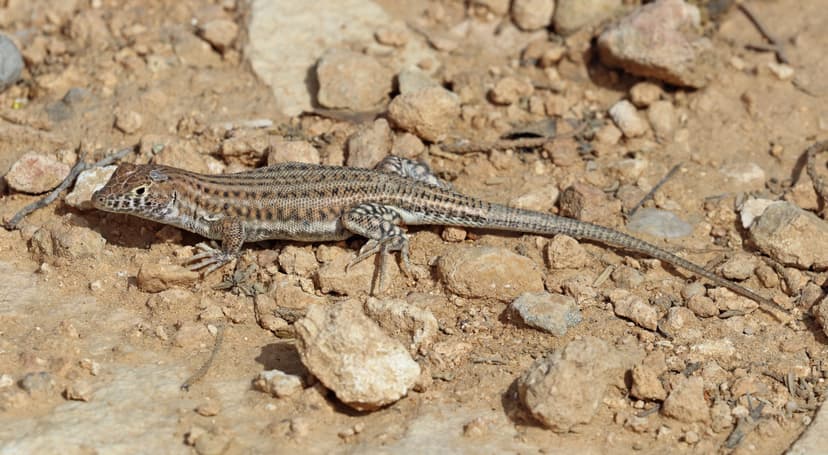
Acanthodactylus boskianus
Bosc's fringe-toed lizard (Acanthodactylus boskianus) is a medium-sized lizard found across North Africa and Western Asia. It is characterized by its olive-grey dorsal surface with dark stripes and distinctive long, fringed digits on its feet. This fast-moving lizard inhabits diverse environments, from coastal plains to oases, and is a common diurnal species within its extensive range.

Yuman fringe-toed lizard
The Yuman fringe-toed lizard (Uma cowlesi) is a species of lizard found in northwestern Mexico, primarily in the Yuma Desert region of Sonora. It is known for its distinctive fringe-like scales on its toes, which aid in movement on sandy substrates. A hybrid population with Uma notata extends its range into southwestern Arizona.

Scincella lateralis
The Scincella lateralis, commonly known as the little brown skink or ground skink, is a small lizard found in the eastern United States and northern Mexico. It is characterized by its coppery brown back, white or yellow underside, and dark lateral stripe. This species is primarily a forest dweller, preferring habitats with deep leaf litter for cover and moisture.