
Brookesia griveaudi
The Marojejy leaf chameleon, scientifically known as Brookesia griveaudi, is a species of chameleon endemic to northeastern Madagascar. This lizard, described in 1974, is characterized by its presence in the Marojejy National Park and surrounding areas. It is currently listed as Near Threatened due to habitat degradation.
Key Facts
- ›Endemic to northeastern Madagascar.
- ›Described as a new species in 1974.
- ›Found in Marojejy National Park and Massif.
- ›Listed as near Threatened by the IUCN.
- ›Affected by logging and slash-and-burn agriculture.

Marojejy Leaf Chameleon
Madagascar
Stays With Its Young and Eggs During the Day.
Logging, Slash-and-Burn Agriculture
About Brookesia griveaudi
Brookesia griveaudi: The Marojejy Leaf Chameleon
The Marojejy leaf chameleon, scientifically identified as Brookesia griveaudi, is a species of chameleon belonging to the family Chamaeleonidae. This species is exclusively found in the northeastern region of Madagascar. It was formally described as a new species in 1974 by scientists Brygoo, Blanc, and Domergue.
Distribution and Habitat
Brookesia griveaudi is endemic to northeastern Madagascar, with its type locality being the Marojejy National Park and the Marojejy Massif in the Sava region. The species occupies an estimated area of 21,829 square kilometers, stretching from Masoala in the south to Daraina in the north. It has been observed at elevations up to 1,350 meters above sea level.
Conservation Status
The International Union for Conservation of Nature (IUCN) has classified Brookesia griveaudi as Near Threatened. This designation reflects concerns about its population, which, despite inhabiting a considerable area, is spread out. The species is primarily impacted by human activities such as logging and slash-and-burn agriculture, which degrade its natural habitat. Although found within numerous protected areas, its population is believed to be in decline.
Description and Behavior
During daylight hours, the Marojejy leaf chameleon is observed to remain with its young and eggs. Further details regarding its specific physical characteristics and detailed behavioral patterns are not extensively documented in the provided information.
Source: Wikipedia ↗
Frequently Asked Questions
What is the scientific name for the Marojejy leaf chameleon?
The scientific name for the Marojejy leaf chameleon is Brookesia griveaudi. It was first described as a species new to science in 1974.
Where is Brookesia griveaudi found?
Brookesia griveaudi is endemic to northeastern Madagascar. Its type locality is the Marojejy National Park and the Marojejy Massif, in the Sava region.
What is the conservation status of the Marojejy leaf chameleon?
The Marojejy leaf chameleon is listed as Near Threatened by the International Union for Conservation of Nature. This status is due to its population being spread out and facing threats from habitat loss.
What are the main threats to Brookesia griveaudi?
The primary threats to Brookesia griveaudi are logging and the slash-and-burn method of agriculture, which lead to habitat degradation. Despite being found in protected areas, its population is believed to be declining.
When was Brookesia griveaudi first described?
Brookesia griveaudi was first described as a species new to science in 1974 by Brygoo, Blanc, and Domergue.
Related Lizards

Brookesia betschi
Brookesia betschi, also known as Blanc's leaf chameleon or the Marojejy leaf chameleon, is a small lizard species endemic to the forests of northern Madagascar. This diurnal reptile relies on its cryptic coloration for camouflage and inhabits subhumid forests at high altitudes. It is oviparous and faces threats from habitat destruction.

Furcifer timoni
Furcifer timoni is a species of chameleon endemic to the Montagne d'Ambre National Park in northern Madagascar. This lizard is characterized by its distinctive coloration, with females displaying a green base with blue spots and males having a green head with purplish spots. Its preferred habitat is forest, and it is classified as Near Threatened by the IUCN due to potential threats like logging.
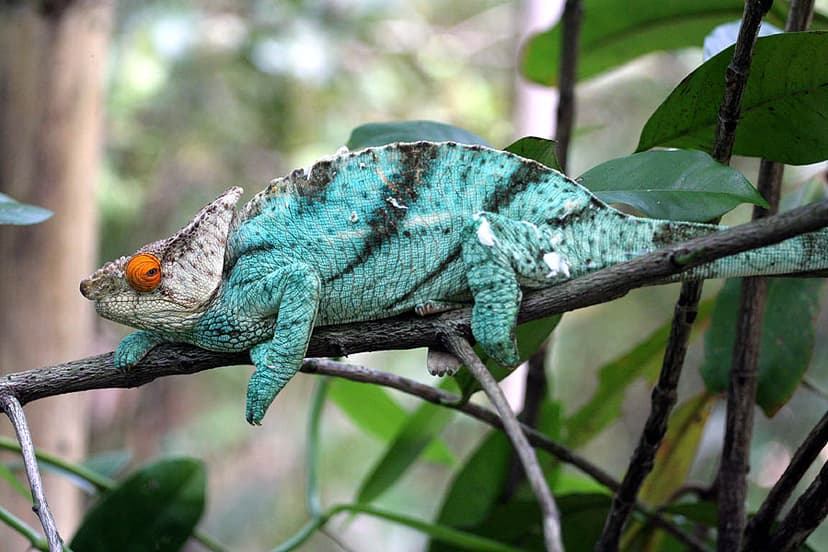
Calumma parsonii
Parson's chameleon (Calumma parsonii) is one of the world's largest chameleons, known for its impressive size, longevity, and slow reproductive rate. Primarily found in the humid primary forests of eastern and northern Madagascar, this species exhibits striking color variations in males and is a slow-moving, sit-and-wait predator. Despite its protected status and large range, it faces threats from habitat loss and the pet trade.