
Brookesia therezieni
Brookesia therezieni, commonly known as the Perinet leaf chameleon, is a species of lizard endemic to eastern Madagascar. This small chameleon is found in forest habitats at elevations between 900 and 1,500 meters. It is recognized for its classification as 'Least Concern' by the IUCN, although its population is experiencing a decline.
Key Facts
- ›Endemic to eastern Madagascar, with a known range of over 30,000 km².
- ›Inhabits forest environments at elevations from 900 to 1,500 meters.
- ›Classified as 'Least Concern' by the IUCN.
- ›Oviparous, meaning it reproduces by laying eggs.
- ›First described as a new species in 1970 by Brygoo and Domergue.
- ›Named in honor of French hydrobiologist Yves Thérézien.

Perinet Leaf Chameleon
Madagascar
About Brookesia therezieni
The Brookesia therezieni, more commonly recognized as the Perinet leaf chameleon, is a species of lizard native to the eastern regions of Madagascar. This chameleon belongs to the Chamaeleonidae family and was first formally described as a new species in 1970 by Édouard-Raoul Brygoo and Charles Antoine Domergue. Its specific name, therezieni, honors the French hydrobiologist Yves Thérézien.
Distribution and Habitat
This species is endemic to eastern Madagascar, with its type locality being Périnet, which gives it its common name. It is also found in the east-central areas of the island, including locations such as An'Ala, Ankeniheny, Andasibe, Anjanaharibe, Mantadia, and Imerimandroso. Brookesia therezieni inhabits forest environments and is typically found at elevations between 900 and 1,500 meters (approximately 3,000 to 4,900 feet) above sea level. Its presence is estimated to cover an area of approximately 30,444 square kilometers.
Conservation Status
The International Union for Conservation of Nature (IUCN) has classified Brookesia therezieni as 'Least Concern' on its Red List of Threatened Species. This assessment is based on its relatively large distribution area and insufficient evidence to suggest a rapid decline in its population numbers. However, it is noted that the population is experiencing a decline, and numbers have decreased.
Reproduction
Brookesia therezieni is an oviparous species, meaning that it reproduces by laying eggs.
Source: Wikipedia ↗
Frequently Asked Questions
What is the Perinet leaf chameleon?
The Perinet leaf chameleon, scientifically known as Brookesia therezieni, is a species of lizard belonging to the Chamaeleonidae family. It is native to the forests of eastern Madagascar.
Where is Brookesia therezieni found?
This species is endemic to eastern Madagascar. It is found in various locations including Périnet, An'Ala, Ankeniheny, Andasibe, Anjanaharibe, Mantadia, and Imerimandroso.
What is the habitat of Brookesia therezieni?
Brookesia therezieni prefers forest habitats. It is typically found at elevations ranging from 900 to 1,500 meters above sea level.
What is the conservation status of the Perinet leaf chameleon?
The International Union for Conservation of Nature (IUCN) has listed Brookesia therezieni as 'Least Concern'. This classification is due to its extensive range, although its population is noted to be declining.
How does Brookesia therezieni reproduce?
Brookesia therezieni is oviparous, which means that it reproduces by laying eggs.
When was Brookesia therezieni first described?
The species Brookesia therezieni was first described as new to science in 1970 by Édouard-Raoul Brygoo and Charles Antoine Domergue.
Related Lizards

Anolis leachii
Anolis leachii, also known as the Antigua Bank tree anole or Leach's anole, is a lizard species endemic to the Caribbean, specifically Antigua and Barbuda. This arboreal species is characterized by its bright green coloration that fades to greyish-brown on its tail, and a grey to brown head with yellowish-orange dewlaps. It inhabits various environments, from forests and shrublands to human-disturbed areas like pastures and farms, provided vertical perching surfaces are available.

Bengal monitor
The Bengal monitor (Varanus bengalensis) is a widely distributed monitor lizard found across the Indian subcontinent, Southeast Asia, and West Asia. It is a large lizard, capable of reaching up to 175 cm in length, and exhibits a varied diet including invertebrates and vertebrates. While generally shy, they are diurnal and possess a forked tongue for sensory purposes, with fat reserves in their tail and body for lean times.
Boettger's lizard
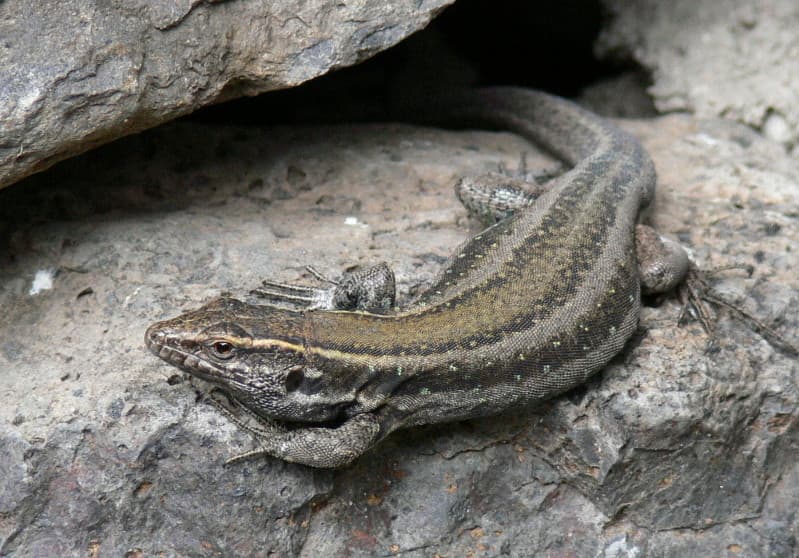
Boettger's lizard (Gallotia caesaris) is a species of wall lizard endemic to the western Canary Islands, specifically El Hierro and La Gomera. This oviparous reptile inhabits rocky areas, shrubland, and forests, and is known for its capacity to lay multiple clutches of eggs per year. It is closely related to the Gallotia galloti species found on neighboring islands.