
Brown basilisk
The Brown basilisk (Basiliscus vittatus), also known as the striped basilisk, is a lizard species native to Mexico, Central America, and northwestern Colombia, with introduced populations in Florida. It is distinguished by its ability to run across water for short distances, a feat enabled by specialized flaps on its hind feet. Males are generally larger than females and possess a more prominent dorsal crest.
Key Facts
- ›Can run on water for distances of 10-20 meters.
- ›Males can reach up to 61 cm in total length, while females are smaller.
- ›Possesses a three-part dorsal crest on the head, back, and tail.
- ›Coloration is brown or olive brown with black crossbands and a white stripe extending from the eyes to the rear legs.
- ›Active during the day and relies on camouflage for predator avoidance.
- ›Females lay 2-18 eggs, five to eight times per year, with eggs hatching after approximately three months.

Striped Basilisk
Mexico, Central America, Northwestern Colombia, Florida
- Males Can Reach Up To 61 cm In Total Length; Females Are Smaller.
- Possesses A Three-Part Dorsal Crest On the Head, Along the Back, and Along the Tail.
- Coloration Is Brown Or Olive Brown With Black Crossbands, Usually On the Flanks and Dorsal Crest.
- Features A White Stripe Extending From the Eyes To the Rear Legs.
- Males Have A Larger Crest Than Females.
- Weighs Between 200–600 g .
- Has Long Toes With Sharp Claws.
- Large Hind Feet With Narrow Flaps of Skin On the Distal Edge of Each Toe, Aiding In Water Running.
Insects, Other Small Animals
- Active During the Day .
- Relies On Camouflage For Predator Avoidance.
- Can Run On the Surface of Water For Short Distances When Facing Danger.
- Younger Individuals Can Typically Run Further On Water Than Older Ones.
- Males Exhibit Peak Spermatogenic Activity During the Dry Season and Peak Insemination/Copulation At the Start of the Rainy Season.
About Brown basilisk
The Brown basilisk, scientifically known as Basiliscus vittatus, is a striking lizard species renowned for its remarkable ability to run across the surface of water. Native to the tropical regions of Mexico, Central America, and parts of northwestern Colombia, this species has also established introduced populations, notably in Florida.
Description and Adaptations
Adult Brown basilisks exhibit sexual dimorphism; males are generally larger than females, with the former reaching up to 61 centimeters (24 inches) in total length, including their tails. Both sexes possess a distinctive three-part dorsal crest that runs along the head, back, and tail, though it is more pronounced in males. Their coloration typically ranges from brown to olive brown, marked with black crossbands that often appear on the flanks and the dorsal crest. A characteristic white stripe extends from the eyes to the hind legs.
The Brown basilisk's most famous adaptation is its capacity to run on water. This is facilitated by specialized flaps of skin on the edges of their toes, which increase the surface area of their hind feet. When propelling themselves rapidly across the water's surface, these flaps help them stay afloat for short distances, allowing them to escape predators or traverse aquatic obstacles.
Behavior and Reproduction
Brown basilisks are diurnal, meaning they are active during the day. They are adept at camouflage, often remaining motionless to evade detection by predators. Their diet primarily consists of insects and other small animals.
Reproductively, female Brown basilisks are prolific egg-layers, producing clutches of 2 to 18 eggs, anywhere from five to eight times per year. The incubation period for these eggs is approximately three months, after which hatchlings emerge weighing around 2 grams. While reproduction may occur year-round, there is evidence suggesting peaks in male reproductive activity correlating with seasonal changes.
Taxonomy and Etymology
The generic name Basiliscus is derived from the Greek word basilískos, meaning "little king." This name references the mythical basilisk of Greek legend, a creature said to possess deadly powers. The species was first described by Carl Linnaeus in his seminal work, Systema Naturae.
Source: Wikipedia ↗
Frequently Asked Questions
What is the brown basilisk's most distinctive ability?
The brown basilisk is most famous for its ability to run across the surface of water for distances of 10 to 20 meters. This allows it to escape predators by appearing to 'walk on water'.
How large do brown basilisks get?
Male brown basilisks can reach a total length of up to 61 centimeters (24 inches), including their tail. Females are typically somewhat smaller than males.
What is the coloration and appearance of the brown basilisk?
Brown basilisks are typically brown or olive brown with black crossbands, which are often found on the flanks and dorsal crest. A distinctive white stripe runs from their eyes to their rear legs.
What is the typical lifespan of a brown basilisk?
The maximum lifespan for a brown basilisk is estimated to be around 7 to 8 years. However, many individuals in the wild likely do not survive this long.
How do brown basilisks reproduce?
Female brown basilisks lay between 2 and 18 eggs, up to five to eight times annually. The eggs typically hatch after about three months.
Are brown basilisks active at night?
No, the brown basilisk is active during the day. They are diurnal reptiles and rely on camouflage to remain undetected.
Related Lizards

Asian water monitor
The Asian water monitor (Varanus salvator) is a large lizard native to South and Southeast Asia, recognized as the second-largest lizard species after the Komodo dragon. These semiaquatic reptiles are excellent swimmers and inhabit riparian areas, adapting well to environments near human civilization. They are carnivorous, with a diverse diet, and play a role in ecosystems by consuming carrion.
Archaeolacerta bedriagae
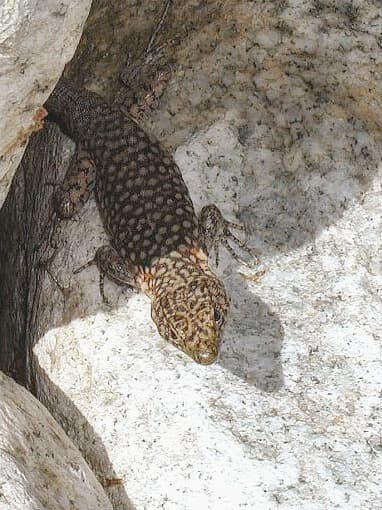
Bedriaga's rock lizard, scientifically known as Archaeolacterta bedriagae, is a species endemic to the islands of Corsica and Sardinia. This lizard is characterized by its brownish-grey coloration with a net pattern, which changes during the mating season, and juveniles are identifiable by their bright blue tails. It inhabits a variety of environments, including rocky areas, Mediterranean shrubland, and rural gardens, and is known for its ability to climb vertical surfaces and jump to catch flying insects.

Iberolacerta monticola
The Iberian rock lizard (Iberolacerta monticola) is a species endemic to Portugal and Spain, inhabiting mountain forests, shrublands, rivers, and rocky areas. It is characterized by a flattened body, short limbs, and a slender tail, with coloration varying across its range but often featuring green bellies in mature individuals. This species faces threats from habitat loss due to agriculture, forestry, and tourism.