
Iberolacerta monticola
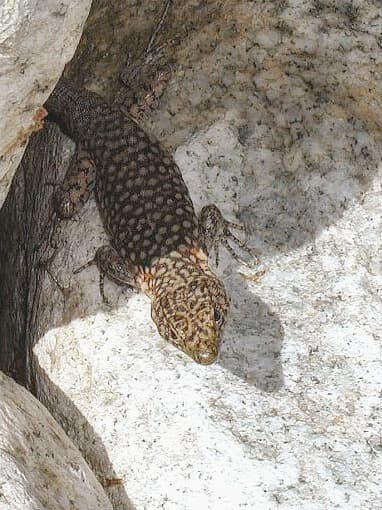
The Iberian rock lizard (Iberolacerta monticola) is a species endemic to Portugal and Spain, inhabiting mountain forests, shrublands, rivers, and rocky areas. It is characterized by a flattened body, short limbs, and a slender tail, with coloration varying across its range but often featuring green bellies in mature individuals. This species faces threats from habitat loss due to agriculture, forestry, and tourism.
Key Facts
- ›Endemic to Portugal and Spain.
- ›Inhabits mountain forests, shrubland, rivers, and rocky areas.
- ›Adults typically measure around 8 cm snout-to-vent with a tail twice that length.
- ›Mature individuals often display a distinctive green belly.
- ›Listed as vulnerable on the IUCN Red List due to habitat fragmentation and threats.

Iberian Rock Lizard
Portugal, Spain
- Measures About 8 cm From Snout To Vent.
- Has A Long, Slender Tail Approximately Twice the Body Length.
- Body Is Somewhat Flattened.
- Possesses Finely Boned, Short Limbs.
- Coloration Varies, Generally Light Brown/Green With Longitudinal Bands Or Rows of Dots.
- Spinal Stripe Is Less Dark Than Other Bands.
- Most Individuals Have A Distinctive Green Belly.
- Juveniles May Have Blue Tails.
- Underparts Turn Green With Maturity, and Upperparts Gradually Turn Green With Further Aging.
Insects, Other Small Invertebrates
- Males Are Often Territorial During the Breeding Season.
- Cold-Resistant Species.
- Climbs Higher Up Cliffs Where Its Range Overlaps With Common Wall Lizards.
Habitat Loss, Agriculture, Forestry Activities, Tourism, Fragmentation of Its Range
About Iberolacerta monticola
Iberian Rock Lizard (Iberolacerta monticola)
The Iberian rock lizard, scientifically known as Iberolacerta monticola, is a species of lizard native to Spain and Portugal. This reptile is found in diverse natural habitats including mountain forests, shrublands, along riverbanks, and in rocky terrains. It is distinguished by its somewhat flattened body, short limbs, and a slender tail that is about twice the length of its body. The coloration of the Iberian rock lizard varies across its geographical range, typically presenting as light brown or green with longitudinal bands or rows of dots. A notable characteristic of mature individuals is a distinctive green belly, and juveniles are sometimes observed with blue tails.
Distribution and Habitat
This species is primarily distributed in the Cantabrian Mountains and Galicia in northwestern Spain, as well as in the Sierra de Gredos in central Spain and the Serra da Estrela in central Portugal. While it can be found at sea level in Galicia, elsewhere it is generally encountered at altitudes ranging from 1,000 to 2,000 meters above sea level. The Iberian rock lizard favors damp environments, often found among boulders in scrubby areas. In Galicia, it also inhabits low-level woodlands. It is a cold-resistant species, frequently located above the tree line in regions with prolonged winters and wet or misty summers. When its territory overlaps with that of the common wall lizard (Podarcis muralis), Iberolacerta monticola tends to occupy higher elevations and climbs higher on cliffs.
Reproduction and Life Cycle
Male Iberian rock lizards may exhibit territorial behavior during the breeding season. Sexually mature females deposit eggs, measuring approximately 10 to 15 mm in length, in concealed locations such as under stones. The hatching period for the young typically spans six to eight weeks, and they reach sexual maturity around two years of age. Field studies have indicated that females may prefer to mate with males displaying more green coloration on their bodies.
Conservation Status
The Iberian rock lizard is currently listed as Vulnerable on the IUCN Red List of Threatened Species. This classification is due to the fragmentation of its habitat and significant threats posed by agricultural expansion, forestry operations, and the impact of tourism. While populations can be abundant in suitable conditions, other groups are experiencing declines. The species is further recognized through three recognized subspecies: Iberolacerta monticola astur, Iberolacerta monticola cantabrica, and the nominotypical subspecies, Iberolacerta monticola monticola.
Source: Wikipedia ↗
Frequently Asked Questions
Where is the Iberian rock lizard found?
The Iberian rock lizard is found in the Cantabrian Mountains and Galicia in northwest Spain, and in the Sierra de Gredos in Central Spain and Serra da Estrela in central Portugal. It can be found at sea level in Galicia but typically resides at higher altitudes elsewhere.
What does the Iberian rock lizard look like?
It has a flattened body, short limbs, and a long, slender tail. The coloration varies, but it is generally light brown or green with longitudinal bands or rows of dots. Mature individuals often develop a green belly, and juveniles may have blue tails.
What is the habitat of the Iberian rock lizard?
The Iberian rock lizard prefers damp places among boulders in scrubby areas. It is found in low-level woodlands in Galicia and favors areas above the tree line in mountains where winters are long and summers are wet or misty.
How does the Iberian rock lizard reproduce?
Males can be territorial during the breeding season. Females lay eggs, approximately 10-15 mm long, under stones or in concealed locations. The young hatch after six to eight weeks and reach maturity in about two years.
What are the threats to the Iberian rock lizard?
The primary threats to the Iberian rock lizard include habitat loss and fragmentation caused by agriculture, forestry activities, and tourism. These factors contribute to the species' vulnerable conservation status.
Related Lizards

Chamaeleonidae
Chamaeleonidae, commonly known as chameleons, are a family of Old World lizards renowned for their distinctive color-shifting abilities, used for camouflage and social signaling. They possess specialized zygodactylous feet, prehensile tails, and independently mobile eyes, along with projectile tongues for capturing prey. These diurnal reptiles inhabit diverse environments across Africa, Madagascar, southern Europe, and southern Asia, ranging from rainforests to deserts.
Archaeolacerta bedriagae
Bedriaga's rock lizard, scientifically known as Archaeolacterta bedriagae, is a species endemic to the islands of Corsica and Sardinia. This lizard is characterized by its brownish-grey coloration with a net pattern, which changes during the mating season, and juveniles are identifiable by their bright blue tails. It inhabits a variety of environments, including rocky areas, Mediterranean shrubland, and rural gardens, and is known for its ability to climb vertical surfaces and jump to catch flying insects.

Algyroides marchi
The Spanish algyroides, also known as Valverde's lizard, is a species of lizard endemic to southeastern Spain. It inhabits temperate forests, riverbanks, and rocky areas at moderate to high altitudes. This oviparous lizard faces threats primarily from habitat loss.