
Callisaurus draconoides
The zebra-tailed lizard (Callisaurus draconoides) is a diurnal reptile native to the arid regions of the Southwestern United States and northwestern Mexico. Known for its distinctive black and white striped tail, which it raises and wags when threatened, this lizard inhabits open desert areas with hard-packed soil and scattered vegetation. It primarily feeds on insects and spiders, occasionally supplementing its diet with plant matter.
Key Facts
- ›Native to the Southwestern United States and northwestern Mexico.
- ›Distinctive zebra-like tail with black and white crossbars.
- ›Diurnal and alert, active in most weather except extreme heat.
- ›Feeds on insects, spiders, and occasionally vegetation.
- ›Can run on hind legs for short distances when escaping predators.
- ›Burrows into sandy soil for shelter at night and when threatened.

Zebra-Tailed Lizard
Southwestern United States, Northwestern Mexico
- Snout-To-Vent Length Ranges From 64 To 102 mm .
- Coloration Is Gray To Sandy Brown.
- Typically Has Paired Dark Gray Spots Down the Back.
- Tail Features Black Crossbands and A White Underside With Black Crossbars.
- Males Possess Paired Black Side Blotches Extending To Blue Belly Patches.
- Females Lack Blue Patches, and Black Bars May Be Faint Or Absent.
Insects, Spiders, Other Smaller Lizards, Vegetation
- Diurnal and Alert.
- Active In All But the Hottest Weather.
- May Stand On Hind Legs During Extreme Heat.
- Raises and Wags Tail When Threatened To Distract Predators.
- Runs Swiftly With Toes Curled and Tail Raised When Escaping.
- Can Run On Hind Legs For Short Distances.
- Burrows Into Fine Sandy Soil For Retreat At Night.
- Seeks Day Shelter In Bush Shade.
- Burrows Under Sand For Safety When Chased.
Birds, Other Lizards, Mammals
About Callisaurus draconoides
Callisaurus draconoides: The Zebra-Tailed Lizard
The zebra-tailed lizard, scientifically known as Callisaurus draconoides, is a distinctive reptile species native to the arid landscapes of the Southwestern United States and northwestern Mexico. This lizard is well-adapted to its environment, preferring open desert areas with hard-packed soil, scattered vegetation, and rocks. Its common name is derived from its prominent tail, which features striking black and white crossbars and is prominently displayed during defensive behaviors.
Habitat and Distribution
Callisaurus draconoides thrives in habitats such as desert flats, washes, and plains. Its geographic range extends across the Mojave and Colorado deserts in the United States, reaching into the southern Great Basin, and continues into adjacent regions of Mexico. The species is common and widely distributed within these arid zones.
Physical Characteristics and Behavior
Adult zebra-tailed lizards typically measure between 64 to 102 mm (2.5 to 4 inches) in snout-to-vent length. Their coloration is generally gray to sandy brown, often adorned with paired dark gray spots along the back. A key identifying feature is the tail, which is white underneath with black crossbars. Males are distinguished by black blotches on their sides and blue patches on their bellies, features that are less pronounced or absent in females. These lizards are diurnal and alert, remaining active except during the most extreme heat, when they may employ unique thermoregulatory postures, such as standing on two legs. When threatened, they exhibit rapid escape tactics, running swiftly with their tails raised and wagged to deter predators. They also utilize burrows in sandy soil for shelter both at night and when pursued.
Diet and Reproduction
The diet of the zebra-tailed lizard is varied, primarily consisting of insects like moths, ants, and bees, as well as spiders and smaller lizards. Occasionally, they will consume plant matter, including spring buds and flowers. Reproduction occurs with females typically laying two to eight eggs during the summer months, with hatching from July to November. Multiple clutches may be laid within a single season, and eggs are thought to be deposited in loose, sandy soil. Their relatively high reproductive rate is likely an adaptation to being a prey species for various predators.
Source: Wikipedia ↗
Frequently Asked Questions
What are the main physical characteristics of the zebra-tailed lizard?
Zebra-tailed lizards range from 2.5 to 4 inches in snout-to-vent length. They are typically gray to sandy brown with dark gray spots down their backs, which can form black crossbands on the tail. Their tails are white underneath with black crossbars. Males exhibit black side blotches and blue belly patches, which are absent or faint in females.
What is the habitat of the zebra-tailed lizard?
These lizards prefer open desert environments characterized by hard-packed soil, scattered vegetation, and rocks. They are commonly found in flats, washes, and plains within their geographic range.
How does the zebra-tailed lizard behave when threatened?
When threatened, the zebra-tailed lizard runs swiftly with its toes curled and tail raised over its back, exposing the distinctive stripes. While stopped, it wags its curled tail side-to-side as a distraction to predators. They are also known to burrow into sand for safety.
What is the diet of the zebra-tailed lizard?
The diet of Callisaurus draconoides consists of various prey, including insects like moths, ants, and bees, as well as spiders and smaller lizards. They may also consume vegetation, such as spring buds and flowers.
Where are zebra-tailed lizards found geographically?
Zebra-tailed lizards are widely distributed throughout the Southwestern United States, extending from the Mojave and Colorado deserts northward into the southern Great Basin. They are also found in adjacent northwestern Mexico.
What is the reproductive behavior of the zebra-tailed lizard?
In the summer, female zebra-tailed lizards typically lay two to eight eggs, with hatching occurring between July and November. They are capable of laying more than one clutch per season, and eggs are presumed to be laid in friable, sandy soil. Their reproductive rate is considered fairly high due to being prey for many animals.
Are there different subspecies of the zebra-tailed lizard?
Yes, there are nine recognized subspecies of Callisaurus draconoides. These include subspecies such as Bogert's zebra-tailed lizard, short-footed zebra-tailed lizard, and Mojave zebra-tailed lizard, among others.
Related Lizards
Aspidoscelis exsanguis
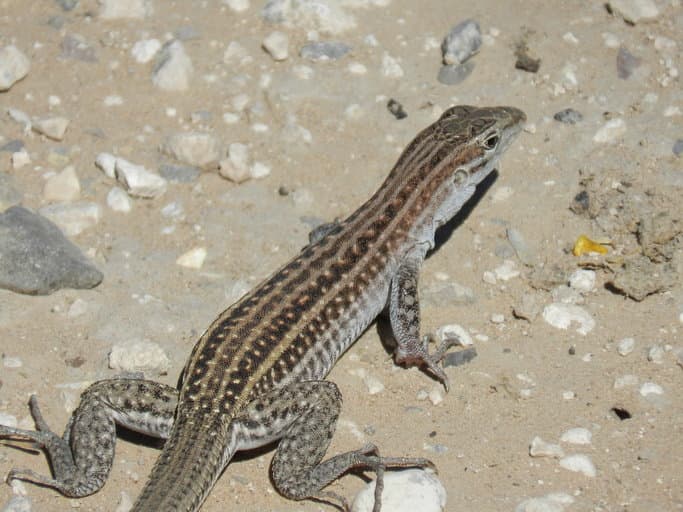
The Chihuahuan spotted whiptail (Aspidoscelis exsanguis) is a parthenogenetic lizard native to arid regions of the southwestern United States and northern Mexico. It is characterized by its reddish-brown coloration, six lighter stripes running the length of its body with spotting in between, and a slender build with a long tail. This diurnal and insectivorous species inhabits various dry environments, including deserts and woodlands.
Chihuahuan spotted whiptail
The Chihuahuan spotted whiptail is a parthenogenetic lizard native to arid regions of the southwestern United States and northern Mexico. It is characterized by its reddish-brown coloration, six lighter stripes, and a slender body with a very long tail. This diurnal and insectivorous species inhabits a variety of dry environments, including deserts and woodlands.

Crotaphytus vestigium
The Baja California collared lizard, scientifically known as Crotaphytus vestigium, is a large-bodied lizard characterized by its broad head, short snout, and two distinctive black collar markings. This species is found in rocky areas, particularly washes, within southern California and Baja California. Adult lizards range from 2.7 to 4.4 inches in snout-to-vent length and are tan to olive-colored with dark crossbands, while males exhibit enlarged postanal scales and a blue-grey throat.