
Crotaphytus vestigium
The Baja California collared lizard, scientifically known as Crotaphytus vestigium, is a large-bodied lizard characterized by its broad head, short snout, and two distinctive black collar markings. This species is found in rocky areas, particularly washes, within southern California and Baja California. Adult lizards range from 2.7 to 4.4 inches in snout-to-vent length and are tan to olive-colored with dark crossbands, while males exhibit enlarged postanal scales and a blue-grey throat.
Key Facts
- ›Found in southern California (USA) and Baja California (Mexico).
- ›Possesses two distinct black collar markings separated dorsally.
- ›Prefers rocky habitats, especially washes.
- ›Adults measure between 2.7 and 4.4 inches in snout-to-vent length.
- ›Males have a blue-grey throat and enlarged postanal scales.
- ›Capabale of powerful bipedal running and can inflict a painful bite.

Baja California Collared Lizard, Baja Black-Collared Lizard
Southern California, Baja California
- Large-Bodied Lizard With A Broad Head and Short Snout.
- Possesses Granular Scales.
- Features Two Distinct Black Collar Markings Separated At the Dorsal Midline By More Than 12 Pale Scales.
- Coloration Is Tan To Olive With Broad Dark Crossbands On the Body.
- Adults Measure Between 6.9 and 11.2 cm In Snout-To-Vent Length.
- Young Lizards Resemble Adults With More Distinct Banding.
- Males Have Enlarged Postanal Scales, A Blue-Grey Throat, and Large Dark Blotches On Their Flanks.
Powerful Bipedal Runner., Adults Can Inflict A Painful Bite.
About Crotaphytus vestigium
Baja California Collared Lizard (Crotaphytus vestigium)
The Baja California collared lizard, also known as the Baja black-collared lizard, is a species of reptile belonging to the Crotaphytidae family. This lizard is endemic to the southern regions of California in the United States and the Baja California peninsula in Mexico.
Description and Physical Characteristics
Crotaphytus vestigium is characterized by its substantial body size, a broad head, and a relatively short snout. Its scales are granular, contributing to its textured appearance. A defining feature is the presence of two distinct black collar markings, which are separated at the dorsal midline by more than twelve pale scales. The lizard's general coloration ranges from tan to olive, adorned with broad dark crossbands that extend across its body. Adult specimens typically measure between 6.9 and 11.2 centimeters (2.7 to 4.4 inches) in snout-to-vent length. Juvenile lizards share a similar appearance to adults, often exhibiting more pronounced banding. Sexual dimorphism is evident in males, which possess enlarged postanal scales, a throat colored in shades of blue-grey, and prominent dark blotches on their flanks.
Habitat and Behavior
The Baja California collared lizard is considered uncommon within its natural range. It shows a preference for rocky terrains, particularly areas characterized by washes. Behaviorally, Crotaphytus vestigium is noted as a powerful runner, capable of moving swiftly on its hind legs. Adult individuals are also known to be able to inflict a painful bite.
Conservation
As of current assessments, no major threats have been identified that significantly endanger the population of Crotaphytus vestigium. The species benefits from its presence within several protected areas, which contribute to its ongoing conservation efforts.
Source: Wikipedia ↗
Frequently Asked Questions
What are the defining physical characteristics of the Baja California collared lizard?
The Baja California collared lizard is a large-bodied species with a broad head, short snout, and granular scales. It is distinguished by two prominent black collar markings that are separated at the dorsal midline by more than 12 pale scales. Its coloration is typically tan to olive, featuring broad dark crossbands on the body.
What is the typical habitat for Crotaphytus vestigium?
Crotaphytus vestigium prefers rocky areas, with a particular affinity for washes. These environments provide suitable terrain and concealment for the species. It is considered uncommon within its natural range.
How large do adult Baja California collared lizards get?
Adult Baja California collared lizards typically measure between 6.9 and 11.2 centimeters (2.7 to 4.4 inches) in snout-to-vent length. Young lizards resemble adults but often display more pronounced banding patterns.
Are there any significant conservation concerns for this species?
Currently, no major threats to Crotaphytus vestigium have been identified. The species benefits from its occurrence within several protected areas, which helps in its conservation.
What are some distinguishing features of male Baja California collared lizards?
Male Baja California collared lizards can be identified by their enlarged postanal scales, a blue-grey coloration on their throat, and the presence of large dark blotches on their flanks. These characteristics are not typically observed in females.
How does the Baja California collared lizard behave?
Crotaphytus vestigium is known for its ability to run powerfully on its hind legs. It is also noted that adult lizards of this species are capable of inflicting a painful bite.
Related Lizards
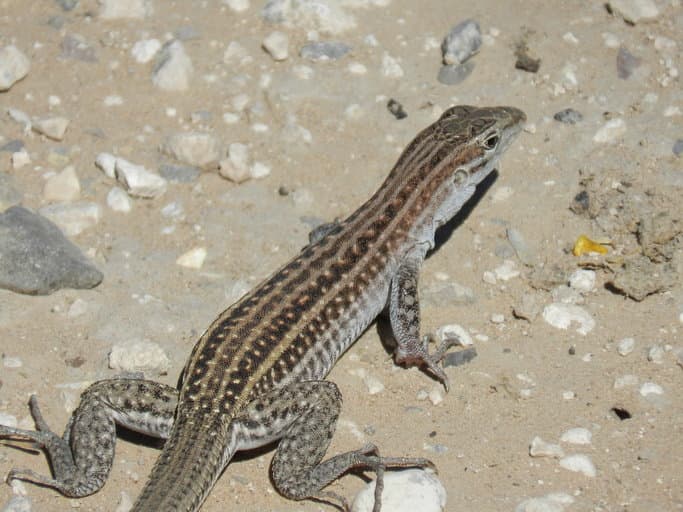
Aspidoscelis exsanguis
The Chihuahuan spotted whiptail (Aspidoscelis exsanguis) is a parthenogenetic lizard native to arid regions of the southwestern United States and northern Mexico. It is characterized by its reddish-brown coloration, six lighter stripes running the length of its body with spotting in between, and a slender build with a long tail. This diurnal and insectivorous species inhabits various dry environments, including deserts and woodlands.

Callisaurus draconoides
The zebra-tailed lizard (Callisaurus draconoides) is a diurnal reptile native to the arid regions of the Southwestern United States and northwestern Mexico. Known for its distinctive black and white striped tail, which it raises and wags when threatened, this lizard inhabits open desert areas with hard-packed soil and scattered vegetation. It primarily feeds on insects and spiders, occasionally supplementing its diet with plant matter.
Chihuahuan spotted whiptail
The Chihuahuan spotted whiptail is a parthenogenetic lizard native to arid regions of the southwestern United States and northern Mexico. It is characterized by its reddish-brown coloration, six lighter stripes, and a slender body with a very long tail. This diurnal and insectivorous species inhabits a variety of dry environments, including deserts and woodlands.