
Chalarodon madagascariensis
Chalarodon madagascariensis is a terrestrial lizard species native to Madagascar, primarily found in coastal, semi-arid to arid regions with sandy soil. It is an insectivore that occasionally consumes plant matter. A key distinguishing feature is its keeled gular and ventral scales.
Key Facts
- ›Native to western, southern, and southeastern Madagascar.
- ›Inhabits coastal, semi-arid to arid regions with sandy soil.
- ›Primarily an insectivore, but also ingests plants like leaves and roots.
- ›Distinguished by keeled gular and ventral scales.
- ›Total length can reach up to 223mm, typically around 200mm.

Madagascar Sand Lizard
Madagascar
Coastal, Semi-Arid, Arid, Sandy Soil, Open Habitats, Sparsely Vegetated Habitats
Keeled Gular Scales, Keeled Ventral Scales, Total Length Up To 223mm, Usually About 200mm Total Length
Insects, Leaves, Roots
Terrestrial
About Chalarodon madagascariensis
Chalarodon madagascariensis, commonly known as the Madagascar sand lizard, is a species of terrestrial lizard endemic to the island of Madagascar. It is found in the western, southern, and southeastern parts of the country, typically inhabiting coastal, semi-arid to arid environments characterized by sandy soil and sparse vegetation.
Habitat and Distribution
The species thrives in open or very sparsely vegetated areas, particularly along the coast. Its range extends across significant portions of Madagascar, including the provinces of Toliara, Fianarantsoa, and Majunga. Until 2015, Chalarodon madagascariensis was believed to be the sole member of its genus, but a second species, C. steinkampi, was identified, though overlap in their distributional ranges is not yet fully understood.
Physical Characteristics and Diet
Chalarodon madagascariensis is most readily identified by its keeled gular (throat) and ventral (belly) scales, a feature absent in its congener, C. steinkampi. These lizards typically reach a total length of around 200mm, with some individuals growing up to 223mm. Their diet consists primarily of insects, supplemented by occasional ingestion of plant materials such as leaves and roots.
Source: Wikipedia ↗
Frequently Asked Questions
Where is Chalarodon madagascariensis found?
Chalarodon madagascariensis is native to western, southern, and southeastern Madagascar. It is primarily found in coastal, semi-arid to arid regions with sandy soil within the provinces of Toliara, Fianarantsoa, and Majunga.
What does Chalarodon madagascariensis eat?
This species is an insectivore, meaning its diet consists mainly of insects. However, it also supplements its diet by ingesting plant matter, particularly leaves and roots.
How can I identify Chalarodon madagascariensis?
A key distinguishing feature of Chalarodon madagascariensis is the presence of keeled gular and ventral scales. In contrast, its related species, C. steinkampi, has unkeeled scales in these areas.
What is the typical size of Chalarodon madagascariensis?
The total length of Chalarodon madagascariensis can reach up to 223mm. However, individuals are usually around 200mm in length.
Related Lizards
Sri Lanka supple skink
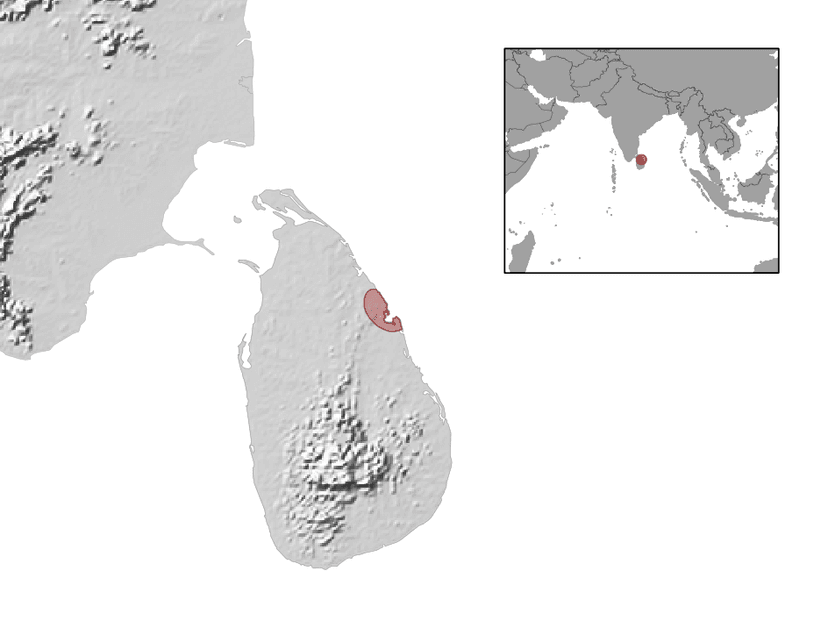
The Sri Lanka supple skink (Lygosoma singha) is a species of skink found exclusively on the island of Sri Lanka. It is believed to be a semi-fossorial lizard inhabiting coastal areas in the northeastern part of the island. Its diet is thought to include insects.

Hemidactylus scabriceps
The scaly gecko (Hemidactylus scabriceps) is a nocturnal, terrestrial, and insectivorous lizard species native to South India and northern Sri Lanka. It is characterized by its short, stout body, convex forehead, blunt snout, and a cylindrical tail. The dorsal scales are imbricate and leaf-shaped, while the venter is creamy white, often with mottled patterns of black and yellow.
Scaly gecko
The scaly gecko (Hemidactylus scabriceps) is a nocturnal, terrestrial, insectivorous gecko native to South India and northern Sri Lanka. Characterized by its short, stout build, blunt snout, and distinctive imbricate, leaf-shaped scales, it inhabits semi-arid, open, and sometimes sandy environments, often found under rocks during the day.