
Hemidactylus scabriceps
The scaly gecko (Hemidactylus scabriceps) is a nocturnal, terrestrial, and insectivorous lizard species native to South India and northern Sri Lanka. It is characterized by its short, stout body, convex forehead, blunt snout, and a cylindrical tail. The dorsal scales are imbricate and leaf-shaped, while the venter is creamy white, often with mottled patterns of black and yellow.
Key Facts
- ›Found in semi-arid and open dry habitats, including coastal sand dunes.
- ›Nocturnal, seeking shelter under rocks during the day.
- ›Diet consists primarily of insects.
- ›Adult males possess pre-anal pores, but femoral pores are absent.
- ›Exhibits territorial behavior with males using chirping calls and displays.
- ›Reproduction involves females laying eggs, with observations of two eggs in July and between December-February.

Scaly Gecko
South India, Northern Sri Lanka
- Adults Are Short and Stout.
- Forehead Is Convex.
- Snout Is Blunt and Rounded, Larger Than the Eyes.
- Limbs Are Short.
- Tail Is Cylindrical and Tapers Towards the Tip.
- Dorsal Scales On Head and Neck Are Small, Rounded, and Granular.
- Mental Scale Is Large.
- Eyes Are Laterally Placed, Large, With A Vertical Pupil and Brown Iris.
- Small Yellow Scales Surround the Eyes.
- 7 To 8 Supralabial Scales and 6 To 8 Infralabial Scales.
- Scales On Dorsum and Belly Are Distinctly Imbricate, Leaf-Shaped, and Almost Smooth.
- Scales Increase In Size From Snout To Tail.
- Largest Scales Are Found Just Above the Limbs and On the Tail.
- Femoral Pores Are Absent.
- Adult Males Have Up To 6 Pre-Anal Pores.
- Fourth Toe Is Subdigital and Partially Divided.
- Coloration Is Brownish, Varying From Yellow To Red On the Dorsum, Fading To A Creamy White Venter.
- Lateral Portion Exhibits Indistinct Mottling With Black and Bright Yellow Scales.
- Head Is Mottled With White and Black Scales.
- Labial Scales Are Straw Yellow.
- Scales Around the Eye Are Yellow.
- Two Parallel Lines Run Along the Dorsum From the Base of the Forelimbs To Near the Tail.
- White Crossbands Are Present Along the Dorsum.
- Limbs Are Brown, Mottled With Black and White.
Insects
- Nocturnal Activity
- Terrestrial Locomotion
- Found Under Rocks During the Day
- Seen On Open Ground At Night
- Moves With An Upright Stance
- Territorial Behavior Observed In Males
- Males Use Chirping Calls, Arched Body, Stretched Legs, and Tail Waving During Territorial Disputes
- Males May Lunge At the Neck of Opponents
About Hemidactylus scabriceps
The Scaly Gecko (Hemidactylus scabriceps)
The scaly gecko, scientifically known as Hemidactylus scabriceps, is a species of nocturnal, terrestrial, and insectivorous lizard found in the arid regions of South India, particularly in Tamil Nadu, and in the northern parts of Sri Lanka. Its discovery in the coastal sand dunes of Ramanathapuram, Tamil Nadu, marked the beginning of its identification, though it was only recently that detailed descriptions and molecular data allowed for its proper classification.
Physical Characteristics
Adult scaly geckos are characterized by a short and stout build. They possess a convex forehead, a blunt and rounded snout that is larger than their eyes, and short limbs. Their tail is cylindrical and tapers to a point. The dorsal surface of the head and neck is covered in small, rounded, granular scales. The eyes are large, positioned laterally, and feature a vertical pupil with a brown iris, surrounded by small yellow scales. The dorsal scales are imbricate, leaf-shaped, and nearly smooth, increasing in size from the snout towards the tail, with the largest scales located above the limbs and on the tail. Adult males are identifiable by up to six pre-anal pores, though femoral pores are absent. The fourth toe shows subdigital lamellae and is partially divided.
In life, the scaly gecko displays a brownish coloration, with hues varying from yellow to red on its dorsum, fading to a creamy white on its venter. The sides often exhibit indistinct mottling of black and bright yellow scales, and the head is mottled with white and black scales. Labial scales are straw yellow, and the scales around the eyes are also yellow. Distinctive markings include two parallel lines running along the dorsum from the base of the forelimbs to near the tail, and white crossbands along the back. The limbs are brown and mottled with black and white.
Habitat and Distribution
This species thrives in semi-arid and open habitats that are dry and sometimes sandy. Its range encompasses Tamil Nadu in South India, with documented sightings in areas such as Ramnad, Adyar, Chennai, Mayiladuthurai, Madurai, Thanjavur, Tirunelveli, Tuticorin, and Vallanadu Wildlife Sanctuary. In Sri Lanka, it has been reported in Marichhukate in the Northern Province. They are frequently found in dry environments, including along coastal sand dunes.
Behavior and Ecology
The scaly gecko is strictly nocturnal, spending daylight hours concealed under rocks. At night, it becomes active on the open ground, moving with a noticeable upright stance. Its diet consists primarily of insects. Evidence of territorial behavior has been observed in males, who engage in vocalizations ('chirping calls') and visual displays, including arching their bodies, stretching their legs, and waving their tails, sometimes lunging at each other. Reproductive activity involves females laying eggs; observations indicate clutch sizes of two eggs in July and also between December and February.
Evolutionary Context
Historically, Hemidactylus scabriceps was sometimes misassigned to different genera due to a lack of clear molecular evidence. However, recent phylogenetic analyses have confirmed its placement within the genus Hemidactylus. It is estimated that this species diverged from its common ancestor approximately 35 million years ago, with its expansion into Sri Lanka likely occurring during the Late Miocene epoch.
Source: Wikipedia ↗
Frequently Asked Questions
What are the main characteristics of the scaly gecko?
The scaly gecko is a stout, short-bodied lizard with a blunt snout and a cylindrical tail. Its dorsal scales are leaf-shaped and imbricate, while its underside is creamy white. It has large eyes with vertical pupils and is typically brownish with yellow and red hues on its back.
Where is the scaly gecko found?
This species is found in South India, specifically in Tamil Nadu, and in the northwestern parts of Sri Lanka. It prefers semi-arid, open, and dry habitats, including coastal sand dunes.
What does the scaly gecko eat?
The scaly gecko is insectivorous, meaning its diet primarily consists of insects. It hunts for food during the night.
What is the activity pattern of the scaly gecko?
The scaly gecko is nocturnal. During the daytime, it hides under rocks, emerging at night to forage on the open ground and move with an upright stance.
Does the scaly gecko exhibit territorial behavior?
Yes, individuals are thought to be territorial. Males have been observed engaging in territorial disputes, which involve chirping calls, arched bodies, stretched legs, and tail waving, occasionally accompanied by lunging at the opponent's neck.
When does the scaly gecko reproduce?
Females have been observed carrying two eggs in July and also between December and February. This suggests breeding activity occurs during these periods.
Related Lizards

Scaly gecko
The scaly gecko (Hemidactylus scabriceps) is a nocturnal, terrestrial, insectivorous gecko native to South India and northern Sri Lanka. Characterized by its short, stout build, blunt snout, and distinctive imbricate, leaf-shaped scales, it inhabits semi-arid, open, and sometimes sandy environments, often found under rocks during the day.
Sceloporus graciosus
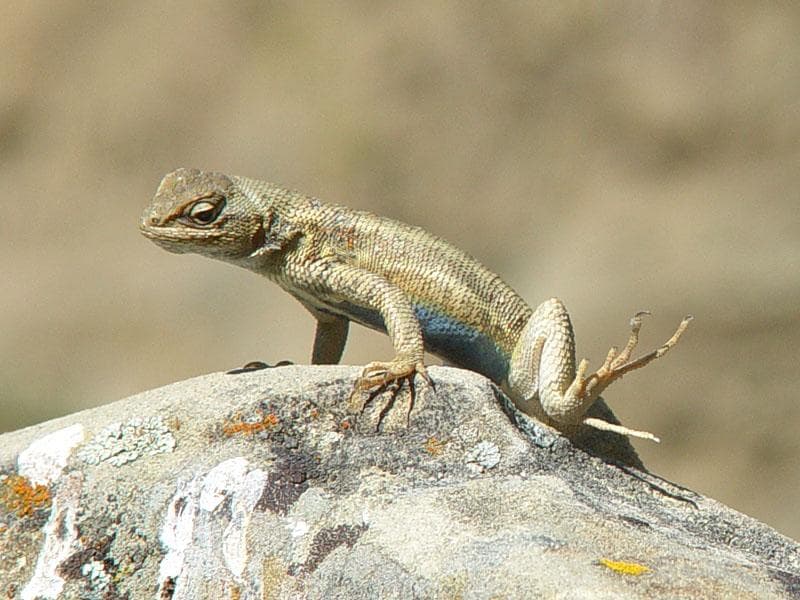
The sagebrush lizard (Sceloporus graciosus) is a common lizard found in the western United States, typically inhabiting shrublands and woodlands at mid to high altitudes. It is distinguished by its keeled and spiny scales, often exhibiting gray or tan coloration with lighter stripes along its back and sides. Males are recognizable by their blue abdominal patches, which can develop into orange during the breeding season.

Sagebrush lizard
The sagebrush lizard (Sceloporus graciosus) is a common spiny lizard found in the western United States, typically inhabiting shrublands, coniferous forests, and piñon-juniper woodlands. Characterized by keeled, spiny scales that are usually gray or tan, it features lighter stripes along its back and often has orange markings on its sides. Males are distinguished by blue patches on their abdomen and throat, which can intensify to orange during the breeding season.