
Chalcides mauritanicus
Chalcides mauritanicus, also known as the two-fingered skink, is an African lizard species native to Algeria and Morocco. It prefers sandy habitats and plantations but is sensitive to severely modified environments and requires adequate ground cover. The species is characterized by giving birth to live young and is currently facing population decline due to habitat fragmentation and scarcity of ground cover.
Key Facts
- ›Native to Algeria and Morocco.
- ›Prefers sandy areas and plantations.
- ›Requires good ground cover for survival.
- ›Distribution is severely fragmented.
- ›Females give birth to live young.
- ›Species is currently declining.

Two-Fingered Skink
Algeria, Morocco
Scarcity of Ground Cover, Severely Modified Habitats, Habitat Fragmentation
About Chalcides mauritanicus
Chalcides mauritanicus: The Two-Fingered Skink
Chalcides mauritanicus, commonly known as the two-fingered skink, is a species of skink native to the North African countries of Algeria and Morocco. This lizard is adapted to arid and semi-arid environments, typically found inhabiting sandy areas and plantations.
Habitat and Survival
The survival of Chalcides mauritanicus is closely linked to the availability of good ground cover. These lizards are sensitive to severely modified habitats, and their populations are declining as this essential cover becomes increasingly scarce. The species' natural distribution is also significantly fragmented, further challenging its long-term viability.
Reproduction and Conservation
Females of the two-fingered skink species exhibit a viviparous reproductive strategy, meaning they give birth to live young. Despite this reproductive capability, the species is facing considerable threats, leading to its classification as endangered. The primary drivers of its decline are habitat loss and fragmentation, alongside the diminishing availability of suitable ground cover.
Source: Wikipedia ↗
Frequently Asked Questions
What is the scientific name for the two-fingered skink?
The scientific name for the two-fingered skink is Chalcides mauritanicus. This binomial nomenclature is used to classify the species within the scientific community.
Where can Chalcides mauritanicus be found?
Chalcides mauritanicus is found in the North African countries of Algeria and Morocco. Its natural habitat includes sandy areas and plantations within these regions.
What kind of habitat does the two-fingered skink prefer?
The two-fingered skink prefers sandy areas and plantations. Crucially, it requires good ground cover to survive, and its presence is negatively impacted by severely modified habitats.
How does Chalcides mauritanicus reproduce?
Females of the Chalcides mauritanicus species give birth to live young. This makes them viviparous, a reproductive strategy where offspring develop inside the mother's body before birth.
What is the conservation status of Chalcides mauritanicus?
The conservation status of Chalcides mauritanicus is listed as endangered on the IUCN Red List. This status reflects significant population decline and fragmentation.
Why is the distribution of Chalcides mauritanicus severely fragmented?
The distribution of Chalcides mauritanicus is severely fragmented due to habitat degradation and the increasing scarcity of essential ground cover. This fragmentation poses a significant threat to the species' long-term survival.
Related Lizards

Chalcides sepsoides
The wedge-snouted skink (Chalcides sepsoides) is a common and widespread lizard found across North Africa and the Middle East, inhabiting sandy areas and dunes. This viviparous species is characterized by its reduced limbs, enabling it to efficiently "swim" beneath the sand as its primary escape tactic. It exhibits seasonal activity patterns, being nocturnal in summer and diurnal in winter.
Sphenops sepsoides
Sphenops sepsoides, also known as the wedge-snouted skink, is a common and widespread skink species found across North Africa and the Middle East. This viviparous lizard is a sand specialist, adept at 'swimming' beneath the sand with its reduced limbs, rarely emerging onto the surface. It inhabits sandy areas and dunes, exhibiting nocturnal behavior in summer and diurnal activity in winter.
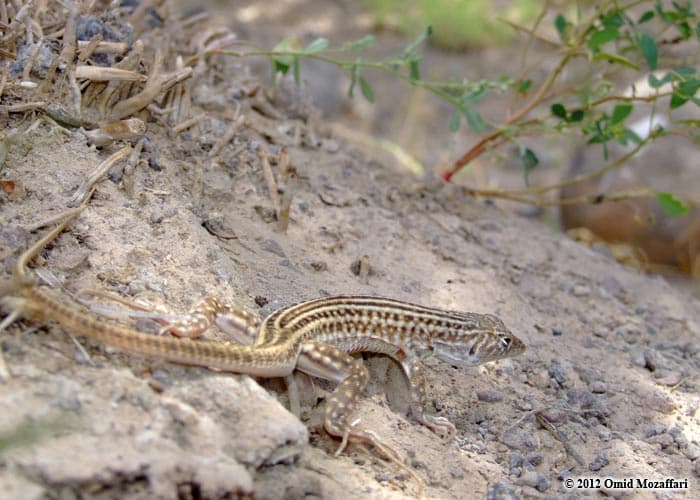
Acanthodactylus cantoris
The Indian fringe-fingered lizard (Acanthodactylus cantoris) is a terrestrial species endemic to Asia, primarily found in sandy desert and shrubland habitats. It is characterized by its acutely pointed snout, keeled dorsal scales, and strong digital denticulations. This oviparous lizard burrows in the sand for protection and its young have distinctive white longitudinal lines on a blackish background.