
Chalcides sepsoides
The wedge-snouted skink (Chalcides sepsoides) is a common and widespread lizard found across North Africa and the Middle East, inhabiting sandy areas and dunes. This viviparous species is characterized by its reduced limbs, enabling it to efficiently "swim" beneath the sand as its primary escape tactic. It exhibits seasonal activity patterns, being nocturnal in summer and diurnal in winter.
Key Facts
- ›Found in Tunisia, Libya, Egypt, Israel, Jordan, and the Palestinian territories.
- ›Moves efficiently by "swimming" under the sand.
- ›Has greatly reduced limbs adapted for fossorial movement.
- ›Habitat includes sandy areas, dunes, open steppe, and bushland with sandy soil.
- ›Nocturnal in summer and diurnal in winter.
- ›Viviparous species.

Wedge-Snouted Skink
Tunisia, Libya, Egypt, Israel, Jordan, Palestinian Territories
Sandy Areas, Dunes, Open Steppe, Bushland With Sandy Soil
- Possesses Greatly Reduced Limbs.
- Adapted For Fossorial Movement, Allowing It To 'Swim' Under Sand.
Moves By "Swimming" Under the Sand., Main Escape Tactic Is To Dive Into the Sand., Rarely Seen On the Ground., Nocturnal During the Summer., Diurnal During the Winter.
Habitat Loss, Overgrazing, Commercial Collection
About Chalcides sepsoides
Wedge-Snouted Skink (Chalcides sepsoides)
The wedge-snouted skink, scientifically known as Chalcides sepsoides, is a common and widely distributed species of skink found across North Africa and the Middle East. Its range encompasses countries such as Tunisia, Libya, Egypt, Israel, Jordan, and the Palestinian territories. This lizard is a specialist of sandy environments, thriving in areas like sand dunes, open steppe, and bushland characterized by sandy soil.
Physical Adaptations and Behavior
A defining characteristic of Chalcides sepsoides is its remarkable adaptation for a fossorial lifestyle. The species possesses greatly reduced limbs, which facilitate its efficient movement by "swimming" beneath the sand. As a result, it is rarely observed on the ground's surface, preferring to remain hidden underground. Its primary defense mechanism involves diving into the sand to escape predators. The activity patterns of the wedge-snouted skink are influenced by the seasons; it is nocturnal during the hot summer months and becomes diurnal, active during the day, throughout the winter.
Ecology and Conservation
Chalcides sepsoides is a viviparous species, meaning that females give birth to live young. While generally considered common and stable in population, the species can face localized threats. These include habitat loss due to various land-use changes, overgrazing by livestock, and collection for commercial purposes. However, these pressures are not currently viewed as severe enough to endanger the species as a whole, and its population is reported to be stable.
Source: Wikipedia ↗
Frequently Asked Questions
What is the wedge-snouted skink's scientific name?
The scientific name for the wedge-snouted skink is Chalcides sepsoides. It is a species within the family Scincidae, commonly known as skinks.
Where does the wedge-snouted skink live?
Chalcides sepsoides is found in a range of countries including Tunisia, Libya, Egypt, Israel, Jordan, and the Palestinian territories. Its preferred habitats are sandy areas and dunes.
How does the wedge-snouted skink move?
This skink is a sand specialist and moves very efficiently by "swimming" under the sand. Its limbs are greatly reduced, which is an adaptation for this fossorial lifestyle.
What are the habitat preferences of Chalcides sepsoides?
The wedge-snouted skink prefers sandy areas and dunes. It can also be found in open steppe and bushland that has sandy soil.
Is the wedge-snouted skink active at night or during the day?
Chalcides sepsoides exhibits seasonal activity patterns. It is nocturnal during the summer months and becomes diurnal during the winter.
What is the reproductive method of the wedge-snouted skink?
The wedge-snouted skink is a viviparous species, meaning it gives birth to live young rather than laying eggs.
What are the main threats to the wedge-snouted skink?
While considered a common species, Chalcides sepsoides can be locally threatened by habitat loss, overgrazing, and commercial collection. However, these threats are not considered very serious, and its population remains stable.
Related Lizards

Sphenops sepsoides
Sphenops sepsoides, also known as the wedge-snouted skink, is a common and widespread skink species found across North Africa and the Middle East. This viviparous lizard is a sand specialist, adept at 'swimming' beneath the sand with its reduced limbs, rarely emerging onto the surface. It inhabits sandy areas and dunes, exhibiting nocturnal behavior in summer and diurnal activity in winter.

Tiliqua occipitalis
The western blue-tongued lizard (Tiliqua occipitalis) is a large skink native to Australia, known for its distinctive blue tongue and brown, banded pattern. It inhabits grasslands, dunes, and shrublands, and is a diurnal hunter of insects, snails, and carrion, also foraging for plants. This species is notable for its slow-moving prey preference due to its less agile nature and powerful jaws capable of crushing shells.
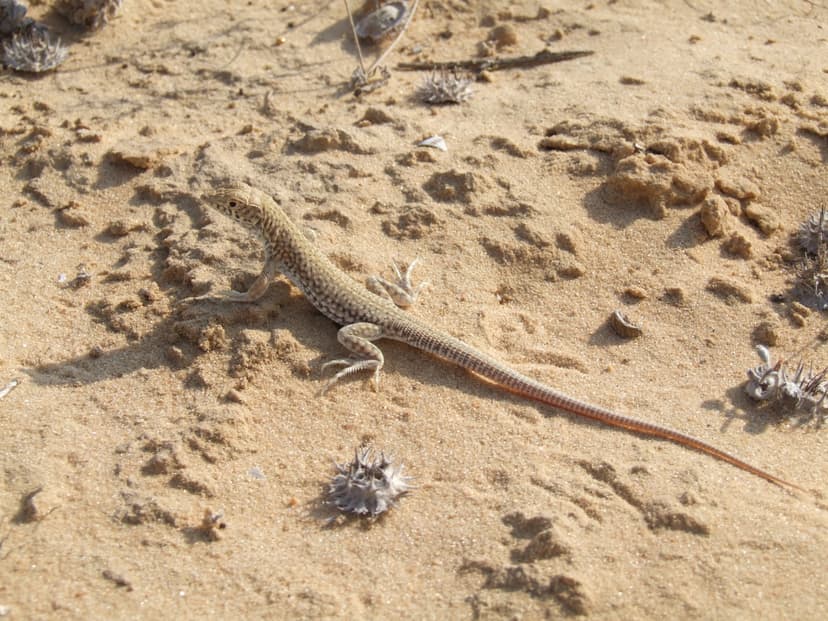
Acanthodactylus scutellatus
The Acanthodactylus scutellatus, commonly known as the Nidua fringe-fingered lizard, is a small lizard species endemic to northern Africa and the Middle East. It is recognized by its unique ventral scale arrangement and its adeptness at burrowing in loose sand for shelter. This diurnal species breeds in late winter, with females laying clutches of 3-6 eggs in the spring.