
Chamaesaura anguina
The Cape grass lizard (Chamaesaura anguina) is a slender, snake-like lizard found in the grasslands of southern Africa. It is ovoviviparous, meaning its eggs hatch internally, and females can breed year-round, an adaptation likely to mitigate losses from wildfires common in its habitat. The species is recognized by three subspecies and is listed as Near Threatened in Eswatini, though globally categorized as Least Concern by the IUCN.
Key Facts
- ›Found widely in the grasslands of southern Africa.
- ›Ovoviviparous reproduction, with eggs hatching inside the mother.
- ›Females can breed throughout the year, an adaptation to wildfire risk.
- ›Has three recognized subspecies: C. a. anguina, C. a. oligopholis, and C. a. tenuior.
- ›Listed as near Threatened in Eswatini.
- ›Globally classified as Least Concern by the IUCN.

Cape Snake Lizard, Highland Grass Lizard, Transvaal Grass Lizard
South Africa, Eswatini, Angola, Kenya, Tanzania, Mozambique, Republic of the Congo, Uganda
Snake-Like Body
Females Breed Throughout the Year.
Wildfires
About Chamaesaura anguina
The Cape Grass Lizard (Chamaesaura anguina)
The Cape grass lizard, scientifically designated as Chamaesaura anguina, is a notable reptile species native to the extensive grasslands of southern Africa. Often referred to by common names such as the Cape snake lizard or highland grass lizard, this species is distinguished by its elongated, serpentine body, which gives it a snake-like appearance.
Habitat and Distribution
Chamaesaura anguina is widely distributed across southern Africa, with confirmed sightings in countries including South Africa, Eswatini, Angola, Kenya, Tanzania, Mozambique, the Republic of the Congo, and Uganda. Its preferred habitat consists of grasslands, environments that are frequently subjected to natural phenomena like wildfires. The resilience and adaptability of the Cape grass lizard are partly explained by its reproductive strategies.
Reproduction and Conservation
This lizard species exhibits ovoviviparity, a mode of reproduction where eggs develop and hatch within the mother's body. A significant discovery regarding its breeding habits is that females can reproduce throughout the year. This continuous reproductive cycle is likely an evolutionary adaptation to mitigate the risks of reproductive failure that could arise from the unpredictable nature of wildfires, which can devastate local populations.
Three distinct subspecies of Chamaesaura anguina have been identified: C. a. anguina, C. a. oligopholis, and C. a. tenuior. While the species is not extensively detailed in broader conservation assessments like the Southern African Red Data, it is listed as Near Threatened in Eswatini. However, on a global scale, the International Union for Conservation of Nature (IUCN) classifies the Cape grass lizard as Least Concern, indicating a stable overall population.
Source: Wikipedia ↗
Frequently Asked Questions
What is the Cape grass lizard?
The Cape grass lizard, scientifically known as Chamaesaura anguina, is a species of lizard native to the grasslands of southern Africa. It is characterized by its long, slender, snake-like body.
Where does the Cape grass lizard live?
This species is widely distributed throughout the grasslands of southern Africa. Recorded locations include South Africa, Eswatini, Angola, Kenya, Tanzania, Mozambique, the Republic of the Congo, and Uganda.
How does the Cape grass lizard reproduce?
The Cape grass lizard is ovoviviparous, meaning the eggs develop and hatch internally within the mother. Females are capable of breeding throughout the entire year.
What are the subspecies of Chamaesaura anguina?
There are three recognized subspecies of the Cape grass lizard: C. a. anguina, C. a. oligopholis, and C. a. tenuior. These subspecies were described by various naturalists between 1758 and 1964.
What is the conservation status of the Cape grass lizard?
While the species is listed as Near Threatened in Eswatini, the IUCN classifies the Cape grass lizard globally as Least Concern. The Transvaal grass lizard also shares a Near Threatened status in some regions.
Related Lizards

Chalcides sexlineatus
The Gran Canaria skink (Chalcides sexlineatus) is a species of skink endemic to the island of Gran Canaria in the Canary Islands. This lizard is characterized by its flattened body, wide head, and distinctive striping patterns, with variations between subspecies. It inhabits a wide range of environments across the island.

Chalcides simonyi
The Fuerteventura skink (Chalcides simonyi) is an endangered ovoviviparous species of skink found exclusively on the Canary Islands of Fuerteventura and Lanzarote. Characterized by the general skink traits of smaller legs and less pronounced necks, this species inhabits a variety of environments including shrubland, grassland, rocky areas, pastureland, and even urban settings.
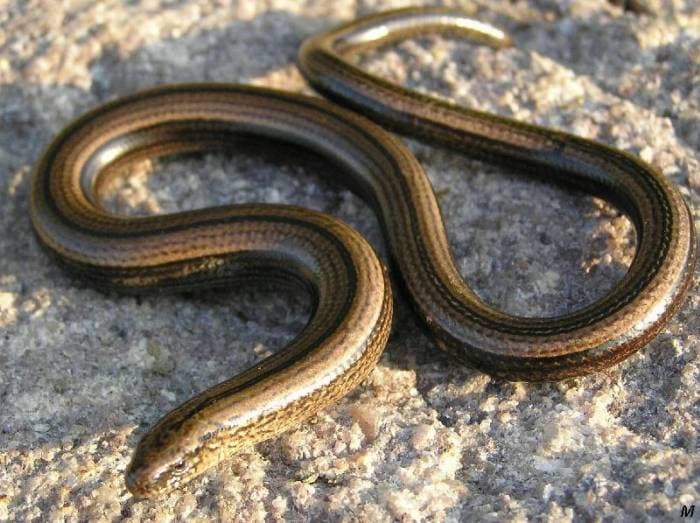
Common slowworm
The common slow worm (Anguis fragilis) is a legless lizard native to Europe, often mistaken for a snake or worm. It is characterized by its smooth, non-overlapping scales and functional, though small, eyes. These semifossorial reptiles are known for their long lifespan and inhabit environments like long grass and gardens, where they hide under objects.