
Common spotted whiptail
The Texas spotted whiptail is a long-tailed lizard species found in the south central and southwestern United States and northern Mexico. It is characterized by its tan brown or green-brown coloration with seven distinct grey or white stripes, and a long tail often three times the body length. This diurnal and insectivorous lizard thrives in diverse habitats, from grasslands to rocky terrains, and is known for its ability to shed its tail as a defense mechanism.
Key Facts
- ›Found in New Mexico, Oklahoma, Texas, and several Mexican states.
- ›Typically measures 17 to 28 cm (6.5 to 11 inches) in total length.
- ›Features seven distinct grey or white stripes running the length of its body.
- ›Males may have red throats and blue bellies, while females have pink throats.
- ›Active during the day (diurnal) and feeds primarily on insects (insectivorous).
- ›Can shed its tail to escape predators (tail autotomy).

Texas Spotted Whiptail
New Mexico, Oklahoma, Texas, Aguascalientes, Campeche, Coahuila, Guanajuato, Hidalgo, Jalisco, MichoacáN, Nuevo LeóN, QueréTaro, San Luis Potosí, Tamaulipas, Veracruz
- Total Length: 6.5 To 11 Inches .
- Coloration: Typically Tan Brown Or Green-Brown.
- Stripes: Seven Distinct Grey Or White Stripes Running the Length of the Body and Stopping At the Tail.
- Spots: Light-Colored Spots Along the Sides.
- Underside: Uniformly White.
- Sexual Dimorphism: Males Often Have A Red-Colored Throat, Blue Belly, and Black Or Blue Patches On the Chest; Females Have Only A Pink-Colored Throat.
- Tail: Long Compared To the Body, Usually Close To Three Times the Body Length; Typically A Uniform Peach Or Tan Color.
Insects
Diurnal ., Highly Active., Capable of Tail Autotomy .
About Common spotted whiptail
Texas Spotted Whiptail
The Texas spotted whiptail, scientifically known as Aspidoscelis gularis, is a distinctive lizard species native to the south central and southwestern United States, extending into northern Mexico. This reptile is recognized by its slender build, a total length typically ranging from 17 to 28 cm (6.5 to 11 inches), and a remarkably long tail that can be up to three times the length of its body. Its coloration is usually a mottled tan brown or green-brown, prominently marked with seven longitudinal grey or white stripes and interspersed with lighter spots along its flanks. The ventral side is consistently white, though males often exhibit more vibrant hues including red throats and blue bellies, contrasting with the female's simpler pink throat.
Habitat and Behavior
This species is diurnal, meaning it is active during daylight hours, and its behavior is characterized by high activity levels. The Texas spotted whiptail is adaptable to a variety of environments, thriving in grasslands, semi-arid regions, canyons, and rocky terrains, with a preference for areas near permanent water sources. A notable defense mechanism employed by this lizard, common among whiptails, is tail autotomy – the ability to shed its tail to evade predators. Reproduction occurs in the spring, with females laying clutches of 1 to 5 eggs in early summer.
Taxonomy and Distribution
Six subspecies of the Texas spotted whiptail are currently recognized. Its geographic range includes the U.S. states of New Mexico, Oklahoma, and Texas, and extends into numerous Mexican states such as Coahuila, Nuevo León, and Tamaulipas, among others. The family Teiidae encompasses this species, which is known by its scientific name, Aspidoscelis gularis.
Source: Wikipedia ↗
Frequently Asked Questions
What is the scientific name for the Texas spotted whiptail?
The scientific name for the Texas spotted whiptail is Aspidoscelis gularis. It belongs to the family Teiidae.
Where can the Texas spotted whiptail be found?
This lizard species is native to the south central and southwestern United States, including New Mexico, Oklahoma, and Texas. It also extends into northern Mexico, with populations in states such as Coahuila, Nuevo León, and Tamaulipas.
What does the Texas spotted whiptail look like?
The Texas spotted whiptail is typically tan brown or green-brown with seven prominent grey or white stripes along its body that extend to the tail. It has light-colored spots along its sides and a uniformly white underside. Males often display a red throat and blue belly, while females have a pink throat. Its tail is notably long, usually about three times the length of its body.
What kind of habitat does the Texas spotted whiptail prefer?
This lizard is found in a variety of habitats, including grasslands, semi-arid regions, canyons, and rocky areas. It generally prefers to stay relatively close to a permanent water source.
What does the Texas spotted whiptail eat?
The Texas spotted whiptail is primarily an insectivore, meaning its diet consists mainly of insects. It is highly active, likely foraging for its prey in its diverse habitats.
When does the Texas spotted whiptail reproduce?
Breeding occurs in the spring for sexually mature individuals. A clutch of 1 to 5 eggs is typically laid in the early summer.
Does the Texas spotted whiptail have any defense mechanisms?
Yes, like many other whiptail lizards, the Texas spotted whiptail is capable of tail autotomy. This means it can shed its tail to distract and escape from predators.
Related Lizards

Aspidoscelis gularis
The Texas spotted whiptail (Aspidoscelis gularis) is a long-tailed lizard native to the south-central and southwestern United States and northern Mexico. Characterized by its tan brown or green-brown coloration with seven distinct stripes and light spots, it is highly active and found in diverse habitats. This diurnal and insectivorous species is known for its quick movements and ability to shed its tail as a defense mechanism.

Cordylidae
Cordylidae, commonly known as girdled lizards, spinytail lizards, or girdle-tail lizards, are a family of small to medium-sized lizards native to southern and eastern Africa. They are characterized by their flattened bodies, armored scales, and often spiny tails, which aid in defense and securing themselves in crevices. These diurnal and insectivorous lizards are primarily terrestrial, inhabiting rocky terrain, though some species may burrow or live in trees.
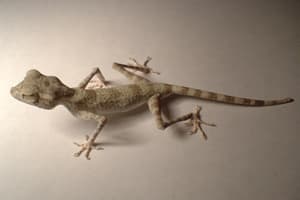
Agamura persica
The Persian spider gecko (Agamura persica) is a reptile found in the semidesert regions of Iran, Pakistan, and Afghanistan. Characterized by its long, slender legs and tail that give it a spider-like appearance, it is well-adapted to its rocky and stony habitats. This gecko is primarily nocturnal but can be observed basking during the day.