
Crotaphytidae
The Crotaphytidae, commonly known as collared lizards, are a family of fast-moving, desert-dwelling reptiles native to the southwestern United States and northern Mexico. These lizards are characterized by their long limbs and tails, with some species capable of running on two legs at high speeds. Their diet primarily consists of insects and smaller lizards.
Key Facts
- ›Native to the southwestern United States and northern Mexico.
- ›Known for their rapid movement and ability to run bipedally.
- ›Carnivorous, feeding on insects and smaller reptiles.
- ›Possess long limbs and tails.
- ›Two genera comprise the family, with 12 known species.

Collared Lizards
Southwestern United States, Northern Mexico
- Long Limbs
- Long Tails
- Some Species Capable of Bipedal Running
- Femoral Pores Present
- Interparietal Scale Small
- Never Have An Enlarged Middorsal Scale Row Or Fringe
- Never Have A Divided Rostral Scale
- No Bony Spines Or Projecting Ridges On Their Heads
- No Scales Projecting Over Their Ears
- No Scales Forming A Prominent Fringe On Sides of Toes
Insects, Smaller Lizards
Very Fast-Moving, Capable of Bipedal Running At Top Speed
About Crotaphytidae
The Crotaphytidae, commonly referred to as collared lizards, represent a family of reptiles adapted to arid environments. These lizards are native to the desert regions of the southwestern United States and northern Mexico. They are distinguished by their remarkable speed, facilitated by long limbs and tails, with some species exhibiting the ability to run on their hind legs at high velocities.
Physical Characteristics and Behavior
Collared lizards possess several key physical traits that aid their survival in desert habitats. These include long limbs, long tails, and the capacity for bipedal locomotion. Technically, they are characterized by the presence of femoral pores and a small interparietal scale, distinctly smaller than their ear opening. Unlike some other lizard groups, they do not have an enlarged middorsal scale row or fringe, nor a divided rostral scale. They also lack bony spines or projecting ridges on their heads, and their ears are not covered by projecting scales. Additionally, they lack the prominent toe fringe seen in some related families.
Diet and Ecology
The diet of Crotaphytidae is primarily carnivorous, consisting of insects and smaller lizards. Their swift movements are crucial for both hunting their prey and evading potential predators. The family is composed of two genera, which together encompass 12 distinct species.
Taxonomy and Relatives
While recognized as a family, Crotaphytidae is sometimes classified as a subfamily, Crotaphytinae, within the clade Pleurodonta. There is also a potential evolutionary link suggested between Crotaphytidae and the extinct Arretosauridae of Paleogene Asia, based on similarities in jaw morphology. However, other studies place Arretosauridae within Acrodonta, grouping them with Old World iguanians.
Source: Wikipedia ↗
Frequently Asked Questions
What are collared lizards?
Collared lizards are a family of desert-dwelling reptiles known for their speed and distinctive coloration. They are native to arid regions of the southwestern United States and northern Mexico.
What do collared lizards eat?
These lizards are carnivorous. Their diet primarily consists of insects and smaller lizards, which they hunt with great speed.
Can collared lizards run on two legs?
Yes, some species of collared lizards are capable of achieving bipedal running at top speeds. This is an adaptation for their fast-paced hunting and escape behaviors.
Where do collared lizards live?
Collared lizards are found in desert environments across the southwestern United States and northern Mexico. They are well-adapted to arid conditions.
Related Lizards
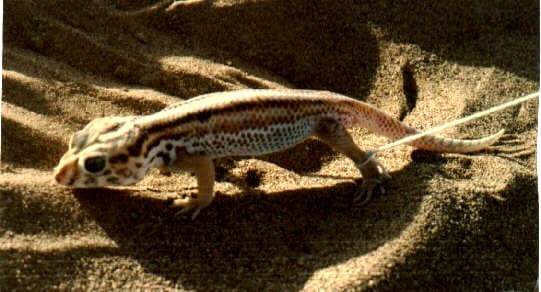
Teratoscincus scincus
Teratoscincus scincus, also known as the common wonder gecko or frog-eyed gecko, is a species of lizard native to the arid regions of Asia. It is well-adapted to desert life with specialized scales on its digits for sandy terrain and a broad head with large eyes. This nocturnal gecko primarily inhabits deserts and semi-arid areas, digging burrows to regulate its temperature and hydration.
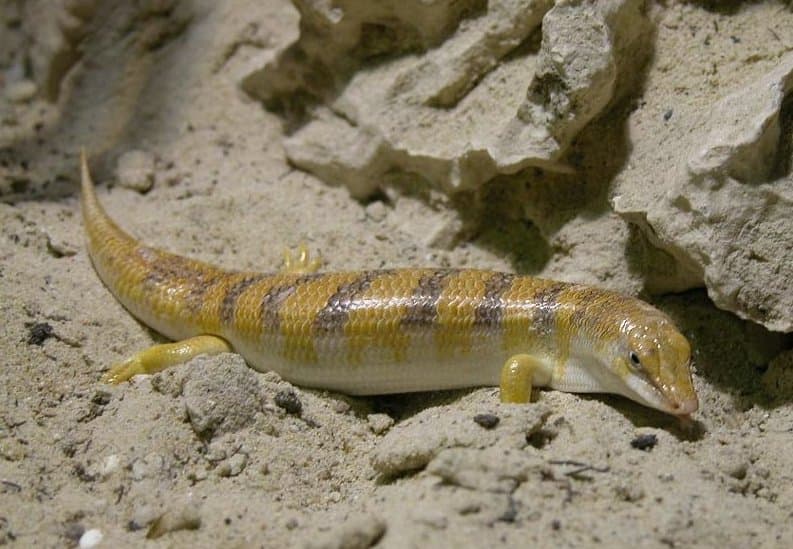
Scincus scincus
Scincus scincus, commonly known as the sandfish skink, is a desert-dwelling lizard native to the Sahara Desert and Arabian Peninsula, renowned for its remarkable ability to "swim" through sand. Its physical adaptations, including a wedge-shaped snout, smooth scales, and shovel-like feet, allow it to burrow and move efficiently beneath the surface to escape heat and predators.

Algerian psammodromus
The Algerian psammodromus is a species of lizard recognized for its metallic brownish dorsal coloration often accented by conspicuous white or yellowish stripes. It inhabits dense bushy vegetation in southwestern Europe and northwestern Africa, preying primarily on terrestrial arthropods. This species faces threats primarily from habitat loss.