
Cyprus rock agama
The Cyprus rock agama is a species of agamid lizard endemic to the island of Cyprus. It inhabits a variety of rocky environments, from arid to Mediterranean habitats, and has adapted well to human presence in towns and agricultural areas. This diurnal lizard is primarily insectivorous but also consumes small vertebrates and fruits.
Key Facts
- ›Endemic to Cyprus, found throughout the island.
- ›Inhabits rocky areas, including arid, semi-arid, and Mediterranean landscapes.
- ›Adapts to human-modified environments like towns, gardens, and agricultural fields.
- ›Primarily insectivorous, supplemented with small vertebrates and fruits.
- ›Listed as 'least concern' by the IUCN due to its wide range and adaptability.

Cyprus Rock Agama
Cyprus
Rocky Areas, Arid Habitats, Semi-Arid Habitats, Mediterranean Habitats, Urban Areas, Gardens, Agricultural Areas, Phrygana Shrubland
Insects, Small Vertebrates, Fruit
- Diurnal
- Found On the Ground, But Can Be Seen On Trees
- Habituates To Humans In Tourist Areas, Using Them As A Shield Against Predators
Cats
Predation By Cats Near Human Settlements
About Cyprus rock agama
The Cyprus rock agama, scientifically known as Laudakia cypriaca, is a species of lizard endemic to the island of Cyprus. This agamid lizard is found throughout the island, inhabiting a variety of environments from arid and semi-arid regions to Mediterranean landscapes, often in rocky areas. Notably, it exhibits a strong adaptability to human-modified environments, frequently being observed in towns, gardens, and agricultural settings, and even nesting in man-made structures like walls and warehouses.
Ecology and Behavior
This species is diurnal, meaning it is active during daylight hours. While typically found on the ground, the Cyprus rock agama is also capable of climbing trees, including carob, palm, and olive trees, as well as pines. Its diet is primarily insectivorous, but it also supplements its food intake with small vertebrates and fruits. While specific breeding studies are limited, related agama species typically lay clutches of 3 to 12 eggs, which hatch within two to four months.
Conservation Status
The Cyprus rock agama is currently listed as 'least concern' by the International Union for Conservation of Nature (IUCN). This status reflects its extensive range across Cyprus, a stable population, and its remarkable ability to adapt to human settlements. Despite its widespread presence and adaptability, populations near humans can be threatened by predation from domestic cats. Research has also indicated that in areas with high tourist activity, these lizards may become habituated to human presence, potentially altering their predator avoidance behaviors during off-seasons.
Source: Wikipedia ↗
Frequently Asked Questions
What is the scientific name of the Cyprus rock agama?
The scientific name for the Cyprus rock agama is Laudakia cypriaca.
Where is the Cyprus rock agama found?
This species is endemic to Cyprus and can be found across the entire island, even at elevations up to 1,930 meters.
What kind of habitats does the Cyprus rock agama prefer?
It inhabits rocky areas and a range of arid, semi-arid, and Mediterranean environments. It also thrives in human-altered areas such as towns, gardens, and agricultural fields.
What does the Cyprus rock agama eat?
The Cyprus rock agama is mainly insectivorous. Its diet is supplemented with small vertebrates and fruits.
What is the conservation status of the Cyprus rock agama?
The Cyprus rock agama is listed as 'least concern' on the IUCN Red List. This is due to its large range, stable population, and ability to adapt to human settlements.
Is the Cyprus rock agama a diurnal or nocturnal species?
The Cyprus rock agama is a diurnal species, meaning it is active during the day.
Related Lizards
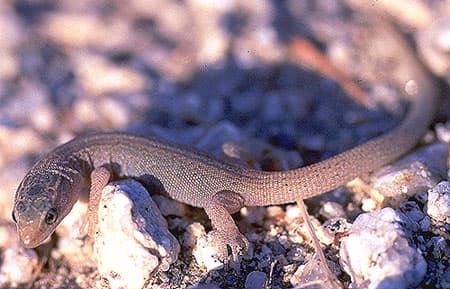
Xantusia vigilis
The desert night lizard (Xantusia vigilis) is a small, secretive reptile found in arid and semi-arid regions of the southwestern United States and northern Mexico. Despite its name, it is diurnal and known for its ability to change color from light olive to dark brown. A distinctive feature of this species is its unusual social behavior, forming family groups that can persist for years.

Blanus cinereus
The Iberian worm lizard (Blanus cinereus) is a limbless reptile resembling a worm, characterized by its small, underdeveloped eyes and smooth scales. It inhabits a variety of Mediterranean habitats across Portugal and central and southern Spain, where it lives a subterranean life. This species relies heavily on chemosensory signaling to navigate, detect prey, and avoid predators, compensating for its near-complete inability to see.
Iberian worm lizard
The Iberian worm lizard, also known as the Mediterranean or European worm lizard, is a limbless reptile resembling a worm, found in Portugal and central and southern Spain. It possesses small, underdeveloped eyes and relies heavily on chemosensory signaling for navigation, prey detection, and predator avoidance. This fossorial species inhabits diverse Mediterranean environments, burrowing in loose soil and utilizing rocks for thermoregulation.