
Xantusia vigilis
The desert night lizard (Xantusia vigilis) is a small, secretive reptile found in arid and semi-arid regions of the southwestern United States and northern Mexico. Despite its name, it is diurnal and known for its ability to change color from light olive to dark brown. A distinctive feature of this species is its unusual social behavior, forming family groups that can persist for years.
Key Facts
- ›Native to the southwestern United States and northern Mexico, often found in arid and semi-arid habitats.
- ›Despite being called a 'night lizard,' it is active during the day.
- ›Known for its ability to change color, typically ranging from grey, yellow-brownish, or olive.
- ›Forms stable family social groups, a rare trait among lizards.
- ›Viviparous, giving birth to live young, usually 1 to 3 offspring.
- ›Typically inhabits rock crevices or areas with Yucca species.
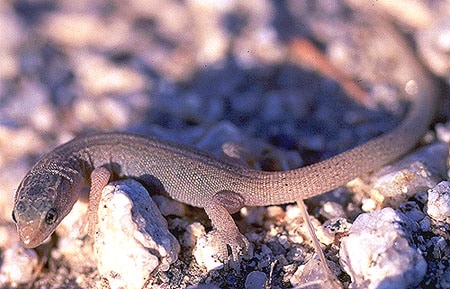
Yucca Night Lizard
Southern California, Eastern Sierra, San Gabriel Mountains, Baja California, Southern Nevada, Southwestern Utah, Western Arizona
Arid Habitats, Semi-Arid Habitats, Rock Crevices, Under Fallen Plant Debris, Areas With Yucca Species
- Small Reptile With A Snout-To-Vent Length of 3.8 To 7.0 cm.
- Tail Is Roughly the Same Length As the Body.
- Coloration Is Usually Grey, Yellow-Brownish, Or Olive.
- Capable of Changing Color From Light Olive To Dark Brown.
- Adult Females Average 80 mm Total Length and 1.3 g Weight.
- Adult Males Average 65 mm Total Length and 1.1 g Weight, and Are Lighter and Shorter.
- Males Have A Stouter, Wider Tail and Enlarged Femoral Pores.
- Possess 12 Longitudinal Rows of Rectangular Ventral Scales.
- Have 30-50 Granular Dorsal Scales Around Their Mid-Region.
- Supraorbital Scales Located Above Each Eye .
- Body Color Typically Ranges From Light Gray To Brown.
- May Have Dark Spots, Though Often A Uniform Color.
Termites, Small Insects, Spiders, Other Arthropods
- Diurnal Despite the Common Name 'Night Lizard'.
- Secretive and Rarely Leaves Cover During the Day.
- Good Climber.
- Forms Stable Family Social Groups With Father-Mother Pairs and Offspring.
- Young Huddle With Relatives.
- Sedentary Species, Remaining Obscure and Hidden.
- Engages In Winter Aggregation For Warmth.
- Philopatric, Tending To Remain In Their Birth Region.
About Xantusia vigilis
Xantusia vigilis: The Desert Night Lizard
The desert night lizard, scientifically known as Xantusia vigilis, is a small, secretive reptile native to the arid and semi-arid regions of the southwestern United States and northern Mexico. Despite its common name, this lizard is diurnal, meaning it is active during daylight hours. It is known for its remarkable ability to change its coloration, shifting from a light olive hue typically seen in the evening to a darker brown during the day, likely for thermoregulation and camouflage.
Habitat and Distribution
Xantusia vigilis is primarily found in the Mohave and Sonoran Deserts, extending through southern California and Baja California, with smaller populations in western Arizona, central California's coastal ranges, Colorado, the Sierra Nevada, and Utah. These lizards favor habitats that are arid or semi-arid, often seeking refuge during the day in rock crevices or beneath fallen plant debris. They are frequently associated with Yucca species, such as the Joshua tree (Yucca brevifolia) and Yucca gloriosa, which can lead to them being locally referred to as the 'Yucca Night Lizard.'
Physical Characteristics
Desert night lizards are small, with adult females averaging about 80 mm (3.1 inches) in total length and 1.3 grams in weight, while males are slightly smaller at approximately 65 mm (2.6 inches) and 1.1 grams. Males are distinguishable by their lighter color, shorter length, stouter tails, and enlarged femoral pores. Their bodies are covered in a combination of granular dorsal scales and rectangular ventral scales, with specific supraorbital scales above each eye. The typical body color ranges from light gray to brown, sometimes featuring dark spots.
Diet and Behavior
The diet of Xantusia vigilis consists mainly of termites, small insects, spiders, and other arthropods, which they hunt using their climbing abilities. A particularly noteworthy aspect of this species is its unusual social structure. Unlike most lizards, desert night lizards form stable family groups that can include parents and offspring, with young sometimes delaying dispersal for several years. These groups are more stable when kin are present, and kin presence has been linked to increased reproductive success for females. They also form larger winter aggregations, sometimes comprising up to 20 individuals, to improve heat retention and survive colder months.
Reproduction and Lifespan
Desert night lizards are viviparous, giving birth to live young, typically producing one to three offspring between August and December. Gestation lasts approximately 90 days, and reproduction is influenced by climate variations, diet, and nutritional status. Females possess a well-developed placenta for nutrient exchange with the developing fetus. The average lifespan for Xantusia vigilis is estimated to be between 8 to 10 years.
Source: Wikipedia ↗
Frequently Asked Questions
Is the desert night lizard nocturnal?
Despite its common name, the desert night lizard (Xantusia vigilis) is actually diurnal, meaning it is active during the day. It is known to change color, becoming darker brown during the day and lighter olive in the evening.
What is unique about the social behavior of Xantusia vigilis?
Desert night lizards exhibit unusual social behavior for reptiles, forming family social groups that can include a father-mother pair and offspring. These groups can remain stable for years, with kin presence positively influencing reproductive success and encouraging animals to stay in their birth region.
What is the typical habitat of the desert night lizard?
Xantusia vigilis prefers arid and semi-arid environments. They are commonly found in rock crevices or under fallen plant debris, and are often associated with Yucca species like the Joshua tree.
How large is an adult desert night lizard?
Adult desert night lizards are quite small. Females typically reach a total length of about 80 mm (3.1 inches) and weigh around 1.3 grams, while males are slightly smaller, averaging 65 mm (2.6 inches) in length and 1.1 grams in weight.
What do desert night lizards eat?
Their diet primarily consists of termites, small insects, spiders, and other arthropods. They are adept climbers, which aids them in foraging for prey.
How long do desert night lizards live?
The typical lifespan for a desert night lizard is between 8 to 10 years. This can vary depending on environmental factors and whether they are in the wild or captivity.
Related Lizards

Cyprus rock agama
The Cyprus rock agama is a species of agamid lizard endemic to the island of Cyprus. It inhabits a variety of rocky environments, from arid to Mediterranean habitats, and has adapted well to human presence in towns and agricultural areas. This diurnal lizard is primarily insectivorous but also consumes small vertebrates and fruits.

Hokou gecko
The Hokou gecko (Gekko hokouensis) is a small, nocturnal, and insectivorous gecko found across parts of East Asia and introduced to several islands. It is characterized by shades of brown, grey, or tan with distinct darker cross-bands on its back and tail, and a unique scale near the base of its tail. This species plays a role in its ecosystem, primarily by consuming insects, and its reproductive cycle largely occurs during the summer months.

Lygodactylus madagascariensis
The Madagascar dwarf gecko (Lygodactylus madagascariensis) is a small, diurnal gecko species endemic to Madagascar. It inhabits a variety of ecosystems, from rainforests to human-altered gardens, and is characterized by its agile bodies and specialized toe pads for climbing. Conservation efforts are ongoing due to threats like habitat loss and introduced species.