
Diplodactylus jeanae
Diplodactylus jeanae, also known as the southern phasmid gecko or Jean's spiny-tailed gecko, is a species of gecko endemic to Australia. This slender reptile inhabits arid grasslands and shrublands, and when threatened, it can display a bright yellow mouth lining or eject a viscous orange fluid from its tail.
Key Facts
- ›Found in northern Northern Territory and northern Western Australia.
- ›Prefers arid grassland and shrubland habitats.
- ›Can reach a snout-to-vent length of up to 4.9 cm.
- ›Displays a bright yellow mouth lining when threatened.
- ›Ejects a bright orange viscous fluid from tail glands as a defense mechanism.
- ›Reproduction is oviparous (egg-laying).

Southern Phasmid Gecko, Jean's Spiny-Tailed Gecko
Northern Territory, Australia, Western Australia, Australia
- Slender-Bodied and Thin-Legged.
- Striped Appearance.
- May Attain A Snout-To-Vent Length of 4.9 cm .
- the Rostral Scale Is In Contact With the Nostril.
- When Threatened, May Gape Its Mouth To Display A Bright Yellow Lining.
- When Threatened, May Squirt A Bright Orange Viscous Fluid From Glands In the Tail.
About Diplodactylus jeanae
Diplodactylus jeanae, commonly referred to as the southern phasmid gecko or Jean's spiny-tailed gecko, is a species of gecko belonging to the family Gekkonidae. This species is native to Australia, found specifically in the northern regions of the Northern Territory and Western Australia.
Habitat and Distribution
The preferred natural habitats for Diplodactylus jeanae are arid zones, where it is found in grassland and shrubland environments. Its distribution is confined to the northern parts of the Northern Territory and northern Western Australia.
Physical Characteristics
Diplodactylus jeanae is characterized by its slender build, thin legs, and a striped appearance. Adult individuals can reach a snout-to-vent length of up to 4.9 centimeters (1.9 inches). Anatomically, its rostral scale is noted to be in contact with the nostril.
Defensive Behaviors
When faced with a threat, Diplodactylus jeanae exhibits distinct defensive behaviors. It may open its mouth wide to display a bright yellow lining. Additionally, it possesses glands in its tail from which it can eject a bright orange, viscous fluid as a deterrent.
Reproduction
The species is oviparous, meaning it reproduces by laying eggs. Further details regarding specific reproductive cycles or clutch sizes are not extensively documented in the provided information.
Source: Wikipedia ↗
Frequently Asked Questions
What is Diplodactylus jeanae commonly known as?
Diplodactylus jeanae is commonly known as the southern phasmid gecko and Jean's spiny-tailed gecko. These common names reflect its appearance and a nod to Jean White, in whose honor the species was named.
Where is Diplodactylus jeanae found?
This gecko species is endemic to Australia. Its natural range includes the northern parts of the Northern Territory and northern Western Australia.
What kind of habitat does Diplodactylus jeanae prefer?
Diplodactylus jeanae thrives in arid environments. Its preferred natural habitats are grassland and shrubland areas.
How does Diplodactylus jeanae defend itself?
When threatened, Diplodactylus jeanae employs a couple of defense strategies. It may gape its mouth to reveal a bright yellow lining, and it can also squirt a bright orange viscous fluid from glands located in its tail.
What are the physical characteristics of Diplodactylus jeanae?
Diplodactylus jeanae is a slender gecko with thin legs. It can reach a snout-to-vent length of up to 4.9 cm (1.9 inches) and is characterized by its striped appearance. The rostral scale is in contact with the nostril.
How does Diplodactylus jeanae reproduce?
Diplodactylus jeanae is oviparous, meaning it reproduces by laying eggs. Specific details about clutch size or incubation periods are not provided in the available information.
Related Lizards
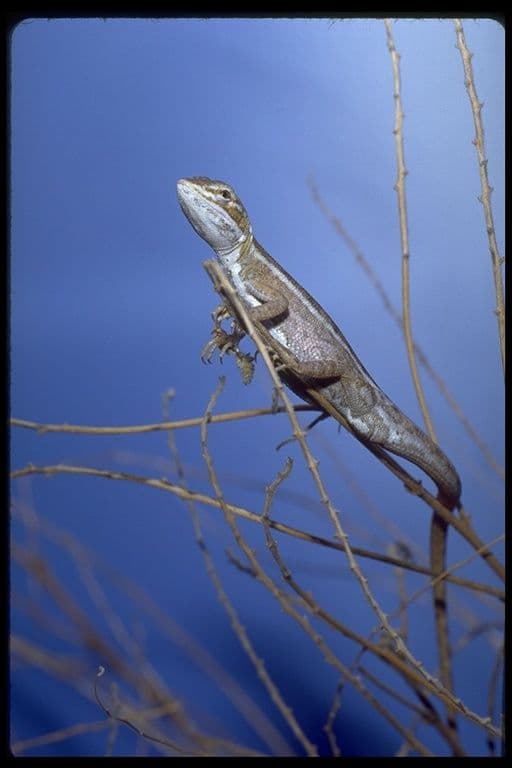
Diporiphora winneckei
The Canegrass Dragon (Diporiphora winneckei) is a small, terrestrial lizard endemic to the arid zones of Australia. Characterized by its slim build, long tail and limbs, and distinctive grey or pale brown coloration with prominent ventral and lateral stripes, this diurnal species is well-camouflaged within its sandy habitat. It is an insectivore, though it may occasionally consume plant matter, and plays a role in the food web of its environment.

Hardwick's spiny-tailed lizard
Hardwicke's spiny-tailed lizard, also known as the Indian spiny-tailed lizard, is a herbivorous reptile found in arid regions of India and Pakistan. It is characterized by its flattened body, wrinkled skin, and a tail adorned with spiny scales. This species is known to live in colonies and excavates complex burrows for shelter and hibernation.
Uromastyx hardwickii
Saara hardwickii, also known as Hardwicke's spiny-tailed lizard or the Indian spiny-tailed lizard, is a herbivorous agamid lizard found in arid regions of India and Pakistan. It is characterized by its flattened body, wrinkled skin, and a tail adorned with spiny scales. These lizards are known to live in colonies and excavate deep burrows for shelter.