
Dipsosaurus dorsalis
The desert iguana (Dipsosaurus dorsalis) is a medium-sized lizard native to the Sonoran and Mojave Deserts of the southwestern United States and northwestern Mexico. Characterized by its pale gray-tan to cream coloration with a reticulated pattern and a distinctive crest of spiked scales along its back, this species thrives in arid desert scrubland, often near creosote bushes. They are known for their ability to tolerate high temperatures and their herbivorous diet, supplemented with insects.
Key Facts
- ›Found in the Sonoran and Mojave Deserts of the southwestern us and northwestern Mexico.
- ›Averages 41 cm in total length, with a maximum of 61 cm.
- ›Coloration is pale gray-tan to cream with a reticulated pattern and a spiked dorsal crest.
- ›Primarily herbivorous, feeding on buds, flowers, fruits, and leaves, especially of the creosote bush.
- ›Can tolerate high temperatures and often retreats into burrows when extremely hot.
- ›Clutches typically contain 3-8 eggs, hatching in September.

Desert Iguana
Southwestern United States, Northwestern Mexico, Gulf of California Islands
Desert Scrubland, Sandy Desert, Rocky Streambeds, Arid Subtropical Scrub, Tropical Deciduous Forest
- Medium-Sized Lizard, Averaging 41 cm In Total Length, With A Maximum of 61 cm.
- Pale Gray-Tan To Cream Coloration.
- Light Brown Reticulated Pattern On Back and Sides, With Brown Spots Near Hind Legs and Stripes On the Tail.
- Row of Slightly Enlarged, Keeled Dorsal Scales Forming A Crest Along the Middle of the Back.
- Tail Is Approximately 1.5 Times the Snout-To-Vent Length.
- Pale Belly.
- Sides Become Pinkish During the Breeding Season For Both Sexes.
Buds, Flowers, Fruits, Leaves, Insects, Feces of Other Herbivores
- Active At High Temperatures, Often Out When Other Lizards Have Retreated.
- Seek Shade When Body Temperature Is In the Low-Forties Celsius.
- Retreat Into Burrows When Body Temperature Reaches Mid-Forties Celsius.
- Burrow Extensively, Often Digging Under Bushes Or Using Burrows of Other Animals.
- If Threatened, Will Scamper Into Shrubs and Quickly Descend Into A Burrow.
Birds of Prey, Foxes, Rats, Long-Tailed Weasels, Snakes
About Dipsosaurus dorsalis
Desert Iguana (Dipsosaurus dorsalis)
The desert iguana, scientifically known as Dipsosaurus dorsalis, is a distinctive lizard species native to the arid landscapes of the Sonoran and Mojave Deserts in the southwestern United States and northwestern Mexico, extending to several islands in the Gulf of California.
Description and Characteristics
This medium-sized lizard typically reaches an average total length of 41 cm, with individuals capable of growing up to 61 cm. Its coloration is a pale gray-tan to cream, adorned with a light brown reticulated pattern across its back and sides, which transitions to brown spots near the hind legs and stripes along the tail. A notable feature is the row of slightly enlarged, keeled dorsal scales that form a prominent crest extending along the middle of its back, giving it its specific epithet 'dorsalis'. The tail is usually about one and a half times the length of its body from snout to vent, and its belly is pale. During the breeding season, both male and female desert iguanas develop pinkish hues on their sides.
Habitat and Behavior
The desert iguana thrives in dry, sandy desert scrubland, predominantly below 1,000 meters (3,300 ft) and often within the range of the creosote bush. They are also found in rocky streambeds and, in the southern parts of their range, in arid subtropical scrub and tropical deciduous forests. These lizards possess a remarkable tolerance for high temperatures, remaining active when many other reptiles have retreated. They actively manage their body temperature, seeking shade when it reaches the low forties Celsius and retreating into burrows when it climbs to the mid-forties Celsius. Their burrows are typically dug under bushes like the creosote or are often shared with animals such as kit foxes and desert tortoises. If threatened, they are quick to dart into nearby shrubs and disappear down a burrow.
Diet and Reproduction
Desert iguanas are primarily herbivorous, feeding on the buds, flowers, fruits, and leaves of various annual and perennial plants, with a strong preference for the creosote bush and alfalfa. Their diet is supplemented by insects, including ants, crickets, and mealworms, and occasionally the feces of other herbivores. Mating occurs around May to June, after which the female lays a single clutch of 3 to 8 eggs per year. The high temperatures of their environment are believed to be crucial for successful egg hatching, with eggs typically developing and hatching between 28 and 38 degrees Celsius. The hatchlings emerge around September.
Taxonomy
The species was first described in 1852 and later reclassified under its current scientific name, Dipsosaurus dorsalis. The genus name Dipsosaurus is derived from Greek words meaning 'thirsty lizard,' reflecting its adaptation to arid environments. Genetic studies suggest that the Dipsosaurus genus represents the sister lineage to all other members of the Iguanidae family, having diverged approximately 38 million years ago during the late Eocene epoch. There are recognized subspecies, including two peninsular and one continental form.
Source: Wikipedia ↗
Frequently Asked Questions
What is a desert iguana?
The desert iguana (Dipsosaurus dorsalis) is a species of lizard found in the arid regions of the southwestern United States and northwestern Mexico. It is known for its ability to withstand high temperatures and its primarily herbivorous diet.
What does a desert iguana look like?
Desert iguanas are medium-sized lizards, typically pale gray-tan to cream in color with a distinct reticulated pattern on their backs and sides. They possess a crest of slightly enlarged, spiked dorsal scales running down the middle of their back.
Where do desert iguanas live?
Their preferred habitat is dry, sandy desert scrubland, predominantly within the range of the creosote bush, at elevations below 1,000 meters. They are found in the Sonoran and Mojave deserts and can also inhabit rocky streambeds and arid subtropical scrub areas.
What do desert iguanas eat?
Desert iguanas are primarily herbivores, consuming buds, flowers, fruits, and leaves of various desert plants, with a particular fondness for the creosote bush and alfalfa. They also supplement their diet with insects like ants and crickets, and occasionally the feces of other herbivores.
How do desert iguanas cope with heat?
These lizards are adapted to high temperatures and remain active when other lizards seek shelter. They seek shade when their body temperature is in the low forties Celsius and retreat into burrows when it reaches the mid-forties Celsius.
When do desert iguanas reproduce?
Mating for desert iguanas typically occurs in May and June. Females lay a single clutch of 3-8 eggs each year, and the hatchlings emerge around September.
Related Lizards

Diplodactylus conspicillatus
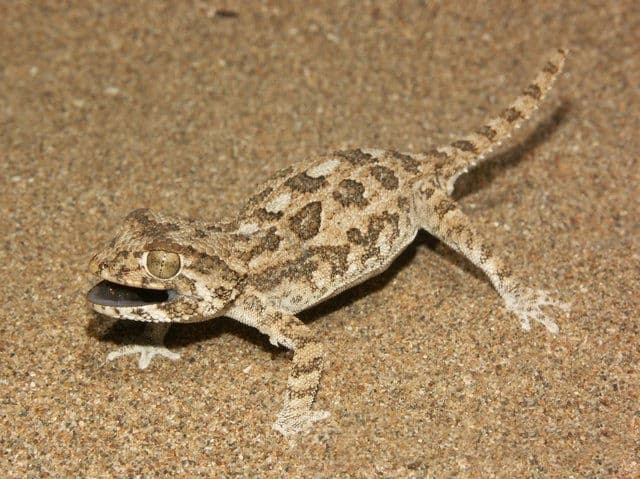
The variable fat-tailed gecko (Diplodactylus conspicillatus) is a small to medium-sized lizard endemic to arid and semi-arid regions of Australia. Characterized by its stout body, short limbs, and a broad, flat tail, it typically displays a fawn to reddish-brown coloration with a reticulated pattern and pale speckles. This nocturnal insectivore primarily feeds on termites and is known for its unique burrow-plugging behavior, though much of its ecology remains under-researched.
Tarentola chazaliae
The helmethead gecko (Tarentola chazaliae) is a species of lizard native to the sandy and rocky desert coastlines of northwestern Africa. Characterized by a distinctive casque formed by enlarged tubercles at the back of its head, this nocturnal gecko possesses extraordinary color vision in low light conditions. Its populations are currently considered vulnerable due to habitat degradation and collection for the pet trade.

Aprasia haroldi
Aprasia haroldi, also known as Harold's legless skink, is a small, limbless lizard endemic to the Shark Bay region of Western Australia. It is characterized by its pale brownish-grey coloration with darker markings and a yellowish-white chin and lips. This species inhabits coastal sand dunes and sandy desert areas, where it burrows in loose soil.