
Erdelen's horned lizard
Erdelen's horned lizard, scientifically known as *Ceratophora erdeleni*, is a species of agamid lizard endemic to Sri Lanka. It is characterized by a rudimentary "horn" on its snout, which can sometimes be absent. This arboreal and diurnal lizard inhabits midhill rainforests.
Key Facts
- ›Endemic to Sri Lanka, specifically Morningside Forest Reserve.
- ›Possesses a rudimentary or occasionally absent rostral appendage (horn).
- ›Inhabits midhill rainforests and is arboreal.
- ›Active during the day (diurnal).
- ›Adult females lay 2 to 3 eggs per clutch.
- ›Dorsal coloration is yellow, light brown, or reddish brown with dark crossbands.

Erdelen's Horn Lizard
Sri Lanka
Rainforest, Midhill Forests, Arboreal
- Oval Head, Longer Than Wide.
- Rudimentary Rostral Appendage , Less Than 18% of Snout Length, Occasionally Missing In Both Sexes.
- Tympanum Hidden Under Skin.
- Weak Dorso-Nuchal Crest Confined To the Neck.
- 24-28 Lamellae Under the Fourth Toe.
- Dorsum: Yellow, Light Brown, Or Reddish Brown With 17 Broad Dark Brown Crossbands Separated By Narrow Light Interspaces On Body and Tail.
- Venter: Yellowish Green.
- Juveniles: Green With Black Transverse Bands.
Arboreal, Diurnal
About Erdelen's horned lizard
Erdelen's horned lizard, scientifically recognized as Ceratophora erdeleni, is a distinctive species of lizard belonging to the Agamidae family. This species is exclusively found in Sri Lanka, with its known range limited to the Morningside Forest Reserve, situated at an elevation of 1,060 meters. A key characteristic of C. erdeleni is its rostral appendage, commonly referred to as a "horn," which is typically rudimentary and can sometimes be entirely absent in individuals of both sexes.
Habitat and Behavior
The natural habitat of Erdelen's horned lizard consists of the midhill rainforests of Sri Lanka. It is an arboreal species, meaning it primarily lives in trees, and exhibits diurnal behavior, being active during daylight hours. The physical description of the lizard includes an oval head and a weak nuchal crest confined to the neck region. Its dorsal coloration varies from yellow to light brown or reddish brown, adorned with broad, dark brown crossbands that are separated by lighter interspaces. The underside, or venter, is a yellowish-green, and juveniles are notable for their green coloration marked with black transverse bands.
Reproduction
Reproductively, adult females of Ceratophora erdeleni are capable of producing clutches of 2 to 3 eggs. Each egg measures approximately 7.2 mm in width and 13.7 mm in length. Further details regarding the species' diet, lifespan, or specific predators are not extensively documented in available records.
Source: Wikipedia ↗
Frequently Asked Questions
What is Erdelen's horned lizard?
Erdelen's horned lizard, *Ceratophora erdeleni*, is a species of lizard belonging to the Agamidae family. It is native to Sri Lanka and is distinguished by a small, often rudimentary, horn on its snout.
Where does Erdelen's horned lizard live?
This species is found exclusively in Sri Lanka, specifically within the Morningside Forest Reserve at an elevation of 1,060 meters. Its habitat is confined to the midhill rainforests of the region.
What does Erdelen's horned lizard look like?
It has an oval head and a rudimentary rostral appendage that can sometimes be missing. The body is typically yellow, light brown, or reddish brown with distinct dark brown crossbands. Juveniles are green with black bands.
What is the behavior of Erdelen's horned lizard?
Erdelen's horned lizard is arboreal, meaning it lives in trees, and is diurnal, meaning it is active during daylight hours. It inhabits the rainforest environment of Sri Lanka's midhills.
How does Erdelen's horned lizard reproduce?
Reproduction involves egg-laying. An adult female of this species can produce between 2 to 3 eggs at a time, with each egg measuring approximately 7.2 mm by 13.7 mm.
Related Lizards
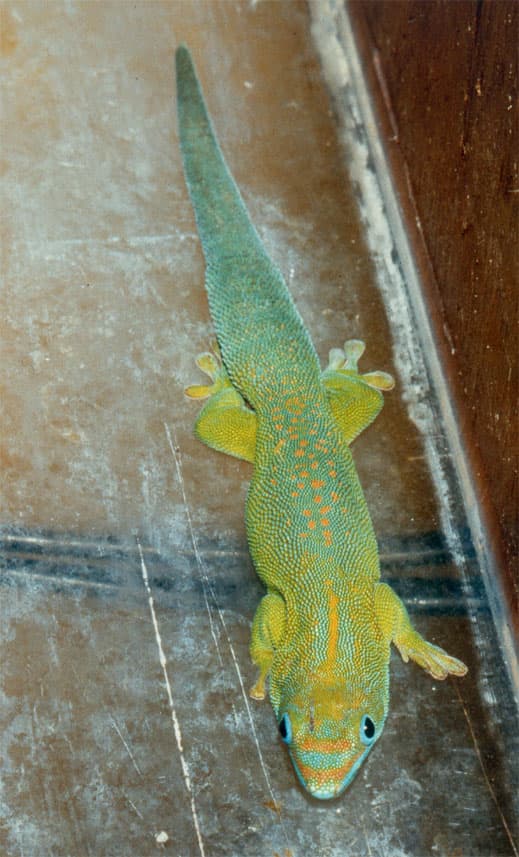
Phelsuma flavigularis
The yellow-throated day gecko (Phelsuma flavigularis) is an endangered, diurnal gecko native to eastern Madagascar's rainforests. This medium-sized species is characterized by its bluish-green body, red snout bars, and a distinctive yellow throat. It primarily inhabits trees and feeds on insects and nectar.

Furcifer balteatus
The Furcifer balteatus, also known as the two-banded chameleon or the rainforest chameleon, is a chameleon species native to southeast Madagascar. It is characterized by its green coloration with darker diagonal stripes and paler bands, often featuring a buff-colored diagonal streak, and males possess distinctive horny projections on their heads. This arboreal species inhabits rainforests at elevations between 800 and 1,050 meters.

Anolis oculatus
The Dominica anole, also known as the Dominican anole or eyed anole, is a lizard species endemic to the Caribbean island of Dominica. It is characterized by a remarkable diversity of color forms, which are thought to be ecotypes influenced by environmental conditions rather than distinct subspecies. This semi-arboreal lizard primarily hunts insects on the ground but also spends time in trees, and is known for its territorial behavior and distinctive throat fan in males.