
Eremias przewalskii
Eremias przewalskii, commonly known as the Gobi racerunner, is a species of lizard belonging to the Lacertidae family. This reptile is endemic to Asia, inhabiting diverse environments ranging from deserts and shrublands to forests and wetlands. It is distinguished by its viviparous reproductive method.
Key Facts
- ›Endemic to Asia, found in China, Kyrgyzstan, Mongolia, and Russia.
- ›Inhabits a variety of habitats including desert, forest, shrubland, and wetlands.
- ›Reproduces viviparously, meaning it gives birth to live young.
- ›Can be found at altitudes ranging from 500 to 1,800 meters.
- ›Named in honor of the Russian explorer and naturalist Nikolai Mikhailovitch Prjevalsky.

Gobi Racerunner
China, Kyrgyzstan, Mongolia, Russia
About Eremias przewalskii
Eremias przewalskii, commonly referred to as the Gobi racerunner, is a species of lizard native to the continent of Asia. It belongs to the family Lacertidae, a diverse group of lizards known for their agility and often keen eyesight.
Geographic Range and Habitat
The Gobi racerunner is found across a wide area of Asia, with documented occurrences in China, Kyrgyzstan, Mongolia, and Russia. Its preferred natural environments are varied, encompassing desert regions, forests, shrublands, and even wetland areas. This adaptability allows it to thrive in a range of ecological niches, and it is often found at elevations between 500 and 1,800 meters above sea level.
Taxonomy and Naming
The scientific name, Eremias przewalskii, was given in honor of Nikolai Mikhailovitch Prjevalsky, a notable Russian explorer and naturalist. Prjevalsky's expeditions through Central Asia were instrumental in documenting the region's flora and fauna, and this lizard is one of the species named to commemorate his work.
Reproduction
A distinctive characteristic of Eremias przewalskii is its reproductive strategy; it is a viviparous species. This means that, unlike many other reptiles that lay eggs, the females of this species give birth to live young, which are nurtured internally.
Source: Wikipedia ↗
Frequently Asked Questions
What is Eremias przewalskii commonly called?
Eremias przewalskii is commonly known as the Gobi racerunner. This name reflects its geographic origin and its swift movements.
Where is the Gobi racerunner found?
The Gobi racerunner is found in several Asian countries, including China, Kyrgyzstan, Mongolia, and Russia. It is endemic to this region.
What kind of environments does Eremias przewalskii prefer?
Eremias przewalskii prefers a range of habitats, including desert, forest, shrubland, and wetlands. It can be found at elevations between 500 and 1,800 meters.
How does Eremias przewalskii reproduce?
Eremias przewalskii is viviparous, which means that the females give birth to live young rather than laying eggs.
Who is Eremias przewalskii named after?
The species name, przewalskii, honors the Russian explorer and naturalist Nikolai Mikhailovitch Prjevalsky. His explorations in Asia likely led to the documentation of this species.
Related Lizards
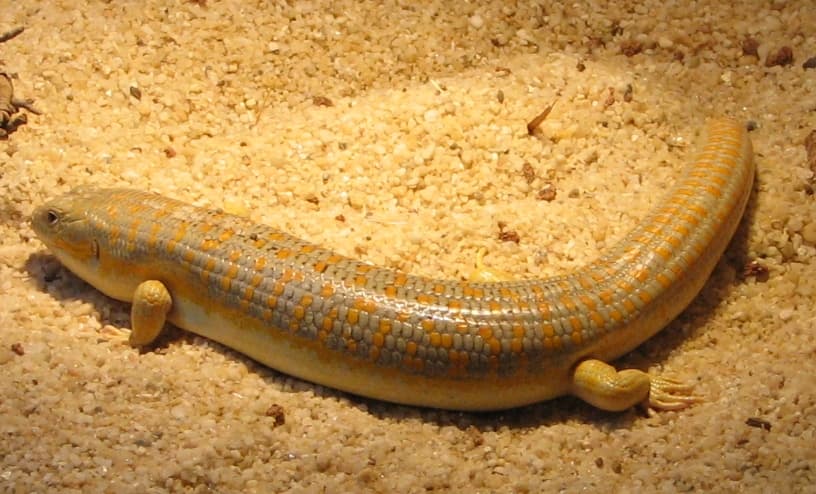
Eumeces schneiderii
Eumeces schneiderii, commonly known as Schneider's skink, is a species of lizard found across Central Asia, Western Asia, and North Africa. It is characterized by its smooth scales, a moderately sized head with an obtuse snout, and a yellowish lateral streak. This oviparous species inhabits a variety of environments including rocky areas, grasslands, and shrublands.

Oplurus quadrimaculatus
Oplurus quadrimaculatus, also known as Duméril's Madagascar Swift or the Madagascar spotted spiny-tailed iguana, is a terrestrial lizard endemic to Madagascar. This species is characterized by its greyish coloration, spotted back and tail, and legs covered in enlarged, spinous scales. It inhabits a variety of environments across Madagascar, from arid spiny forests to humid rainforest margins.
Schneider's skink
Schneider's skink (Eumeces schneiderii) is a species of lizard found across Central Asia, Western Asia, and North Africa. Characterized by smooth scales and a distinctive yellowish lateral streak, this skink inhabits rocky areas, grasslands, and shrublands. It is an oviparous species, meaning it reproduces by laying eggs.