
Oplurus quadrimaculatus
Oplurus quadrimaculatus, also known as Duméril's Madagascar Swift or the Madagascar spotted spiny-tailed iguana, is a terrestrial lizard endemic to Madagascar. This species is characterized by its greyish coloration, spotted back and tail, and legs covered in enlarged, spinous scales. It inhabits a variety of environments across Madagascar, from arid spiny forests to humid rainforest margins.
Key Facts
- ›Endemic to Madagascar, found from central to southern regions.
- ›Reaches a total length of 25–39 cm.
- ›Possesses greyish coloration with a spotted back and tail.
- ›Legs are covered in enlarged, spinous scales.
- ›Primarily insectivorous diet.
- ›Mating is brief, with eggs laid in sheltered areas.

DuméRil's Madagascar Swift, Madagascar Spotted Spiny-Tailed Iguana
Madagascar
Arid Regions, Dry Spiny Forests, Wetlands, Humid Areas, Rainforest Margins, Shrubland, Loamy Slopes, Clay Expanses, Large Rocks
Reaches A Length of 25–39 cm., Greyish Coloration., Spotted Back and Tail., Legs Covered With Enlarged, Spinous Scales.
Insects
Spends Hours Basking In Sunlight.
About Oplurus quadrimaculatus
Oplurus quadrimaculatus, commonly known as Duméril's Madagascar Swift or the Madagascar spotted spiny-tailed iguana, is a terrestrial lizard belonging to the Opluridae family. This species is native and endemic to the island of Madagascar, where it can be found in diverse environments across the country.
Description and Habitat
The Madagascar spotted spiny-tailed iguana typically measures between 25 and 39 centimeters in total length. Its appearance is characterized by a greyish body, adorned with a spotted pattern on its back and tail. A distinctive feature of this lizard is its legs, which are covered in enlarged, spinous scales. Oplurus quadrimaculatus inhabits a variety of terrains, from arid dry spiny forests to more humid areas near rainforests, and can be found on loamy slopes, clay expanses, and among large rocks. It has been observed at elevations up to 2,050 meters above sea level.
Behavior and Diet
This species is known to spend significant periods basking in the sunlight. Its diet is primarily insectivorous, meaning it feeds mainly on insects. Mating in Oplurus quadrimaculatus is a brief event, lasting only a few seconds, after which the female lays her eggs in sheltered locations.
Source: Wikipedia ↗
Frequently Asked Questions
What is the scientific name for the Madagascar spotted spiny-tailed iguana?
The scientific name for this species is Oplurus quadrimaculatus. It is also sometimes referred to by its common names, Duméril's Madagascar Swift or the Madagascar spotted spiny-tailed iguana.
Where is Oplurus quadrimaculatus found?
Oplurus quadrimaculatus is endemic to Madagascar. Its distribution spans from the central areas of the country down to the south, and it can be found at elevations up to 2,050 meters.
What does Oplurus quadrimaculatus eat?
The Madagascar spotted spiny-tailed iguana is mainly insectivorous. Its diet consists primarily of insects.
How large does Oplurus quadrimaculatus get?
Oplurus quadrimaculatus can reach a total length between 25 and 39 centimeters (9.8 to 15.4 inches). This includes the tail.
What kind of habitats does Oplurus quadrimaculatus prefer?
This lizard inhabits a range of environments, including loamy slopes, clay expanses, and large rocks. It can be found in arid regions like dry spiny forests, as well as in northern wetlands, humid areas near rainforests, and shrubland.
What are the distinctive physical features of Oplurus quadrimaculatus?
Oplurus quadrimaculatus is typically greyish with a spotted pattern on its back and tail. A notable characteristic is that its legs are covered with enlarged, spinous scales.
Related Lizards

Lialis burtonis
Burton's legless lizard (Lialis burtonis) is a unique reptile native to Australia and Papua New Guinea, characterized by its complete lack of forelimbs and greatly reduced hind limbs, resembling a snake but distinct in its evolutionary lineage. This species is a visual predator with specialized adaptations for capturing and consuming other lizards, often found in diverse habitats from deserts to rainforest margins.

Greek slowworm
The Greek slow worm (Anguis graeca) is a legless lizard species native to Greece, Albania, and North Macedonia. It thrives in vegetated, humid environments offering ample hiding places among rocks and leaves. This species is known for its defensive behavior of feigning death when threatened.
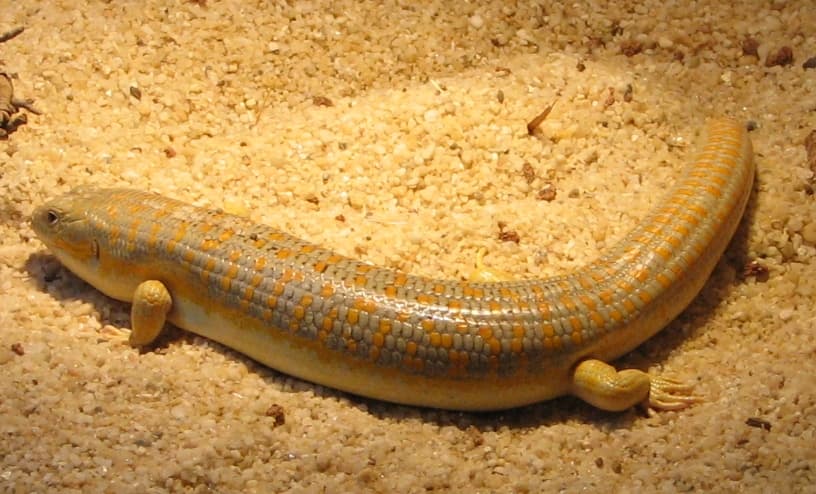
Eumeces schneiderii
Eumeces schneiderii, commonly known as Schneider's skink, is a species of lizard found across Central Asia, Western Asia, and North Africa. It is characterized by its smooth scales, a moderately sized head with an obtuse snout, and a yellowish lateral streak. This oviparous species inhabits a variety of environments including rocky areas, grasslands, and shrublands.