
Eublepharis hardwickii
The East Indian leopard gecko, scientifically known as Eublepharis hardwickii, is a distinctive lizard species endemic to India and Bangladesh. Characterized by its stout body, short limbs, and a head covered in irregular scales and tubercles, it exhibits a reddish-brown and cream coloration with prominent bands. This gecko is known for its unique water-drinking behavior and the production of a shrill vibrating noise when surprised.
Key Facts
- ›Endemic to India and Bangladesh.
- ›Possesses a stout body with short limbs and a head covered in scales and tubercles.
- ›Coloration includes reddish-brown and cream with distinct bands across the body and tail.
- ›Known to lay one or two leathery eggs buried in soil.
- ›Can produce a shrill vibrating noise when startled.
- ›Feeds on insects detected by their movement.
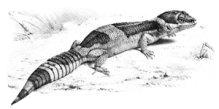
East Indian Leopard Gecko, Hardwicke's Gecko
India, Bangladesh
- Stout Body With Rather Short Limbs.
- Digits Are Short.
- Snout Length Is Equal To the Distance Between the Orbit and the Ear-Opening.
- Ear-Opening Is Large, Suboval, and Vertical.
- Head Covered With Irregular Polygonal Scales, Intermixed With Enlarged Tubercles On the Temple and Occiput.
- Rostral Scale Is Sub-Pentagonal, Twice As Broad As High, With A Median Cleft Above.
- Possesses 3 Or 4 Internasals and About 10 Upper and 10 Lower Labials.
- Mental Scale Is Broadly Pentagonal, In Contact With Two Enlarged Chin-Shields.
- Body Covered Above With Small, Irregular, Flat Scales, Intermixed With Numerous Roundish, Subconical Tubercles.
- Tubercles Are Larger Than the Interspaces Between Them.
- Male Has 14 To 18 Preanal Pores.
- Tail Is Swollen, Rounded, Tapering At the End, and Verticillated.
- Tail Scales Are Small and Flat Above, With Rows of Enlarged Sub-Corneal Tubercles; Beneath, Scales Are Larger and Flat, Arranged Regularly.
- Dorsal Coloration Is Reddish-Brown and Cream-Colored.
- Reddish-Brown Forms Two Broad Bands Across the Back and Three Around the Tail.
- Cream-Colored Borders the Upper Lip and Forms A Horseshoe-Shaped Band Across the Neck.
- Cream Color Also Occupies the Interspace Between Dorsal and Caudal Bands.
- Lower Surfaces Are White.
- Pale Reddish-White Is Also Described, With Upper Head To Nape, Two Broad Bands Across the Trunk, and Three Or Four Rings Around the Tail Being Deep Brown Or Black, Edged With Black.
- Limbs Are Reddish Olive With Black Dots On the Elbows and Knees.
- Attains A Length of 8 To 9 Inches .
Insects Detected By Their Movements, Variety of Insects
- Timid In Captivity.
- Allows To Be Lifted By Hand.
- Prey Are Detected By Their Movements.
- Can Exhibit Cannibalism, Attacking From the Neck.
- Waits For Artificial Showers To Drink Water.
- Makes A Shrill Vibrating Noise When Surprised.
Palm Civet
About Eublepharis hardwickii
East Indian Leopard Gecko (Eublepharis hardwickii)
The East Indian leopard gecko, scientifically recognized as Eublepharis hardwickii and also known as Hardwicke's gecko, is a species of gecko native to India and Bangladesh. This lizard is distinguished by its stout build, relatively short limbs, and a head adorned with irregular scales and noticeable tubercles, particularly on the temples and occiput. Its coloration typically features a pattern of reddish-brown and cream, with prominent bands encircling the body and tail, while the underside is a pale white.
Biology and Behavior
Eublepharis hardwickii inhabits areas such as forest roads and open spaces, often found under rocks and stones during the day. In captivity, these geckos are noted for their timid nature, though they readily accept a diet of insects, which they detect through movement. A peculiar behavior observed is their method of hydration; they do not drink from water containers but instead wait for artificial sprays to lick water droplets. When startled, the species is capable of producing a shrill, vibrating noise. Reproduction is oviparous, with females laying one to two leathery eggs which are then buried in the soil. The species has been documented as prey for the palm civet (Paradoxurus hermaphroditus).
Source: Wikipedia ↗
Frequently Asked Questions
What is the scientific name for the East Indian leopard gecko?
The scientific name for the East Indian leopard gecko is Eublepharis hardwickii. This binomial nomenclature is used to classify the species within the scientific community.
Where is Eublepharis hardwickii found?
Eublepharis hardwickii is naturally found in India and Bangladesh. Specific locations include Chittagong, Russelconda in Madras Presidency, the Anamallai Mountains, and Waltair.
What does Eublepharis hardwickii look like?
This gecko has a stout body with rather short limbs and a head covered in irregular polygonal scales and enlarged tubercles. Its coloration is typically reddish-brown and cream, featuring broad bands across the back and tail. The lower surfaces are white.
What is the diet of Eublepharis hardwickii?
Eublepharis hardwickii primarily feeds on insects, which it detects by their movement. In captivity, they readily accept a variety of insects.
How does Eublepharis hardwickii drink water?
In captivity, Eublepharis hardwickii has been observed to not drink from containers. Instead, they wait for artificial showers and lick drops of water from their heads or surrounding surfaces.
What is the reproduction method of Eublepharis hardwickii?
Eublepharis hardwickii is oviparous, meaning it reproduces by laying eggs. Typically, one or two leathery eggs are laid and then buried in the soil.
Does Eublepharis hardwickii make any sounds?
Yes, Eublepharis hardwickii is known to make a shrill vibrating noise when it is surprised or startled.
Related Lizards
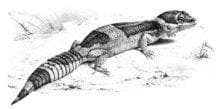
East Indian leopard gecko
The East Indian leopard gecko (Eublepharis hardwickii), also known as Hardwicke's gecko, is a species of gecko found in India and Bangladesh. It is characterized by its stout body, short limbs, and distinctive reddish-brown and cream-colored markings with black edges, often featuring irregular polygonal scales interspersed with tubercles. This species is known for its timid nature and its unique method of drinking water by licking droplets from surfaces.

Ablepharus
Ablepharus, commonly known as snake-eyed skinks, are small lizards distinguished by fused eyelids that prevent blinking, similar to snakes. They inhabit dry fields, hills, and rocky areas, often concealed within leaf litter. These skinks possess shiny, bronze scales and a characteristic dark stripe along their sides, feeding primarily on small insects and mollusks.

Ctenotus robustus
The Ctenotus robustus, commonly known as the eastern striped skink, is a large, fast-moving skink native to Australia. It is characterized by a distinctive white-edged black stripe running down its back and tail, set against a brown background with broader brown stripes and rows of white spots on its sides. This diurnal reptile prefers open habitats with available shelter and is widely distributed across various Australian states.