
Hemiphyllodactylus aurantiacus
The Southern Ghats slender gecko (Hemiphyllodactylus aurantiacus) is a small gecko species endemic to the hills of southern India. It is characterized by its elongated body, short limbs, and minute granular scales, with distinctive undulating dark-brown lines along its head and back. This species inhabits rocky areas and is typically found under stones.
Key Facts
- ›Found in the hills of southern India, including the Anamallays, Western Ghats, Bangalore, and Kolli Hills.
- ›Distinguished by an elongated body, short limbs, and a head covered in very minute granules.
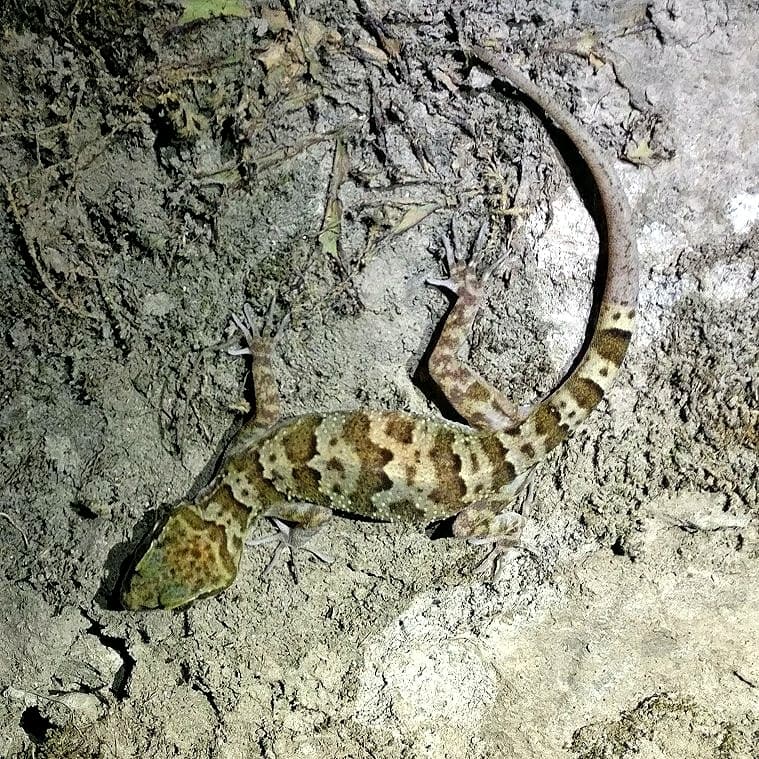
- ›Its coloration is grey-brown with dark-brown undulating lines on the head and back, and a dark brown streak through the eye.
- ›Males possess an angular series of 7 to 9 preanal pores.
- ›Adults reach a snout-to-vent length of up to 36 mm and a tail length of up to 32 mm.

Southern Ghats Slender Gecko
India
- Head Oviform, Longer Than Broad.
- Snout Rounded, Very Convex, Slightly Shorter Than the Distance Between Eye and Ear-Opening.
- Ear-Opening Very Small and Round.
- Body Elongate, More So In Females Than Males.
- Limbs Short; Fore Limb Measures About Half the Distance Between Axilla and Groin.
- Digits Short, Free, With Inner Digit Very Small and Rudimentary; Two Large Chevron-Shaped Divided Lamellae Under the Distal Part of Digits, Followed By Transverse Undivided Lamellae.
- Head Covered With Very Minute Granules.
- Rostral and Mental Scales Very Small.
- Nostril Pierced Between Rostral, First Labial, and Several Granules.
- Labial Scales Very Small, 9 Or 10 Upper and As Many Lower.
- Back Covered With Very Small Granular Scales.
- Abdominal Scales A Little Larger, Flat, Imbricate.
- Males Have An Angular Series of 7 To 9 Preanal Pores.
- Tail Cylindrical, Tapering, Covered With Small Imbricated Smooth Scales, Larger Below.
- Coloration: Grey-Brown Above With Dark-Brown Undulating Lines Along the Head and Back, Which May Be Broken Into Spots.
- A Dark Brown Streak From the Tip of the Snout To the Fore Limb, Passing Through the Eye.
- Whitish Dots Scattered On the Head and Back.
- Tail With Darker Spots Or Annuli and Two Large Whitish Black-Edged Spots At the Base, Frequently Confluent Mesially.
- Lower Surfaces Whitish, More Or Less Speckled With Brownish.
About Hemiphyllodactylus aurantiacus
Southern Ghats Slender Gecko
The Southern Ghats slender gecko, scientifically known as Hemiphyllodactylus aurantiacus, is a small gecko species found exclusively in the hilly regions of southern India. Its distribution is restricted to areas like the Anamallays, the Western Ghats, Bangalore, and the Kolli Hills, where it typically inhabits elevations around 4,000 feet. Historical accounts suggest they are often found sheltering under stones.
Description and Appearance
This gecko is characterized by its elongated body, which is more pronounced in females, and relatively short limbs. The head is oviform and covered with very fine granular scales, while the ear opening is notably small and round. The back is adorned with minute granular scales, contrasting with the slightly larger, flat, and imbricate scales on the abdomen. A distinctive feature is the coloration: a base of grey-brown is overlaid with dark-brown undulating lines running along the head and back, sometimes appearing as broken spots. A prominent dark brown streak extends from the tip of the snout, passing through the eye, to the forelimb. The tail is cylindrical and tapering, covered in small imbricated smooth scales, and often displays darker spots or rings, along with two large, black-edged whitish spots at its base.
Size
Adult specimens of Hemiphyllodactylus aurantiacus typically measure up to 36 mm (1.4 inches) from snout to vent, with a tail length of approximately 32 mm (1.25 inches). Males are identifiable by a series of 7 to 9 preanal pores arranged in an angular fashion.
Source: Wikipedia ↗
Frequently Asked Questions
What is the scientific name of the Southern Ghats slender gecko?
The scientific name for the Southern Ghats slender gecko is Hemiphyllodactylus aurantiacus. This binomial nomenclature is used to classify it within the scientific community.
Where can the Southern Ghats slender gecko be found?
This gecko species has a restricted distribution in the hills of southern India. Key locations include the Anamallays, Western Ghats, Bangalore, and the Kolli Hills.
What are the key physical characteristics of Hemiphyllodactylus aurantiacus?
Hemiphyllodactylus aurantiacus has an elongated body, more so in females than males, and short limbs. Its head is oviform and covered in very minute granules, with small ear openings. The back has small granular scales, while abdominal scales are larger and flat.
What is the typical coloration of this gecko species?
The Southern Ghats slender gecko is typically grey-brown above, featuring dark-brown undulating lines along the head and back that can break into spots. A dark brown streak runs from the snout through the eye to the forelimb. Whitish dots are scattered on the head and back, and the tail has darker spots or annuli.
What is the size of an adult Southern Ghats slender gecko?
The recorded size from snout to vent for this species is up to 1.4 inches (36 mm), with a tail length of approximately 1.25 inches (32 mm).
What is the habitat of Hemiphyllodactylus aurantiacus?
The Southern Ghats slender gecko is found in hilly regions at elevations around 4,000 feet. Historical records indicate they were found under stones in areas like the Shevaroys.
Related Lizards
Cyrtopodion fasciolatus
The banded bent-toed gecko, scientifically known as Cyrtodactylus fasciolatus, is a gecko species native to north-western India. It is characterized by its distinctive banding patterns and is found in the hilly regions of the Western Himalayas.

Eutropis nagarjuni
Eutropis nagarjuni, also known as Sharma's mabuya, is a skink species endemic to India. It is characterized by specific scale arrangements, a dark brown or black coloration with longitudinal white stripes, and a distinct oval ear opening. This species inhabits hilly regions along the Krishna River in Andhra Pradesh.

Amphisbaena ridleyi
Amphisbaena ridleyi, also known as Ridley's worm lizard or the Noronha worm lizard, is a species unique to the island of Fernando de Noronha off the coast of Brazil. This legless reptile possesses a stout head with a broad snout and a tail that resembles its head, allowing it to move effectively in both directions. Its diet consists primarily of snails and other invertebrates, though it has also been observed climbing trees to feed on nectar during droughts.