
Furcifer tuzetae
Furcifer tuzetae is a chameleon species endemic to Madagascar, known only from its type locality near Befandriana Sud. This species inhabits dry forest environments and is oviparous, meaning it reproduces by laying eggs. Due to limited data, its conservation status is rated as "data deficient" by the IUCN, with potential threats including agricultural practices and logging.
Key Facts
- ›Endemic to Madagascar, specifically known from Andrenalamivola near Befandriana Sud.
- ›Inhabits dry forest environments, potentially gallery forests.
- ›Reproduction method is oviparous (egg-laying).
- ›Conservation status is "data deficient" according to the IUCN.
- ›Described in 1972 by Brygoo, Bourgat, and Domergue.
- ›The specific name 'tuzetae' honors French parasitologist Odette Tuzet.

Madagascar
Slash-and-Burn Agriculture, Logging For Charcoal
About Furcifer tuzetae
Furcifer tuzetae is a species of chameleon that is endemic to the island of Madagascar. It is known only from its type locality, Andrenalamivola, situated near Befandriana Sud. The species was first described in 1972 by Édouard-Raoul Brygoo, Robert M. Bourgat, and Charles Antoine Domergue.
Distribution and Habitat
The known distribution of Furcifer tuzetae is restricted to Madagascar, specifically the area of Andrenalamivola. This chameleon inhabits dry forest environments and may also be found in gallery forests. Despite multiple surveys, the species has only been collected once, suggesting it is either rare or difficult to find.
Reproduction
Regarding its reproductive strategy, Furcifer tuzetae is oviparous, meaning it reproduces by laying eggs.
Conservation Status
The International Union for Conservation of Nature (IUCN) has classified Furcifer tuzetae as "data deficient." This designation reflects the limited amount of data collected on the species. It is suspected that the population is declining, potentially due to threats such as slash-and-burn agriculture and logging for charcoal, which impact its dry forest habitat.
Taxonomy
Initially described under the name Chamaeleo tuzetae, the species was later transferred to the genus Furcifer in 1994 by Glaw and Vences. The specific name, tuzetae, was given in honor of the French parasitologist Odette Tuzet.
Source: Wikipedia ↗
Frequently Asked Questions
Where is Furcifer tuzetae found?
Furcifer tuzetae is found in Madagascar. Its known range is limited to its type locality, Andrenalamivola, near Befandriana Sud.
What kind of habitat does Furcifer tuzetae live in?
This chameleon species is known to inhabit dry forest areas. It might also be found in gallery forests within its range.
How does Furcifer tuzetae reproduce?
Furcifer tuzetae is oviparous, which means it reproduces by laying eggs.
What is the conservation status of Furcifer tuzetae?
The International Union for Conservation of Nature (IUCN) has rated Furcifer tuzetae as "data deficient". This is due to insufficient data having been collected on the species.
What are the potential threats to Furcifer tuzetae?
Potential threats to Furcifer tuzetae include the slash-and-burn method of agriculture and logging for charcoal. Its population is likely declining, as it has only been found once despite surveys.
When was Furcifer tuzetae first described?
Furcifer tuzetae was first described in 1972 by Édouard-Raoul Brygoo, Robert M. Bourgat, and Charles Antoine Domergue. It was initially named Chamaeleo tuzetae before being transferred to the genus Furcifer.
Related Lizards

Calumma fallax
Calumma fallax, also known as the deceptive chameleon or short-nosed deceptive chameleon, is a species of chameleon native to eastern Madagascar. This medium-sized chameleon is found in mid-altitude forests and is characterized by its snout-to-vent length, with males and females reaching similar sizes. Its conservation status is currently listed as data deficient due to insufficient information.

Furcifer belalandaensis
Furcifer belalandaensis, also known as the Belalanda chameleon, is a critically endangered chameleon species endemic to a small region in southwestern Madagascar. It is characterized by its green coloration and a somewhat smaller casque compared to its relative, the veiled chameleon. The species' habitat has been significantly altered by logging, leading to its current existence in planted non-indigenous trees and remaining mature trees.
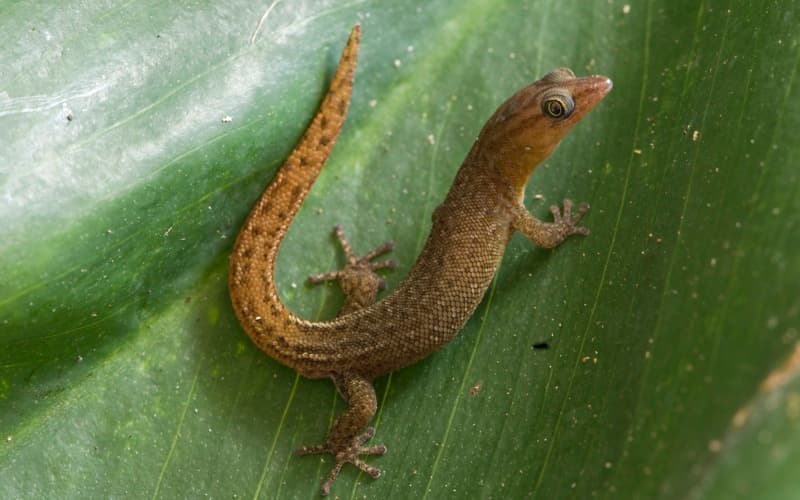
Sphaerodactylus sabanus
The Saba least gecko (Sphaerodactylus sabanus) is a small gecko species endemic to the Lesser Antilles in the Caribbean. It exhibits a range of coloration from light to dark brown, with some individuals displaying dull orange heads and dark brown stripes. This adaptable species inhabits various environments, including forests, palm groves, xeric habitats, and human settlements, and is generally considered to be of least concern for conservation.