
Gallotia intermedia
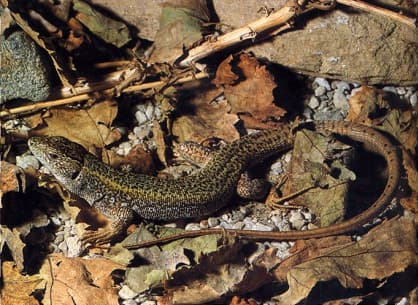
The Tenerife speckled lizard (Gallotia intermedia) is a small lacertid lizard endemic to the island of Tenerife in the Canary Islands. Discovered in 1996, it is the smallest member of a clade that includes larger giant species. Its populations are currently restricted to small coastal areas in the northwest and a location in the south of the island, with conservation efforts focused on controlling introduced predators.
Key Facts
- ›Endemic to the island of Tenerife in the Canary Islands.
- ›Discovered in 1996 by biologist Efraín Hernández.
- ›Considered the smallest member of the clade containing western islands' giant species.
- ›Found in isolated populations along the northwest coastline and in the south of Tenerife.
- ›Main threats include predation by feral cats and rats.
- ›Population numbers have been increasing due to control of introduced mammals.

Tenerife Speckled Lizard
Tenerife, Canary Islands
- Small Lacertid Lizard.
- Smallest Member of the Clade Containing Western Islands' Giant Species.
Feral Cats, Rats
Predation By Feral Cats, Predation By Rats
About Gallotia intermedia
Tenerife Speckled Lizard (Gallotia intermedia)
The Tenerife speckled lizard, scientifically known as Gallotia intermedia, is a species of wall lizard that is exclusively found on the island of Tenerife in the Canary Islands archipelago. This reptile holds significance as the smallest member within the evolutionary group that includes the larger giant lizard species native to the western Canary Islands.
Discovery and Distribution
This distinct lizard species was identified and described in 1996 by biologist Efraín Hernández. Its discovery took place in the Macizo de Teno, a mountainous region located in the northwestern part of Tenerife. While historical evidence suggests that Gallotia intermedia was once distributed more broadly across the island, its present-day known populations are confined to very specific and limited locations. These areas include a small coastal zone in the island's extreme west and a separate population found at Montana de Guaza in the south.
Population and Conservation
The total number of individuals is quite low, with estimates around 500 animals in the northwestern distribution area, spread across approximately 40 isolated populations along nine kilometers of coastline. In the southern region, about 100 individuals have been recorded. The primary threats to the survival of the Tenerife speckled lizard are predation by introduced feral cats and, to a lesser extent, by rats. Encouragingly, conservation initiatives focused on controlling these invasive mammals have led to an increase in the lizard's numbers since the beginning of the 21st century.
Source: Wikipedia ↗
Frequently Asked Questions
What is the Gallotia intermedia?
The Gallotia intermedia, also known as the Tenerife speckled lizard, is a species of wall lizard that is found only on the island of Tenerife in the Canary Islands. It is a relatively small lizard and is part of a group that includes larger giant species found on the western islands.
When and where was the Tenerife speckled lizard discovered?
The Gallotia intermedia was discovered in 1996 by biologist Efraín Hernández. Its discovery occurred in the Macizo de Teno, located in the extreme northwest of Tenerife.
What is the current distribution of Gallotia intermedia?
While believed to have once been widespread, the Tenerife speckled lizard is now found in only a few small areas. These include a limited stretch of coastline in the extreme west of Tenerife and a separate population at Montana de Guaza in the south of the island.
What are the main threats to the Tenerife speckled lizard?
The primary threat to the Gallotia intermedia is predation by introduced feral cats. Rats also pose a threat to a lesser degree. These introduced mammals have significantly impacted the lizard's populations.
Are the populations of Gallotia intermedia recovering?
Yes, there have been positive signs of recovery for the Tenerife speckled lizard. Since the turn of the century, their numbers have been increasing due to successful control measures implemented for introduced mammals like cats and rats.
Related Lizards

Chalcides parallelus
Chalcides parallelus, commonly known as the Chafarinas's skink, is a species of skink found in parts of North Africa and Southern Europe. This lizard inhabits Mediterranean coastal environments, including shrubland, rocky areas, and sandy shores. Its primary threat is habitat loss.
Balkan green lizard
The Balkan green lizard (Lacerta trilineata) is a widespread lizard species found throughout the Balkans and parts of the Eastern Mediterranean. It inhabits diverse environments such as Mediterranean shrubland, sandy shores, and agricultural areas. A key characteristic is its reproductive cycle, which typically spans from April to July, with individuals reaching sexual maturity around 80 millimeters in body size.

Cnemaspis beddomei
Beddome's day gecko, scientifically known as Cnemaspis beddomei, is a species of lizard endemic to the Western Ghats of India. This diurnal reptile is typically found under rocks in forested areas and primarily feeds on insects. It is named in honor of Richard Henry Beddome.