
Gan's Lanka skink
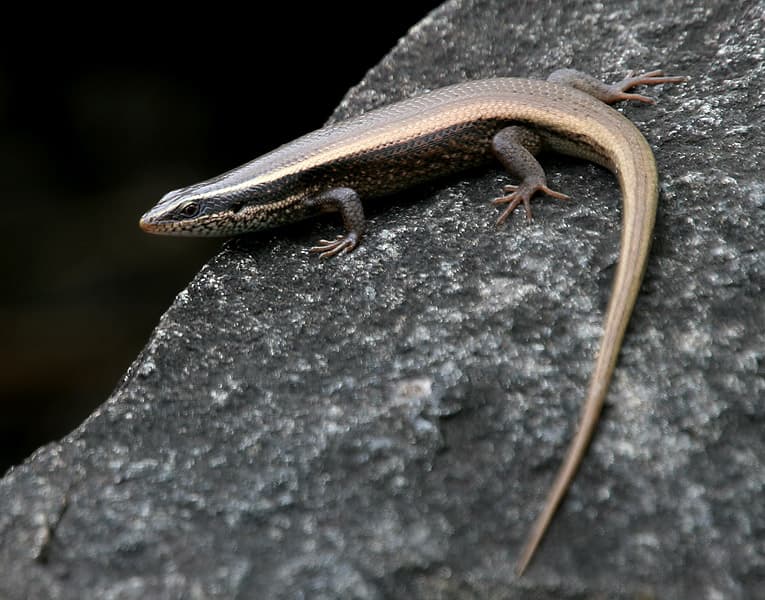
Gan's Lanka skink (Lankascincus gansi) is a species of skink native to Sri Lanka. This lizard is commonly found in home gardens and forests in wet climatic zones, from sea level up to 1,000 meters. It is characterized by its grayish-brown dorsum with distinct vertebral and flank stripes, and a yellowish cream spotting on its flanks.
Key Facts
- ›Endemic to the island of Sri Lanka.
- ›Found in home gardens and forests within wet climatic zones.
- ›Dorsum is grayish-brown with brownish-black stripes and yellowish cream spots.
- ›Preys primarily on insects.
- ›Females lay clutches of one to two eggs in loose soil.

Gans's Lankaskink, Gans's Tree Skink
Sri Lanka
- 23–28 Scale Rows At Midbody.
- 12–16 Lamellae Under the Fourth Toe.
- Dorsum Is Grayish Brown With Brownish-Black Vertebral and Flank Stripes.
- Flanks Are Spotted With Yellowish Cream.
- Iris Is Yellowish Brown.
- Venter Is Unpatterned Grayish Yellow.
- Throat of the Male Is Dark.
Insects
- Hides Under Logs, Stones, and Leaf Litter.
- Becomes Active and Forages In the Morning and At Dusk.
About Gan's Lanka skink
Gan's Lanka skink, scientifically known as Lankascincus gansi, is a species of skink endemic to the island nation of Sri Lanka. This lizard, also referred to as Gans's lankaskink or Gans's tree skink, is a common inhabitant of home gardens as well as forests within the island's wet climatic zones. Its natural range extends from sea level up to elevations of approximately 1,000 meters.
Physical Characteristics
The physical description of Gan's Lanka skink includes a distinctive grayish-brown dorsal coloration, marked by prominent brownish-black vertebral and flank stripes. The flanks themselves are adorned with spots of yellowish cream. Anatomically, the species typically presents with 23 to 28 scale rows counted at midbody, and the lamellae beneath the fourth toe number between 12 and 16. Its iris is a yellowish-brown hue, and its venter, or underside, is an unpatterned grayish yellow. Notably, the throat of the male is dark in coloration.
Habitat and Behavior
Gan's Lanka skink thrives in a variety of environments within Sri Lanka, preferring areas that are both sheltered and moist. Its behavioral patterns involve seeking refuge under natural cover such as logs, stones, and leaf litter. The skink is crepuscular, meaning it becomes active and ventures out for foraging during the early morning hours and again at dusk. This activity pattern allows it to hunt effectively during these transitional periods of the day.
Diet and Reproduction
As an insectivore, the diet of Gan's Lanka skink consists primarily of insects, which it actively hunts. Reproduction in this species is oviparous, with sexually mature females laying clutches of one to two eggs. These eggs are typically deposited in loose soil, where they undergo incubation until hatching.
Taxonomy and Etymology
The species belongs to the family Scincidae, a diverse group of lizards commonly known as skinks. The specific epithet, gansi, was chosen in honor of the German-born American herpetologist Carl Gans (1923–2009), recognizing his contributions to the field of herpetology.
Source: Wikipedia ↗
Frequently Asked Questions
What is the scientific name for Gan's Lanka skink?
The scientific name for Gan's Lanka skink is Lankascincus gansi. This binomial nomenclature identifies it within the scientific classification of species.
Where does Gan's Lanka skink live?
Gan's Lanka skink is endemic to Sri Lanka. It is commonly found in home gardens and forests in the wet climatic zones of the island, from sea level up to 1,000 meters.
What does Gan's Lanka skink eat?
Gan's Lanka skink is an insectivore, meaning its diet consists primarily of insects. It actively forages for its prey.
How does Gan's Lanka skink reproduce?
Reproduction in Gan's Lanka skink involves females laying a small clutch of one to two eggs. These eggs are deposited in loose soil, where they will incubate.
What are the physical characteristics of Gan's Lanka skink?
Gan's Lanka skink has a grayish-brown dorsum marked with brownish-black vertebral and flank stripes, and yellowish cream spots on its flanks. It has 23–28 scale rows at midbody and 12–16 lamellae under the fourth toe. The iris is yellowish brown, and the venter is an unpatterned grayish yellow.
Related Lizards

Furcifer lateralis
The carpet chameleon (Furcifer lateralis) is a small chameleon species endemic to eastern Madagascar. Known for its striking coloration, especially in females, it inhabits a variety of environments from forests to gardens. This species is relatively fast-maturing and short-lived, capable of breeding within months of hatching.

Tytler's mabuya
Tytler's mabuya (Eutropis tytleri) is a large skink species endemic to the Andaman Islands in India. It is characterized by its bronzish-brown dorsal coloration and light yellow underside, with a long tail. This adaptable species thrives in various habitats, including forests and human-modified areas, and is known to climb trees.
Bronze mabuya
The bronze grass skink, also known as the bronze mabuya or speckled forest skink, is a common but shy, ground-dwelling lizard found across South and Southeast Asia. It inhabits various environments including forests, grasslands, and rocky areas, and is characterized by its cylindrical body, keeled dorsal scales, and distinctive dorso-lateral bands. This skink is an insectivore, active both day and night, and plays a role in its ecosystem by consuming invertebrates.