
Golden gecko
The golden gecko, scientifically known as Gekko badenii, is a species of lizard native to Vietnam, distinguished by its gold-colored scales. Primarily insectivorous, it also consumes some fruits and inhabits granite rocky areas within lowland rainforests. Males are larger than females and exhibit distinct physical characteristics like a longer tail base and fleshy knobs.
Key Facts
- ›Native to Vietnam, found in Tây Ninh and Kon Tum Provinces.
- ›Characterized by gold-colored scales on its body.
- ›Males typically reach 18-20 cm total length, females 13-15 cm.
- ›Inhabits granite rocky areas within lowland rainforests.
- ›Diet consists mainly of insects and some fruits.
- ›Reproduction is oviparous (egg-laying).

Baden's Pacific Gecko
Vietnam
Granite Rocky Areas, Lowland Rainforest
- Gold-Colored Scales On the Body.
- Males: 18-20 cm Total Length, Longer Tail Base, Fleshy Knobs At Tail Base.
- Females: 13-15 cm Total Length.
- Males Have Visible Pores On the Insides of Their Legs; Females Do Not.
Insects, Fruit
- Males Fight If Housed Together.
- Captive Hatchlings Feed Daily, Adults Every 5-6 Days.
About Golden gecko
The golden gecko, scientifically identified as Gekko badenii, is a distinct lizard species native to Vietnam. Its common name is derived from the characteristic gold hue of its scales, which adorn its body. This species is primarily found in the Tây Ninh and Kon Tum Provinces of southern Vietnam, inhabiting granite rocky areas within lowland rainforest environments. These geckos can be found at altitudes ranging from sea level up to approximately 986 meters.
Description and Size
Adult male golden geckos typically reach a total length of 18 to 20 cm (7 to 8 inches), distinguishing themselves from females, which usually measure between 13 to 15 cm (5 to 6 inches) in total length. Males possess a longer tail base and notable fleshy knobs at the base of their tail. An observable difference between sexes is the presence of pores on the insides of the males' legs, which are absent in females.
Diet and Habitat
The golden gecko's diet is predominantly composed of insects, commonly referred to as bugs. They also supplement their nutritional intake with certain types of fruit. For hydration, they have been observed drinking water that collects on leaves following rainfall. Their preferred natural habitat consists of granite rocky formations, often situated within lowland rainforest ecosystems.
Reproduction and Behavior
Gekko badenii reproduces via oviparity, meaning they lay eggs. In captivity, the species requires specific care; housing two golden geckos of the same sex together is not advisable, as they are prone to fighting. Juvenile golden geckos in captivity are fed daily, while adults require feeding approximately every five to six days. Their diet in captivity includes crickets, mealworms, wax worms, and fruits such as bananas and mangos, which are valued for their calcium content.
Source: Wikipedia ↗
Frequently Asked Questions
What is the scientific name of the golden gecko?
The scientific name of the golden gecko is Gekko badenii. It is also sometimes referred to as Baden's Pacific gecko.
Where is the golden gecko found geographically?
The golden gecko is native to Vietnam. It has been reported from the Tây Ninh Province and Kon Tum Province in southern Vietnam.
What kind of habitat does the golden gecko prefer?
The golden gecko prefers granite rocky areas, including those found in lowland rainforests. They can be found from sea level up to altitudes of 986 meters.
What does the golden gecko eat?
The golden gecko's diet primarily consists of insects, often referred to as bugs. They will also supplement their diet with certain fruits. They hydrate by drinking rainwater collected on leaves.
How large do golden geckos get?
Males of the species typically grow to about 18 to 20 cm (7 to 8 inches) in total length, including their tail. Females are generally smaller, reaching around 13 to 15 cm (5 to 6 inches) in total length.
Is the golden gecko a popular pet?
The golden gecko is not very popular in the pet trade, meaning most specimens available are wild-caught. They require a terrarium of at least 20 US gallons, with vertical space being important for adult housing.
Related Lizards
Andaman bent-toed gecko
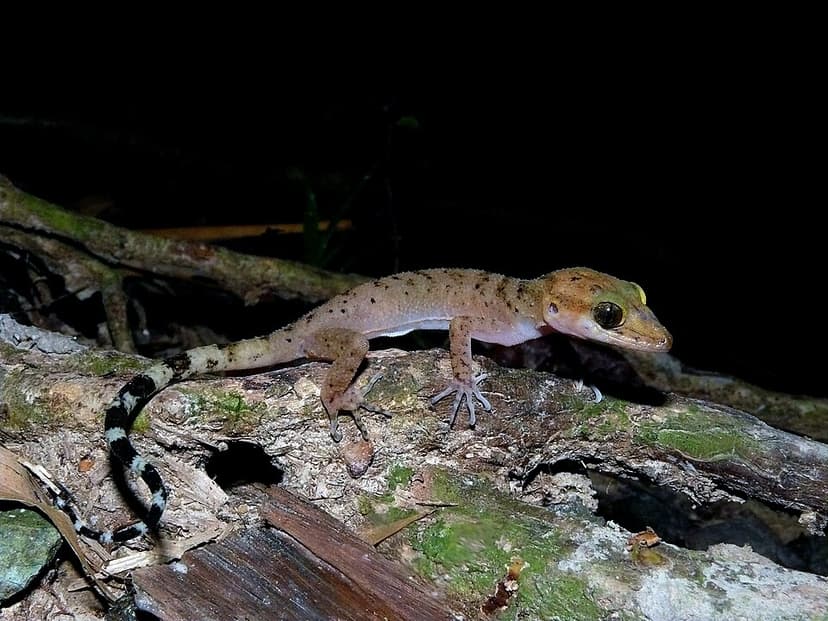
The Andaman bent-toed gecko, also known as the red bow-fingered gecko, is a small to medium-sized gecko found in the Andaman Islands of India and the Coco Islands of Myanmar. It inhabits lowland and deciduous forests, often found near human dwellings, and is known for its reddish-brown to dark grey coloration marked with black bands or blotches, and a black and white banded tail. This species is oviparous, typically laying two eggs, and exhibits both terrestrial and arboreal behaviors.
Cyrtodactylus rubidus
Cyrtodactylus rubidus, also known as the Andaman bent-toed gecko or red bow-fingered gecko, is a small to medium-sized gecko native to the Andaman Islands of India and the Coco Islands of Myanmar. It inhabits lowland and deciduous forests, exhibiting both terrestrial and arboreal behavior, and is characterized by its black-banded yellowish-brown body and a distinctive black and white banded tail.

Cyprus rock agama
The Cyprus rock agama is a species of agamid lizard endemic to the island of Cyprus. It inhabits a variety of rocky environments, from arid to Mediterranean habitats, and has adapted well to human presence in towns and agricultural areas. This diurnal lizard is primarily insectivorous but also consumes small vertebrates and fruits.