
Hemidactylus
Hemidactylus, commonly known as house geckos, is a large genus of geckos found in tropical and subtropical regions worldwide. These geckos are well-adapted to living alongside humans, often found in and around dwellings, and are notable for their adhesive toe pads that aid in climbing. They communicate through various vocalizations and are recognized by their vertical pupils and split toe lamellae.
Key Facts
- ›Hemidactylus geckos are found in tropical and subtropical regions globally.
- ›They are commonly called house geckos due to their association with human habitations.
- ›Their scientific name, Hemidactylus, refers to the 'half' lamellae on their 'fingers' and toes.
- ›These geckos possess vertical pupils and males may have pre-anal or femoral pores.
- ›Some species can run across water using a unique quadrupedal gait.
- ›Hemidactylus species communicate through distinct vocalizations such as clicks, squeaks, and chirps.

House Gecko, Leaf-Toed Gecko
Tropical Regions of the World, Subtropical Parts of Africa, Subtropical Parts of Europe, Oceanic Islands, Polynesia
Human Habitations, Tropical Regions, Subtropical Regions
- Dorsal Scale Pattern Is Either Uniform Or Heterogeneous.
- Pupil of the Eye Is Vertical.
- Males Have Pre-Anal Or Femoral Pores.
- Fingers and Toes Have Split Lamellae Underneath.
- Fingers and Toes Are Free, Or More Or Less Webbed, and Dilated.
- Each Finger Or Toe Has A Slender Distal Clawed Joint, Angularly Bent and Rising From Within the Extremity of the Dilated Portion.
Readily Adapt To and Coexist With Humans., Confine Excretions To One Area of A House., Communicate With Distinct Vocalizations., Some Species Can Run Across Water.
About Hemidactylus
The genus Hemidactylus represents a diverse group of geckos belonging to the common gecko family, Gekkonidae. The name itself, derived from Ancient Greek, signifies 'half-finger,' a nod to the distinctive split lamellae found on their toes. These geckos are globally distributed, thriving in all tropical regions and extending into subtropical zones of Africa and Europe. They are particularly adept at colonizing new territories, including oceanic islands, often by rafting on flotsam.
Adaptability and Habitat
A defining characteristic of Hemidactylus is their remarkable ability to coexist with humans, leading to their common designation as 'house geckos.' They are frequently found living in and around human habitations, demonstrating a high degree of adaptability. This close association means they are easily encountered in various built environments.
Physical Characteristics and Communication
Hemidactylus geckos typically exhibit a vertical pupil and, in males, may possess pre-anal or femoral pores. Their fingers and toes are dilated and equipped with specialized lamellae underneath, which are crucial for their climbing abilities. Some species within the genus have shown the unique capacity to run across water surfaces. Communication among these geckos is achieved through distinct vocalizations, which can vary from subtle clicks to more pronounced squeaks and chirps, depending on the specific species.
Source: Wikipedia ↗
Frequently Asked Questions
What does the name Hemidactylus mean?
The name Hemidactylus comes from Ancient Greek words: 'hēmi' meaning 'half' and 'dáktulos' meaning 'finger'. This refers to the characteristic split or 'half' lamellae found underneath their toes.
Where are Hemidactylus geckos typically found?
Hemidactylus geckos are widespread and can be found in all tropical regions of the world, extending into subtropical areas of Africa and Europe. They are also adept at colonizing oceanic islands.
Why are they called house geckos?
They are commonly known as house geckos because they readily adapt to and coexist with humans. As a result, they are frequently encountered in and around human dwellings and structures.
What are some distinctive physical features of Hemidactylus geckos?
Hemidactylus geckos typically have vertical pupils and males often possess pre-anal or femoral pores. Their fingers and toes are dilated and bear split lamellae, which aid in climbing.
How do Hemidactylus geckos communicate?
Like many gecko species, Hemidactylus geckos communicate through distinct vocalizations. These sounds can range from quiet clicks to short squeaks and chirps, with some species, like the Asian common house gecko, being known for their distinctive chirping.
Are there any unusual abilities of Hemidactylus geckos?
Yes, some members of the Hemidactylus genus, such as H. platyurus, have demonstrated the ability to run quadrupedally across water. This is achieved through a mechanism that is partially dependent on surface tension.
Related Lizards
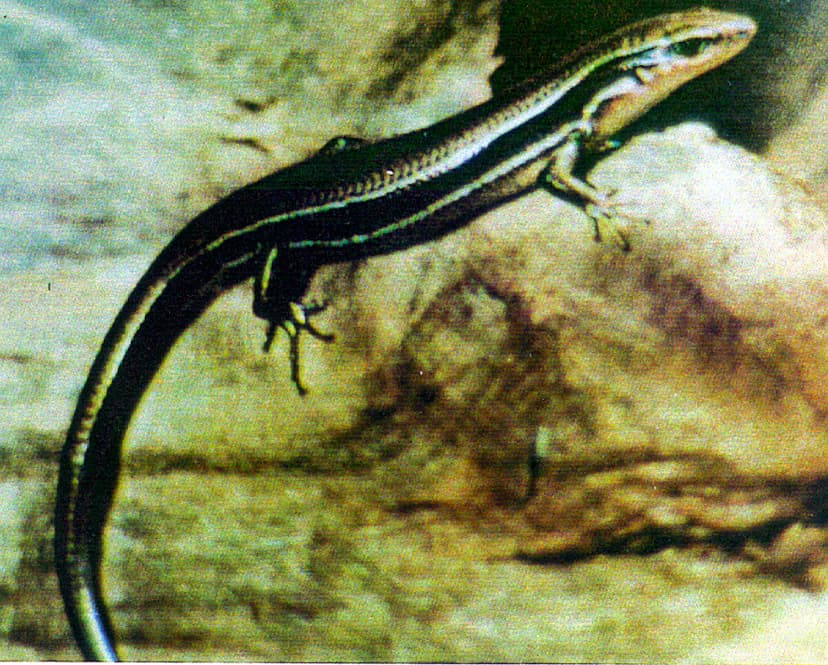
Spondylurus powelli
Spondylurus powelli, commonly known as the Anguilla Bank skink, is a species of lizard found on several islands in the northern Lesser Antilles, primarily Anguilla and Saint Barthélemy. It is characterized by a pale stripe down its back, flanked by darker stripes, and pale feet. This skink typically inhabits rocky areas, sunny spots on cacti, tall grass, and can be found near human habitations.
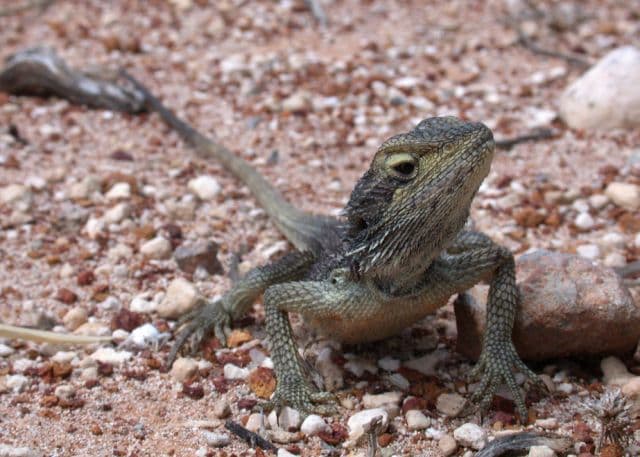
Abrolhos bearded dragon
The Abrolhos bearded dragon (Pogona minor minima) is a small agamid lizard endemic to the islands of the Houtman Abrolhos archipelago off the coast of Western Australia. It is characterized by its smaller size compared to related bearded dragons and inhabits sandy or limestone outcrop environments.

Algerian sand racer
The Algerian sand racer, scientifically known as Psammodromus algirus, is a lizard species found in southwestern Europe and northwestern Africa. It typically inhabits dense bushy vegetation and can be found at high elevations, though it is more common at lower altitudes. This species is characterized by its metallic brownish dorsal coloration with conspicuous white or yellowish stripes.