
Spondylurus powelli
Spondylurus powelli·Scincidae
Spondylurus powelli, commonly known as the Anguilla Bank skink, is a species of lizard found on several islands in the northern Lesser Antilles, primarily Anguilla and Saint Barthélemy. It is characterized by a pale stripe down its back, flanked by darker stripes, and pale feet. This skink typically inhabits rocky areas, sunny spots on cacti, tall grass, and can be found near human habitations.
Key Facts
- ›Found on Anguilla, Saint Barthélemy, and Île Tintamarre.
- ›Distinguished by a pale MID-dorsal stripe and dark lateral stripes.
- ›Males have a maximum snout-vent length of 72 mm, females 70 mm.
- ›Inhabits rock walls, cacti, tall grass, and occasionally houses.
- ›Belongs to the skink family (Scincidae) and genus Spondylurus.
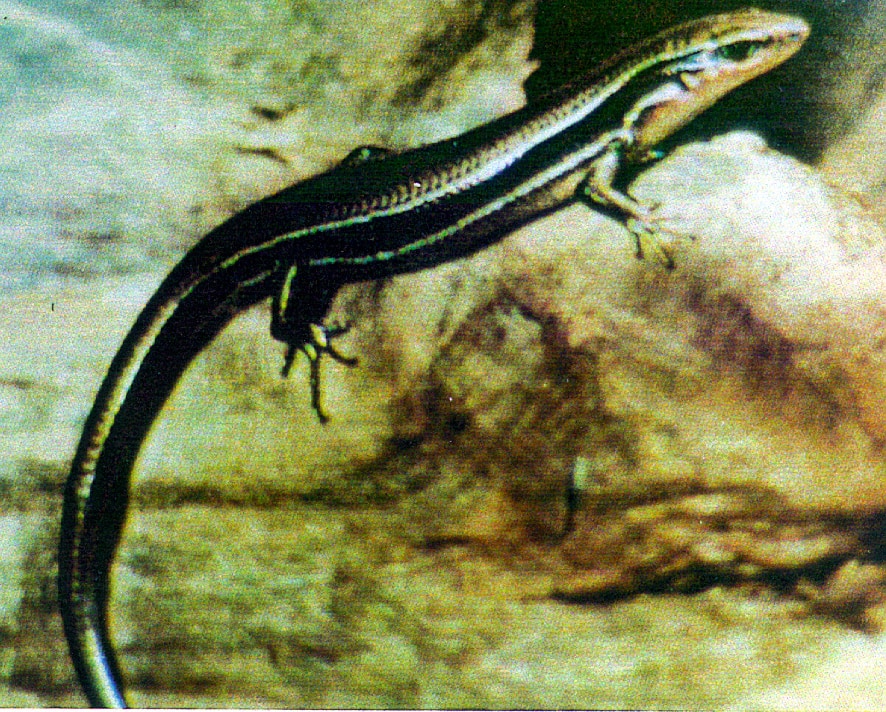
Anguilla Bank Skink
Anguilla, Saint BarthéLemy, îLe Tintamarre
Rocky Areas, Cacti, Tall Grass, Human Habitations
- Maximum Snout-Vent Length: 72 mm , 70 mm .
- Pale Stripe Along the Middle of the Back.
- Dark Stripes On Either Side of the Mid-Dorsal Stripe.
- Dark Stripes Along the Flanks.
- Pale Feet.
About Spondylurus powelli
What is Spondylurus powelli?
Spondylurus powelli, commonly known as the Anguilla Bank skink, is a species of lizard belonging to the family Scincidae. It is native to several islands in the northern Lesser Antilles, most notably Anguilla and Saint Barthélemy. The species is part of the S. martinae species group within the genus Spondylurus.
Description and Habitat
The Anguilla Bank skink is characterized by a distinct pale stripe running down the middle of its back, bordered by darker stripes. Additional dark stripes are present along its flanks, and its feet are pale. Adult males typically reach a maximum snout-vent length of 72 mm, while females are slightly smaller, with a maximum of 70 mm. These skinks are adaptable to various environments, being found in rock walls, sunny spots among cacti, and in tall grasses. They have also been observed to inhabit human dwellings.
Distribution
Spondylurus powelli has a limited geographic distribution. While primarily found on Anguilla and Saint Barthélemy, it is notably absent from the main island of Saint Martin. However, a population was discovered in 2017 on Île Tintamarre, an uninhabited island situated northeast of Saint Martin. There is also a tentative identification of this species on Dog Island, located off the coast of Anguilla.
Source: Wikipedia ↗
Frequently Asked Questions
What islands are Spondylurus powelli found on?
Spondylurus powelli is found on the Anguilla Bank, with established populations on the islands of Anguilla and Saint Barthélemy. A population was also identified on Île Tintamarre in 2017.
What are the key physical characteristics of Spondylurus powelli?
This skink features a pale stripe running along the middle of its back. It also has dark stripes on either side of this central stripe and along its flanks. Its feet are described as pale.
What is the maximum size of Spondylurus powelli?
The maximum snout-vent length for males of this species is 72 mm (approximately 2.83 inches). For females, the maximum snout-vent length is slightly smaller, at 70 mm (approximately 2.76 inches).
Where does Spondylurus powelli typically live?
Spondylurus powelli inhabits various environments. On islands like Anguilla and Île Tintamarre, they are found in rock-built walls. On Saint Barthélemy, they prefer sunny locations on cacti and in tall grass, and have also been observed in houses.
What is the origin of the scientific name Spondylurus powelli?
The genus name Spondylurus is thought to derive from the Greek word 'spondylos,' meaning 'vertebra,' possibly referencing the dorsal stripe found in many species of the genus. The specific epithet 'powelli' honors American herpetologist Robert Powell for his contributions to West Indian herpetology.
Related Lizards

Hemidactylus
Hemidactylus, commonly known as house geckos, is a large genus of geckos found in tropical and subtropical regions worldwide. These geckos are well-adapted to living alongside humans, often found in and around dwellings, and are notable for their adhesive toe pads that aid in climbing. They communicate through various vocalizations and are recognized by their vertical pupils and split toe lamellae.

Ablepharus
Ablepharus, commonly known as snake-eyed skinks, are small lizards distinguished by fused eyelids that prevent blinking, similar to snakes. They inhabit dry fields, hills, and rocky areas, often concealed within leaf litter. These skinks possess shiny, bronze scales and a characteristic dark stripe along their sides, feeding primarily on small insects and mollusks.

Agama agama
The common agama, also known as the red-headed rock agama, is a widespread lizard species native to sub-Saharan Africa and introduced to Florida. It is characterized by its distinct coloration, with males exhibiting blue bodies and yellow tails, while females and subordinates have olive green heads. These lizards are diurnal, territorial, and primarily insectivorous, playing an important role in their ecosystems.