
Hemidactylus giganteus
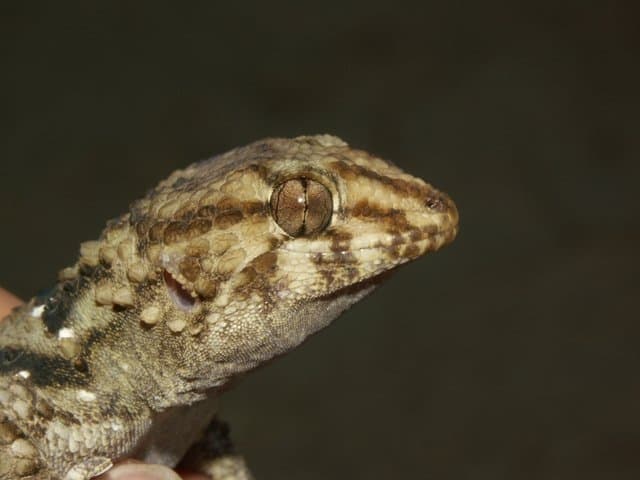
Hemidactylus giganteus, also known as the giant leaf-toed gecko, is a species of gecko endemic to India. It is characterized by its stout body, free digits with dilated pads, and distinct olive-grey coloration with irregular dark, pale-edged marks forming undulating bands. Primarily found on trees near water sources, this species inhabits the Godavari Valley and Malabar regions.
Key Facts
- ›Endemic to India, found in the Godavari Valley and Malabar.
- ›Possesses free digits with strongly dilated pads for climbing.
- ›Olive-grey dorsal coloration with irregular dark, pale-edged marks forming bands.
- ›Snout-to-vent length can reach up to 4.8 inches.
- ›Found on trees, often near water sources.

Giant Leaf-Toed Gecko, Giant Southern Tree Gecko, Giant Gecko
India
Arboreal, Near Water Sources
- Snout Longer Than the Distance Between the Eye and the Ear-Opening.
- Forehead Concave; Ear-Opening Rather Large, Suboval, Vertical.
- Body and Limbs Stout.
- Digits Free, Inner Well Developed, Strongly Dilated; With Straight Transverse Lamella Beneath; 11 Or 12 Under the Inner Digits, 13 To 15 Under the Median.
- Upper Surfaces Covered With Uniform Small Granular Scales, Somewhat Larger On the Snout, Smallest On the Hinder Part of the Head.
- Rostral Quadrangular, Not Quite Twice As Broad As Deep.
- Nostril Pierced Between the Rostral and Three Nasals.
- 12 To 15 Upper and 11 To 13 Lower Labials.
- Mental Large, Pentagonal.
- Two Pairs of Chin-Shields, the Inner the Larger.
- Abdominal Scales Rather Small, Cycloid, Imbricate.
- Male With A Series of Femoral Pores Interrupted Mesially; 19 To 22 Pores On Each Side.
- Tail Without Large Tubercles.
- Olive-Grey Above, With Irregular Dark, Pale-Edged Marks In Imperfect Circles, Tending To Form, Or Forming, 4 Or 5 Transverse Undulating Bands On the Body.
- Below Uniform White.
- From Snout To Vent 4.8 Inches.
About Hemidactylus giganteus
Hemidactylus giganteus, commonly known as the giant leaf-toed gecko, is a species of gecko that is endemic to India. Its distribution is primarily noted in the Godavari Valley and the Malabar region, with specific findings in northern Andhra Pradesh. This gecko is typically found inhabiting trees, often in proximity to water sources.
Description and Physical Characteristics
The giant leaf-toed gecko possesses a stout body and limbs, with distinctly free digits that are strongly dilated and equipped with transverse lamellae underneath, aiding in arboreal locomotion. Its snout is longer than the distance between its eye and ear-opening, and the forehead is concave. The ear-opening is rather large and suboval. The upper surfaces are covered in uniform, small granular scales, which are slightly larger on the snout and smallest on the posterior part of the head. The rostral scale is quadrangular, and the nostril is positioned between the rostral scale and three nasal scales. It has between 12 to 15 upper labials and 11 to 13 lower labials. The mental scale is large and pentagonal, with two pairs of chin-shields, the inner pair being larger. Abdominal scales are described as small, cycloid, and imbricate. Mature males exhibit a series of femoral pores on each side, typically ranging from 19 to 22, which are interrupted mesially. The tail lacks large tubercles. Dorsally, the gecko is olive-grey, adorned with irregular dark, pale-edged marks that form imperfect circles, often coalescing into four or five transverse, undulating bands across the body. The ventral side is uniformly white. Adult specimens have been recorded with a snout-to-vent length of up to 4.8 inches.
Source: Wikipedia ↗
Frequently Asked Questions
What are the common names for Hemidactylus giganteus?
Hemidactylus giganteus is commonly known as the giant leaf-toed gecko, the giant southern tree gecko, or simply the giant gecko.
Where is Hemidactylus giganteus found?
This species is endemic to India, specifically found in the Godavari Valley and the Malabar region, including northern Andhra Pradesh.
What does Hemidactylus giganteus look like?
It has a stout body and limbs, with digits that are free and strongly dilated, featuring transverse lamellae underneath. The upper surfaces are covered in small granular scales, and its coloration is olive-grey with irregular dark, pale-edged marks forming undulating bands.
What is the size of Hemidactylus giganteus?
The snout-to-vent length of an adult Hemidactylus giganteus can reach up to 4.8 inches.
What is the habitat of Hemidactylus giganteus?
Hemidactylus giganteus is typically found on trees, with a preference for areas near water sources.
Related Lizards

Andaman giant gecko
The Andaman giant gecko (Gekko verreauxi), also known as the Andamanese giant gecko, is a large gecko species indigenous to the Andaman Islands of India. Reaching over 30 cm in total length, it is one of the world's largest geckos, characterized by its shy nature and excellent camouflage, which aids its survival in its arboreal and semi-arboreal habitats.

Bark anole
The bark anole, also known as the North Caribbean bark anole or Hispaniolan gracile anole, is a small lizard species native to Hispaniola and the Bahamas, with introduced populations in Florida. Primarily arboreal, it is characterized by its variable coloration, ranging from gray-brown to green, and a dewlap that can be cream-white, yellow, orange, or red. It spends most of its time on tree trunks and exhibits a diverse range of subspecies.
Bibron's sand gecko
Bibron's sand gecko, also known as Bibron's thick-toed gecko, is a moderate-sized lizard native to southern Africa. It is characterized by a stocky build, brown coloration with beaded patterns and black crossbars, and a white or light brown belly. This species is notable for its use in bioastronautic research and its territorial behavior.