
Hemidactylus maculatus
Hemidactylus maculatus, commonly known as the spotted leaf-toed gecko or giant spotted gecko, is a large gecko species native to the Western Ghats of India and parts of Sri Lanka. This gecko is characterized by its distinct spotted pattern, moderate body and limb size, and specialized toe lamellae. It inhabits forested regions and is a terrestrial species.
Key Facts
- ›Found in the Western Ghats of India and Sri Lanka.
- ›Distinguished by dark spots, often forming undulating bands on its back.
- ›Possesses granular scales mixed with keeled tubercles on its upper surfaces.
- ›Males have a series of femoral pores.
- ›Tail is rounded, tapering, and depressed, with prominent tubercles.
- ›Adults can reach a snout-to-vent length of approximately 4.5 inches.
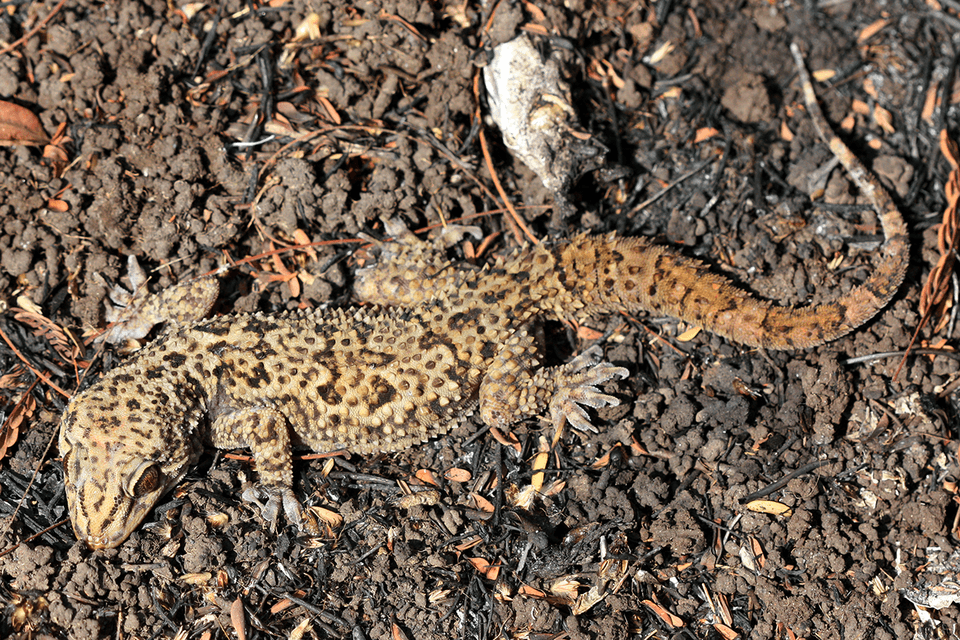
Spotted Leaf-Toed Gecko, Giant Spotted Gecko
India, Sri Lanka
- Head Large and Oviform.
- Snout Longer Than the Distance Between the Eye and the Ear-Opening.
- Ear-Opening Is Large and Oval.
- Body and Limbs Are Moderate In Size.
- Digits Are Moderately Dilated and Free, With Inner Digits Well-Developed.
- Infradigital Lamellae Are Almost Perfectly Straight, Numbering 9 To 11 Under the Inner Digit and 12 Or 13 Under the Median Digit.
- Head Is Covered Anteriorly With Convex Granular Scales, Smaller In the Frontal Concavity, and Posteriorly With Minute Granules Mixed With Round Tubercles.
- Rostral Scale Is Subtetragonal, Not Twice As Broad As Deep, With A Median Cleft Above.
- Upper Surfaces Feature Minute, Granular Scales Interspersed With Moderate-Sized, Trihedral, More Or Less Strongly Keeled Tubercles.
- Tubercles On the Upper Surfaces Are Arranged Irregularly On the Back In About 20 Longitudinal Series.
- Abdominal Scales Are Smooth, Roundish, and Imbricate.
- Males Have A Long Series of Femoral Pores .
- Tail Is Rounded, Tapering, and Depressed, With Small Irregular Keeled Scales and 6 To 8 Longitudinal Series of Large Trihedral Tubercles.
- Lower Surfaces of the Tail Have A Median Series of Transversely Enlarged Plates.
- Coloration Is Brown Above With Darker Spots, Often Forming Confluent Transverse Undulating Bands On the Back.
- Two More Or Less Distinct Dark Streaks Are Present On Each Side of the Head, Passing Through the Eye.
- Lower Surfaces Are Dirty White.
Insects
Terrestrial
About Hemidactylus maculatus
Hemidactylus maculatus, also widely known as the spotted leaf-toed gecko or the giant spotted gecko, is a notable species of gecko found in the biodiverse Western Ghats region of India and extending into parts of Sri Lanka. This reptile is characterized by its substantial size for a gecko, its distinctive spotted pattern, and its specific habitat preferences.
Description and Physical Characteristics
The spotted leaf-toed gecko possesses a large, oviform head with a snout that is longer than the distance between its eye and ear-opening. Its ear-opening is notably large and oval. The body and limbs are of moderate proportion, and its digits are well-developed and dilated, featuring almost perfectly straight infradigital lamellae. The upper surfaces of the head and body are covered with a combination of granular scales and moderate-sized, trihedral, keeled tubercles, arranged irregularly. These tubercles are generally smaller than one-third the diameter of the eye. The abdominal scales are smooth, roundish, and imbricate. Males of the species are distinguished by a series of 19 to 25 femoral pores on each side.
The tail of Hemidactylus maculatus is rounded, tapering, and depressed, adorned with small irregular keeled scales and prominent longitudinal series of large trihedral tubercles. Its coloration is a base brown on the upper surfaces, marked with darker spots that frequently coalesce to form undulating transverse bands across the back. Two distinct dark streaks often run along each side of the head, passing through the eye. The ventral surfaces are typically a dirty white.
Distribution and Habitat
This species is native to southern India, specifically the Western Ghats, and is also found in Sri Lanka. Its habitat is generally associated with forested areas. While primarily terrestrial, its specific microhabitat requirements within these forested environments are key to its survival.
Size
Hemidactylus maculatus is considered a large gecko. Adults typically measure around 4.5 inches from snout to vent, with their tails extending to approximately 5 inches, resulting in a total length of about 9.5 inches.
Source: Wikipedia ↗
Frequently Asked Questions
What are the common names for Hemidactylus maculatus?
Hemidactylus maculatus is commonly referred to as the spotted leaf-toed gecko or the giant spotted gecko. These names reflect its distinctive spotted coloration and its taxonomic classification.
Where is the spotted leaf-toed gecko found?
This species is primarily found in the Western Ghats region of India and also inhabits parts of Sri Lanka. Its distribution is concentrated in these southern Asian territories.
What does Hemidactylus maculatus look like?
It is a large gecko with a brown upper body adorned with dark spots, which frequently form undulating transverse bands. Its head is large and oviform, and its tail is rounded, tapering, and depressed, featuring large tubercles.
What are the key physical characteristics of Hemidactylus maculatus?
Key features include its large, oviform head with a snout longer than the distance from the eye to the ear-opening, and large, oval ear-openings. The digits are moderately dilated with straight infradigital lamellae, and the upper surfaces are covered with granular scales and trihedral tubercles.
What is the size of Hemidactylus maculatus?
The gecko has a moderate body and limbs. An adult can measure up to 4.5 inches from snout to vent, with the tail being approximately 5 inches long.
Are there any notable features in male Hemidactylus maculatus?
Yes, male Hemidactylus maculatus possess a series of femoral pores, typically ranging from 19 to 25 on each side. This series is interrupted in the preanal region.
Related Lizards

Ablepharus
Ablepharus, commonly known as snake-eyed skinks, are small lizards distinguished by fused eyelids that prevent blinking, similar to snakes. They inhabit dry fields, hills, and rocky areas, often concealed within leaf litter. These skinks possess shiny, bronze scales and a characteristic dark stripe along their sides, feeding primarily on small insects and mollusks.

Anolis carolinensis
The Anolis carolinensis, commonly known as the green anole or Carolina anole, is a small to medium-sized lizard native to the southeastern United States. This arboreal species is recognized for its ability to change color from green to brown, a trait that, along with its expandable throat fan, plays a role in communication and social signaling. It inhabits forests, grasslands, and urban areas with sufficient vegetation and insect prey.

Black spiny-tailed iguana
The black spiny-tailed iguana (Ctenosaura similis) is a large iguanid lizard native to Mexico and Central America, known for the distinctive black, keeled spines on its tail. It inhabits grasslands and forests, and is an excellent climber, capable of remarkable speeds. While primarily herbivorous, it will opportunistically consume small animals and eggs.