
Hemidactylus persicus
Hemidactylus persicus, also known as the Persian leaf-toed gecko or Persian gecko, is a species of gecko native to West Asia. It is characterized by its acuminate snout, fringed upper eyelids, and a body covered in small, irregular granular scales interspersed with larger, keeled tubercles. This species is found across a range including Iran, Iraq, Saudi Arabia, Oman, Bahrain, Pakistan, and India.
Key Facts
- ›Possesses an acuminate snout and obliquely crescentic ear-opening.
- ›Infradigital lamellae are obliquely curved.
- ›Body is covered in small, irregular flat granules and trihedral, keeled tubercles.
- ›Males have a series of preanal pores.
- ›The tail is cylindrical and tapering, with scattered pointed tubercles.
- ›Coloration is pale yellowish-brown with faint brownish transverse dorsal bands and a dark brown streak through the eye.
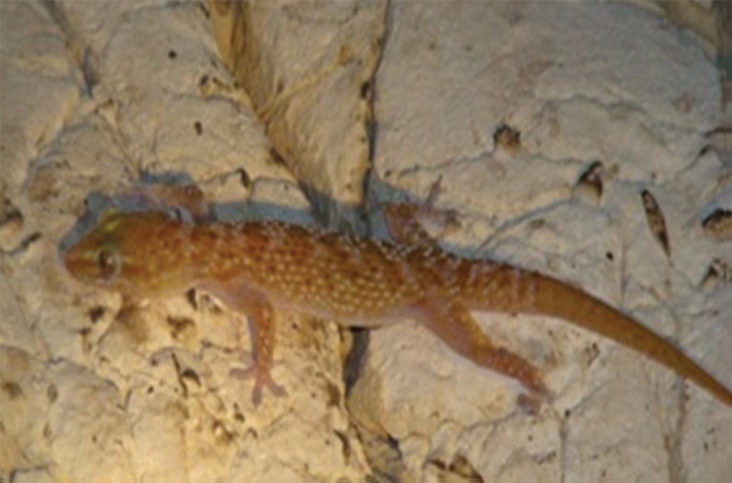
Persian Leaf-Toed Gecko, Persian Gecko
Iran, Iraq, Saudi Arabia, Oman, Bahrain, Pakistan, India
- Snout Is Acuminate, About As Long As the Distance Between the Eye and the Upper Border of the Ear-Opening.
- Forehead Is Concave, With A Very Narrow Interorbital Space.
- Upper Eyelid Is Strongly Fringed.
- Ear-Opening Is Large, Obliquely Crescentic, With Its Concavity Directed Forwards and Upwards.
- Digits Are Free and Moderately Dilated, With Obliquely Curved Infradigital Lamellae.
- Snout Is Covered With Large Convex Granular Scales.
- Hinder Part of the Head Has Minute Granules and Scattered Larger Ones.
- Upper Surface of the Body Has Small Irregular Flat Granules and Moderately Large, Trihedral, Strongly Keeled Tubercles.
- Abdominal Scales Are Small, Smooth, Rounded, and Imbricate.
- Tail Is Cylindrical, Tapering, Covered Above With Small, Irregular, Imbricate Smooth Scales and Scattered Pointed Tubercles, and Beneath With A Series of Transversely Dilated Plates.
- Coloration Is Pale Yellowish-Brown With Six Faint Brownish Transverse Narrow Dorsal Bands.
- Tubercles In the Dorsal Bands Are Almost Black.
- A Dark Brown Streak Runs From the Nostrils Through the Eye Above the Ear, With A Whitish Line Above It.
- Lips Are Whitish.
About Hemidactylus persicus
Hemidactylus persicus, commonly recognized as the Persian leaf-toed gecko or Persian gecko, is a species of gecko found in the West Asian region. This species is characterized by a distinctive acuminate snout, a concave forehead, and a very narrow interorbital space. Its upper eyelids are strongly fringed, and it possesses a large, obliquely crescentic ear-opening.
Physical Characteristics
The body and limbs of Hemidactylus persicus are of moderate size. The digits are free and moderately dilated, featuring obliquely curved infradigital lamellae. The snout is covered with large, convex granular scales, while the hinder part of the head bears minute granules interspersed with larger ones. The upper surface of the body is adorned with small, irregular flat granules and moderately large, trihedral, strongly keeled tubercles arranged in longitudinal series. The abdominal scales are small, smooth, rounded, and imbricate. Males are distinguished by a short angular series of 8 preanal pores.
The tail is cylindrical and tapering, covered dorsally with small, irregular, imbricate smooth scales and scattered pointed tubercles. Ventrally, the tail features a series of transversely dilated plates. The gecko's coloration is typically pale yellowish-brown, marked by six faint brownish transverse dorsal bands. The tubercles within these bands often appear almost black. A notable facial marking is a dark brown streak extending from the nostrils through the eye and above the ear, bordered by a whitish line above it. The lips are whitish.
Distribution and Habitat
Hemidactylus persicus is naturally distributed across a broad geographical area in West Asia. Its range includes Southern Iran (specifically Shiraz, which is its type locality), Iraq, Saudi Arabia, Northern Oman, and Bahrain. Furthermore, it is found in Pakistan, in regions like Sind and Waziristan, and extends into Northern India. Specific details regarding its preferred habitat types are not extensively detailed, but its distribution suggests it inhabits arid to semi-arid environments common in these regions.
Source: Wikipedia ↗
Frequently Asked Questions
What is the scientific name of the Persian leaf-toed gecko?
The scientific name for the Persian leaf-toed gecko is Hemidactylus persicus. This binomial nomenclature is used to classify the species within the scientific community.
Where is Hemidactylus persicus found?
Hemidactylus persicus has a wide distribution across West Asia. It is found in countries such as Iran, Iraq, Saudi Arabia, Oman, Bahrain, Pakistan, and parts of India.
What are the distinctive physical features of this gecko?
Key physical characteristics include an acuminate snout, a narrow interorbital space, strongly fringed upper eyelids, and a large, obliquely crescentic ear-opening. Its body is covered with small, flat granules and larger, trihedral, keeled tubercles.
What is the coloration of the Persian gecko?
The Persian gecko is typically pale yellowish-brown. It exhibits six faint brownish transverse dorsal bands, with the tubercles in these bands appearing almost black. A dark brown streak runs from the nostrils through the eye, bordered by a lighter line above it.
Are there any notable differences between males and females?
The article mentions that males possess a short angular series of 8 preanal pores. This is a distinguishing feature that is not specifically noted for females.
Related Lizards

Aaron Bauer's house gecko
Aaron Bauer's house gecko is a species of lizard found in the Western Ghats of Maharashtra, India. It is notable for its relatively large size within its genus, reaching up to 13 cm in snout-to-vent length. This species prefers rocky outcrops within forested areas as its natural habitat.

Ablepharus
Ablepharus, commonly known as snake-eyed skinks, are small lizards distinguished by fused eyelids that prevent blinking, similar to snakes. They inhabit dry fields, hills, and rocky areas, often concealed within leaf litter. These skinks possess shiny, bronze scales and a characteristic dark stripe along their sides, feeding primarily on small insects and mollusks.

Abor hills agama
The Abor Hills agama, scientifically known as Japalura austeniana, is a rare lizard species belonging to the Agamidae family, endemic to Asia. This species is characterized by its notably long tail relative to its body length. It has been documented in parts of India and Bhutan, with a significant rediscovery occurring in 2006.