
Hokou gecko
The Hokou gecko (Gekko hokouensis) is a small, nocturnal, and insectivorous gecko found across parts of East Asia and introduced to several islands. It is characterized by shades of brown, grey, or tan with distinct darker cross-bands on its back and tail, and a unique scale near the base of its tail. This species plays a role in its ecosystem, primarily by consuming insects, and its reproductive cycle largely occurs during the summer months.
Key Facts
- ›Small, nocturnal, and arboreal gecko.
- ›Primarily insectivorous diet.
- ›Distinctive darker cross-bands on back and tail.
- ›Features a large, undivided tubercular scale at the base of each side of the tail.
- ›Reaches sexual maturity within 1-2 years.
- ›Breeds between April and August with multiple clutches possible.

Hokou Gecko, Kwangsi Gecko
- Southern Kyushu, Japan
- Ryukyu Archipelago, Japan
- Taiwan
- Southern and Central Eastern Continental China
- Introduced To Various Japanese Islands Including Hachijojima
Forests, Forest Edges, Shrubs, Urban Areas, Secondary Forests, Rocky Cliffs, Rock Crevices
- Small Gecko
- Shades of Brown, Grey, Or Tan Coloration
- Distinct, Darker Cross-Bands On Back and Tail
- Back and Limbs Covered With Small, Granular Scales
- Small, Subconical Tubercles Intermixed With Granular Scales
- Tubercles Are Larger and More Numerous Along the Upper Sides of the Back
- Large, Undivided Tubercular Scale On Each Side of the Base of the Tail
- Adult Snout-Vent Length Approximately 60 mm
Insects, Other Arthropods, Fruits, Plant Materials
- Nocturnal
- Arboreal
- Males Produce Low Amplitude Courtship Calls
- Males Exhibit Tail-Waiving Display When Courting Females
- Females Discriminate Between Conspecific Calls
Not Specified
Not Specified
About Hokou gecko
Hokou Gecko (Gekko hokouensis)
The Hokou gecko, scientifically known as Gekko hokouensis, is a small, nocturnal, and primarily insectivorous lizard native to East Asia. Its natural distribution spans southern Kyushu and the Ryukyu Archipelago in Japan, Taiwan, and parts of southern and central eastern continental China. This species has also established invasive populations on several Japanese islands, likely introduced through human activities.
Physical Characteristics and Habitat
The Hokou gecko typically exhibits coloration in shades of brown, grey, or tan, often marked with distinct darker cross-bands across its back and tail. Its body is covered in small, granular scales, interspersed with subconical tubercles, which are more prominent along the sides of its back. A notable diagnostic feature is the presence of a large, undivided tubercular scale located on each side at the base of its tail. Adults generally measure around 60 mm in snout-vent length. This gecko thrives in a variety of habitats, including forests, forest edges, shrubbery, urban areas, secondary forests, rocky cliffs, and rock crevices, often found at altitudes below 1,000 meters.
Behavior and Reproduction
As a nocturnal species, the Hokou gecko is most active during the night. Males are known to produce low-amplitude calls and perform a tail-waving display during courtship. Reproduction largely occurs during the summer months, with breeding activity typically observed between April and August. Females can produce multiple clutches within a single breeding season. Hatchlings usually appear between July and November, and the species reaches sexual maturity within one to two years. Its diet primarily consists of insects and other arthropods, though it has been observed to consume fruits and plant materials.
Genetics and Conservation
Genetic studies have revealed that Gekko hokouensis possesses 19 pairs of chromosomes and a unique karyotype. The species is known to hybridize with other geckos, sometimes leading to complex ecological interactions and species replacement. Despite its invasive potential and presence in various regions, the Hokou gecko is currently listed by the IUCN as Least Concern due to its broad distribution. While it can act as a predator on native insects, it is not considered a highly concerning species and may contribute to pest control in some areas.
Source: Wikipedia ↗
Frequently Asked Questions
What are the main physical characteristics of the Hokou gecko?
The Hokou gecko is typically colored in shades of brown, grey, or tan, often displaying distinct darker cross-bands on its back and tail. Its back and limbs are covered in small, granular scales with intermixed subconical tubercles. A key identifying feature is a large, undivided tubercular scale on each side of the tail base.
Where is the Hokou gecko naturally found?
The natural range of the Hokou gecko includes southern Kyushu and the Ryukyu Archipelago in Japan, Taiwan, and parts of southern and central eastern continental China. It has also been documented on various other islands within Japan.
What does the Hokou gecko eat?
The Hokou gecko is primarily an insectivore, feeding mainly on insects. Its diet can also include other arthropods, and occasionally fruits found inside human dwellings. There have been observations of it consuming plant materials, possibly from tree sap or nectar.
What is the reproductive behavior of the Hokou gecko?
Hokou geckos reproduce largely in the summertime, with breeding occurring between April and August. Females can lay multiple clutches during this season. Hatchlings typically emerge between July and November.
Is the Hokou gecko considered an invasive species?
Yes, the Hokou gecko has been introduced to non-natural habitats, such as Hachijojima Island and other prefectures in Japan, likely through accidental transfer with building materials or garden trees. Its invasive populations are expanding as the climate warms.
What are the genetics of the Hokou gecko?
Gekko hokouensis possesses 19 pairs of chromosomes and lacks microchromosomes, a trait attributed to fusions in its ancestral karyotype. Sex chromosome evolution is diverse within the species, with independent differentiation of sex-determining genes in different populations.
Does the Hokou gecko hybridize with other species?
Yes, the Hokou gecko has been shown to hybridize with other gecko species, such as Gekko yakuensis. This hybridization has led to species replacement in some areas, like southern Kyushu, Japan.
Related Lizards

Lygodactylus madagascariensis
The Madagascar dwarf gecko (Lygodactylus madagascariensis) is a small, diurnal gecko species endemic to Madagascar. It inhabits a variety of ecosystems, from rainforests to human-altered gardens, and is characterized by its agile bodies and specialized toe pads for climbing. Conservation efforts are ongoing due to threats like habitat loss and introduced species.
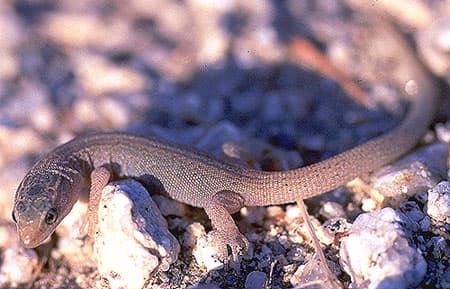
Xantusia vigilis
The desert night lizard (Xantusia vigilis) is a small, secretive reptile found in arid and semi-arid regions of the southwestern United States and northern Mexico. Despite its name, it is diurnal and known for its ability to change color from light olive to dark brown. A distinctive feature of this species is its unusual social behavior, forming family groups that can persist for years.

Trioceros cristatus
The crested chameleon (Trioceros cristatus) is a species native to Central African forests and semi-open wooded areas. Females are typically larger than males, reaching up to 28 cm in total length. This species is currently classified as Least Concern by the IUCN due to its widespread distribution and ability to tolerate disturbed habitats.