
Iberolacerta aranica
The Aran rock lizard (Iberolacerta aranica) is a medium-sized lizard found in a limited area of the central Pyrenees along the Spanish-French border. Its habitat includes temperate grasslands, rocky areas, and pastures. Distinctive features include a grayish back that can be tinted brown or olive, sometimes with a metallic green sheen on males, and dark spotting along the sides.
Key Facts
- ›Found in a small region of the central Pyrenees on the Spanish-French border.
- ›Inhabits temperate grasslands, rocky areas, and pastureland.
- ›Males can reach a total length of up to 62 mm, females up to 67 mm.
- ›Back coloration is typically grayish, sometimes with brown or olive tints and dark spots.
- ›Males may exhibit a glossy metallic green coloration on their backs.
- ›Threatened primarily by habitat loss.

Aran Rock Lizard
Spain, France
- Medium-Sized Lizard.
- Males Reach Up To 62 mm Total Length, Females Up To 67 mm Total Length.
- Back Coloration Is Grayish, Sometimes Tinted Brown Or Olive.
- Back of Some Males Is A Glossy Metallic Green.
- Fine Dark Line May Be Visible In the Middle of the Back.
- Line of Dark Spots Usually Runs Along Both Sides of the Back, Sometimes Extending To the Tail.
- Front Half of the Body Has Two Irregularly Rimmed, Light Longitudinal Bands On the Border Between Back and Flanks.
- Wide, Dark Brown To Black Band Runs Along Each Flank From the Temple To the Proximal Portion of the Tail.
- Underside Is White, Can Be Faintly Bluish Or Greenish Depending On Light.
Habitat Loss
About Iberolacerta aranica
The Aran rock lizard, scientifically known as Iberolacerta aranica, is a medium-sized lizard species belonging to the family Lacertidae. This reptile is endemic to a very specific and limited region within the central Pyrenees mountains, straddling the border between Spain and France. Its natural habitats are characterized by temperate grasslands, rocky terrains, and pasturelands.
Physical Characteristics
Adult Aran rock lizards exhibit a grayish dorsal coloration, which can sometimes be tinged with brown or olive hues. A distinguishing feature, particularly in males, is the potential for a glossy metallic green sheen on their backs. Darker markings are common, with a fine dark line sometimes visible along the middle of the back and a series of dark spots typically running along each side, which may extend onto the tail. The front portion of the body often displays two irregularly edged, light longitudinal bands situated at the junction of the back and flanks. A prominent dark band, ranging from dark brown to black, extends along each flank from the temple area down to the base of the tail. The underside of the lizard is generally white, though its exact appearance can vary to a faint bluish or greenish tone depending on the ambient light.
Size
In terms of size, males of Iberolacerta aranica can reach a maximum total length of approximately 62 mm (2.4 inches), encompassing their body and tail. Females tend to be slightly larger, with a maximum total length of around 67 mm (2.6 inches).
Conservation
The Aran rock lizard faces significant threats, with habitat loss being the primary concern for its population. Its restricted geographic range and specific habitat requirements make it particularly vulnerable to environmental changes and human-induced pressures.
Source: Wikipedia ↗
Frequently Asked Questions
What is the scientific name of the Aran rock lizard?
The scientific name for the Aran rock lizard is Iberolacerta aranica. It is also sometimes referred to by its subspecies name, Lacerta bonnali aranica.
Where is the Aran rock lizard found?
The Aran rock lizard is found in a very restricted area within the central Pyrenees mountains, specifically on the border between Spain and France. Its known range is limited to the Mauberme massif and its foothills.
What are the natural habitats of the Aran rock lizard?
This lizard species prefers temperate grassland environments. It also commonly inhabits rocky areas and pasturelands within its native range.
What are the physical characteristics of the Aran rock lizard?
The Aran rock lizard is a medium-sized reptile. Its back is typically grayish, with variations in brown or olive tones. Dark spots often run along its sides, and males can display a striking glossy metallic green on their backs. Its underside is usually white, sometimes with a bluish or greenish hue.
What is the conservation status of the Aran rock lizard?
The Aran rock lizard is considered to be threatened. The primary threat identified for this species is habitat loss.
What is the size of the Aran rock lizard?
Males of the Aran rock lizard can grow to a total length of up to 62 mm (approximately 2.4 inches), including their tail. Females are slightly larger, reaching up to 67 mm (approximately 2.6 inches) in total length.
Related Lizards

Lacerta schreiberi
The Iberian emerald lizard, scientifically known as Lacerta schreiberi, is a large lizard species endemic to the Iberian Peninsula. Characterized by its impressive size, it inhabits temperate forests, shrublands, and areas near water. Primarily an insectivore, it also preys on smaller reptiles and is known for its oviparous reproduction.
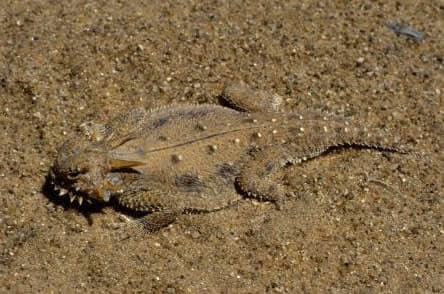
Flat-tail horned lizard
The flat-tail horned lizard is a medium-sized, flat-bodied reptile endemic to the Sonoran Desert of the southwestern United States and northwestern Mexico. It is distinguished by its wide, oval shape, numerous specialized scales, and eight horns extending from the back of its head, with the two central horns being long and sharp. This species has evolved sophisticated camouflage techniques, including a flattened body that minimizes shadow and specialized color-creating cells, to blend with its desert surroundings.

Hemidactylus albofasciatus
The white-striped viper gecko (Hemidactylus albofasciatus) is a slender, ground-dwelling gecko species endemic to India. Primarily found under loose rocks on rock outcrops in the Konkan region of Maharashtra, it is characterized by its patchy distribution and susceptibility to habitat changes. Its survival is notably threatened by the conversion of its lateritic plateau habitat into mango orchards.