
Iberolacerta aurelioi
Aurelio's rock lizard is a small lizard species endemic to the Iberian Peninsula, specifically found in a limited region where Andorra, Spain, and France converge. It inhabits temperate grasslands, rocky terrains, and pasturelands at high altitudes. This oviparous species is characterized by its small size, with a potential snout-to-vent length of up to 6 cm.
Key Facts
- ›Endemic to the Iberian Peninsula.
- ›Inhabits high-altitude temperate grasslands, rocky areas, and pastureland.
- ›Can reach a snout-to-vent length of up to 6 cm.
- ›Reproduces by laying eggs (oviparous).
- ›Threatened primarily by habitat loss.

Aurelio's Rock Lizard
Andorra, Spain, France
Small Species., May Attain A Snout-To-Vent Length of 6 cm .
Habitat Loss
About Iberolacerta aurelioi
Aurelio's Rock Lizard (Iberolacerta aurelioi)
Aurelio's rock lizard, scientifically known as Iberolacerta aurelioi, is a small lizard species belonging to the Lacertidae family. This species is endemic to the Iberian Peninsula, with its natural habitats found in a restricted area near the border confluence of Andorra, Spain, and France. The lizard thrives in high-altitude environments, preferring temperate grasslands, rocky terrains, and pasturelands, typically at elevations between 2,100 and 2,940 meters.
Physical Characteristics and Reproduction
As a small species, Iberolacerta aurelioi may reach a snout-to-vent length of up to 6 centimeters (approximately 2.4 inches). Its reproductive strategy is oviparous, meaning it reproduces by laying eggs. Limited information is available regarding specific details of its physical appearance beyond its size, such as scale coloration or patterns.
Habitat and Conservation
The natural habitats of Aurelio's rock lizard are characterized by their temperate climate and open, rugged landscapes at significant altitudes. Unfortunately, the species faces threats, with habitat loss identified as a primary concern for its population. Further ecological studies and conservation efforts are crucial to understanding and protecting this unique lizard species within its limited geographic range.
Source: Wikipedia ↗
Frequently Asked Questions
Where is Aurelio's rock lizard found?
Aurelio's rock lizard is found in a small area near the confluence of Andorra, Spain, and France. This region is part of the Iberian Peninsula.
What kind of habitat does Iberolacerta aurelioi prefer?
This lizard prefers temperate grassland, rocky areas, and pastureland. It is typically found at high altitudes, ranging from 2,100 to 2,940 meters above sea level.
How large does Aurelio's rock lizard get?
Iberolacerta aurelioi is a small species. It may attain a snout-to-vent length of up to 6 centimeters (approximately 2.4 inches).
How does Aurelio's rock lizard reproduce?
Aurelio's rock lizard is oviparous, meaning it reproduces by laying eggs.
What are the main threats to Iberolacerta aurelioi?
The primary threat to Aurelio's rock lizard is habitat loss. This loss of suitable environment impacts the species' survival.
Related Lizards

Algyroides fitzingeri
Fitzinger's algyroides (Algyroides fitzingeri) is the smallest and most slender member of its genus, native to Corsica and Sardinia. This lizard is distinguished by the sharp demarcation between its side and underside scales and the absence of pale lines above its eyes. It inhabits a variety of temperate and Mediterranean environments, from sea level to high altitudes.

Chalcides simonyi
The Fuerteventura skink (Chalcides simonyi) is an endangered ovoviviparous species of skink found exclusively on the Canary Islands of Fuerteventura and Lanzarote. Characterized by the general skink traits of smaller legs and less pronounced necks, this species inhabits a variety of environments including shrubland, grassland, rocky areas, pastureland, and even urban settings.
Chalcides viridanus
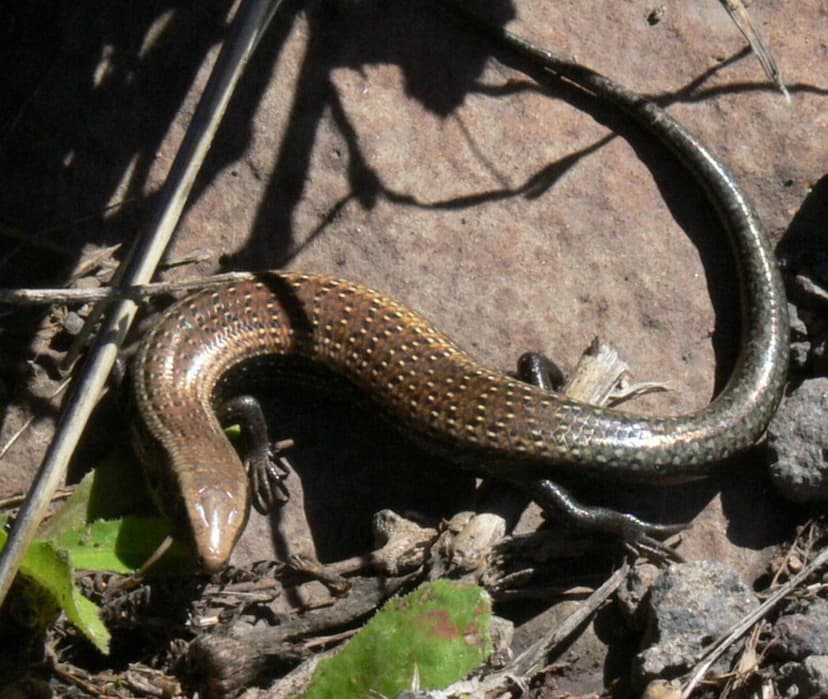
The West Canary skink, scientifically known as Chalcides viridanus, is a species of lizard endemic to the Canary Islands. This skink inhabits a diverse range of environments, from temperate forests and grasslands to urban areas, and can be found at elevations up to 2,000 meters. It is characterized by its cylindrical body and can reach a total length of approximately 18 cm.