
Iguana iguana melanoderma
Iguana iguana melanoderma·Iguanidae
The Saban black iguana (Iguana iguana melanoderma) is a distinct subspecies or species of green iguana, characterized by its darker coloration, black dewlap, and a noticeable black patch between the eye and tympanum. It is primarily found on the islands of Saba and Montserrat, with evidence suggesting a wider distribution across the Caribbean and potentially northern Venezuela. This reptile faces threats from overharvesting for consumption and the pet trade, as well as competition from non-native iguanas.
Key Facts
- ›Characterized by darker coloration, a black dewlap, and a black facial patch.
- ›Believed to be endemic to Saba and Montserrat, with potential distribution in other Caribbean areas and northern Venezuela.
- ›Genomic distinctions and morphological traits differentiate it from other green iguana subspecies.
- ›Threatened by unsustainable harvesting for food and the pet trade.
- ›Faces competition and hybridization from non-native iguana introductions.
- ›Population on Saba estimated at approximately 6,000 individuals.
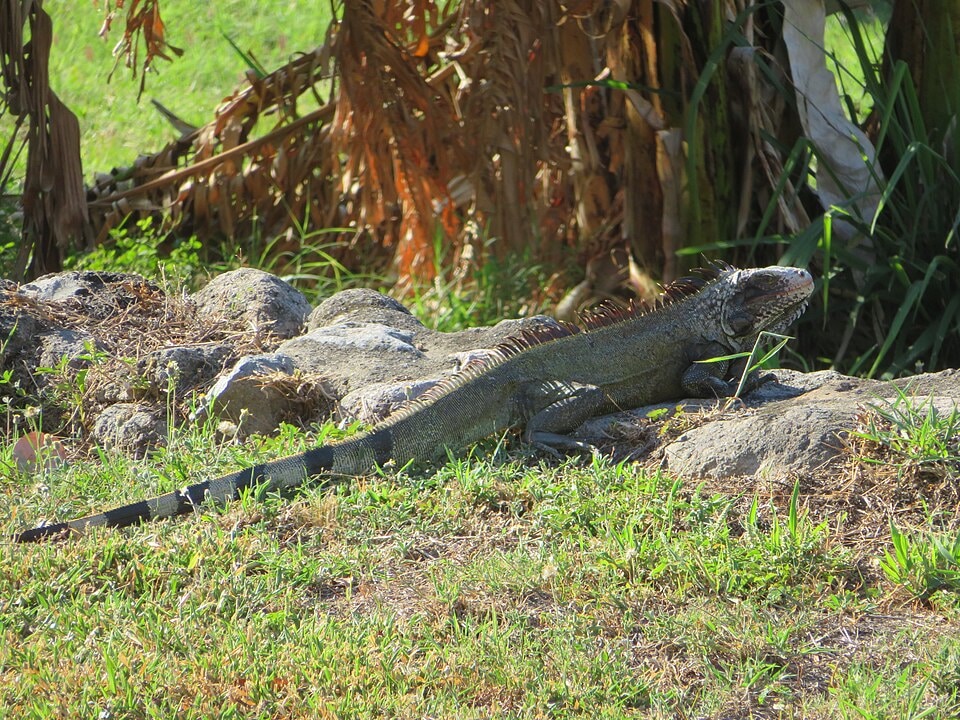
Saban Black Iguana
Saba, Montserrat, Virgin Islands, Vieques, Northern Venezuela
- Darker Coloration Than Other Green Iguana Subspecies, Intensifying With Age.
- Black Dewlap.
- High Dorsal Spikes.
- No Horns On the Snout.
- Noticeable Black Patch Between the Eye and Tympanum.
- A Small Percentage of Adults Become Completely Melanistic; Many Are Partially Melanistic.
Unsustainable Harvest For Consumption, Pet Trade, Competition With Non-Native Iguanas, Hybridization With Non-Native Iguanas
About Iguana iguana melanoderma
The Saban Black Iguana (Iguana iguana melanoderma)
The Saban black iguana, scientifically known as Iguana iguana melanoderma, is a distinct subspecies or sometimes considered a separate species within the green iguana lineage. It is recognized for its darker coloration compared to its relatives, a characteristic that deepens with age. Key physical identifiers include a black dewlap, prominent dorsal spikes, the absence of horns on its snout, and a distinctive black patch situated between its eye and the tympanum.
Taxonomy and Distribution
While initially thought to be endemic to the islands of Saba and Montserrat, genetic and morphological evidence suggests a broader distribution. Populations have been identified on the Virgin Islands and Vieques, as well as in northern Venezuela, including coastal islets and the mainland near Cumaná. Recent genetic studies indicate that melanistic iguanas from Puerto Rico and the Virgin Islands are genetically very similar to those found on Saba and Montserrat. The proposed origin is coastal Venezuela, with dispersal events potentially facilitated by natural processes or human transport, leading to its unusual disjunct geographic range.
Conservation Concerns
The Saban black iguana faces significant threats. Unsustainable harvesting for consumption and the lucrative pet trade are major pressures on its populations. Furthermore, the introduction of non-native iguanas to its habitat, such as on Saba, leads to detrimental competition and hybridization, jeopardizing the genetic integrity of the subspecies. Illegal export and trade, often using fraudulent permits, further exacerbate these conservation challenges.
Future Prospects
Conservation efforts are ongoing, including the removal of invasive iguanas from islands like Saba. There are also plans to reintroduce the Saban black iguana to Redonda, an island from which it may have been extirpated, in an attempt to restore its historical range. The population on Saba alone is estimated to be around 6,000 individuals, highlighting the need for continued monitoring and protective measures.
Source: Wikipedia ↗
Frequently Asked Questions
What are the distinctive physical characteristics of the Saban black iguana?
The Saban black iguana is notably darker than other green iguana subspecies, with its coloration intensifying as it ages. It features a black dewlap, prominent dorsal spikes, lacks horns on its snout, and has a distinct black patch located between its eye and the tympanum.
What is the geographic distribution of Iguana iguana melanoderma?
While initially thought to be endemic to Saba and Montserrat, evidence suggests a wider distribution. Populations have been identified on the Virgin Islands and Vieques, and in northern Venezuela, including coastal areas near Cumaná. Recent genetic data confirms near-identical melanistic iguanas in Puerto Rico and the Virgin Islands share mitochondrial haplotypes with those from Saba and Montserrat.
What are the primary threats to the Saban black iguana population?
The subspecies is threatened by unsustainable harvesting for consumption and the pet trade. Additionally, competition with and hybridization from escaped or released non-native iguanas pose a significant risk, as seen with the introduction of non-native iguanas to Saba.
How is the Saban black iguana classified taxonomically?
It was described as a distinct species in 2020, but is classified by some databases as a subspecies of the common green iguana (Iguana iguana). Genetic evidence supports its distinctiveness, identifying it as a sister group to South American green iguana populations.
Are there any conservation efforts for the Saban black iguana?
Efforts are underway to remove non-native iguanas from Saba, which pose a threat to the native subspecies. There are also plans to reintroduce the Saban black iguana to Redonda, an island where it may have historically occurred before being extirpated.
Is the Saban black iguana a common pet?
Despite concerns about illegal export and trade using fraudulent permits, Saban black iguanas are offered as pets in various countries globally. This trade contributes to the threats faced by the subspecies.
Related Lizards

Anolis lividus
Anolis lividus, also known as the Plymouth anole or Montserrat anole, is a species of lizard found exclusively on the Caribbean island of Montserrat. This anole is characterized by significant variation in appearance between individuals and sexes, with males exhibiting vibrant green or yellow-green coloration, sometimes with speckling or rust-red tints, and females displaying duller brown tones with distinctive stripes.

Chalarodon madagascariensis
Chalarodon madagascariensis is a terrestrial lizard species native to Madagascar, primarily found in coastal, semi-arid to arid regions with sandy soil. It is an insectivore that occasionally consumes plant matter. A key distinguishing feature is its keeled gular and ventral scales.

Hemiergis peronii
The four-toed earless skink (Hemiergis peronii) is a viviparous reptile endemic to southern Australia. It is characterized by its earless appearance and typically measures around 8 cm in snout-vent length. This species inhabits coastal and subcoastal regions across Western Australia, South Australia, and western Victoria.