
Indian fringe-fingered lizard
The Indian fringe-fingered lizard (Acanthodactylus cantoris) is a species of lizard in the Lacertidae family, endemic to Asia. Characterized by its acutely pointed snout, keeled scales, and prominently fringed toes, this terrestrial lizard inhabits sandy desert and shrubland areas. It is known to burrow in the sand for protection and reproduces by laying eggs.
Key Facts
- ›Endemic to Asia, with populations found in eastern Afghanistan, northwestern India, southwestern Iran, Jordan, and Pakistan.
- ›Distinguished by its acutely pointed snout, keeled scales, and digital denticulations, especially on the outer edge of the fourth toe.
- ›Prefers sandy areas within desert and shrubland habitats.
- ›A terrestrial species that burrows in the sand at the roots of bushes for shelter.
- ›Reproduction is oviparous, with clutches typically containing two to four eggs.
- ›Young lizards often have a pink tail and distinct whitish longitudinal lines.
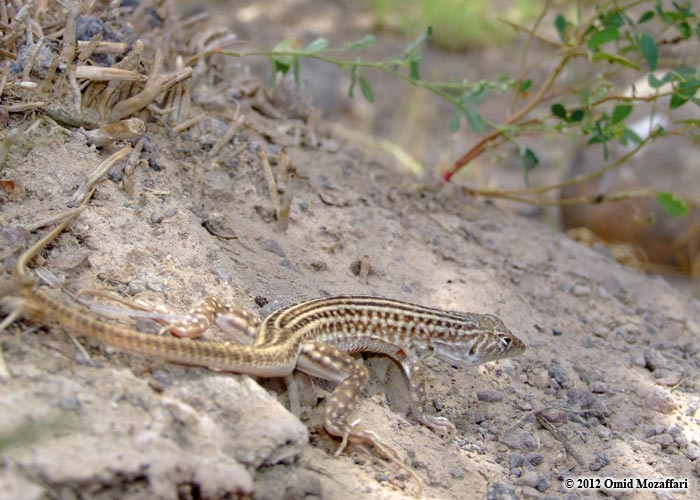
Indian Fringe-Toed Lizard
Afghanistan, India, Iran, Jordan, Pakistan
- Snout Acutely Pointed.
- Four Supraoculars; Subocular Not Reaching the Lip.
- Temporal Scales Keeled; Front Edge of the Ear Usually Feebly, But Distinctly, Denticulated.
- Dorsal Scales Strongly Keeled, Much Larger On the Hinder Part of the Back Than Between the Shoulders and On the Flanks, Rhomboidal, Strongly Imbricate.
- 10 To 16 Large Keeled Scales On A Transverse Line Between the Hind Limbs.
- Ventral Plates Usually Broader Than Long, In Straight Longitudinal and Slightly Angular Transverse Series; 12 Or 14 Plates Across the Middle of the Body.
- Usually A Median Series of Broad Pre-Anals, the Posterior Largest.
- Hind Limb Reaches the Ear Or the Eye.
- 17 To 23 Femoral Pores On Each Side.
- Digital Denticulations Strong, Usually As Long As the Diameter of the Corresponding Part of the Toe, Much More Developed On the Outer Than On the Inner Edge of the Fourth Toe.
- Upper Caudal Scales Strongly Keeled; Basal Subcaudals Smooth Or Obtusely Keeled.
- Coloration Is Grayish Or Buff Above, With Or Without Small Blackish Spots.
- Young Specimens Have Whitish Longitudinal Lines Separated By Blackish Interspaces With Series of Round Whitish Spots, Which Markings Gradually Become More Indistinct.
- Tail Is Pink In the Young.
- Snout To Vent Length Up To 7.0 cm ; Tail Length Up To 15 cm .
Insects, Other Small Invertebrates
- Terrestrial
- Burrows In the Sand At the Roots of Bushes For Protection
About Indian fringe-fingered lizard
The Indian Fringe-fingered Lizard
The Indian fringe-fingered lizard, scientifically known as Acanthodactylus cantoris and also commonly referred to as the Indian fringe-toed lizard, is a species belonging to the Lacertidae family. This reptile is endemic to Asia, with its natural range encompassing parts of eastern Afghanistan, northwestern India, southwestern Iran, Jordan, and Pakistan.
Description and Habitat
This lizard is characterized by an acutely pointed snout and strongly keeled scales, with notable digital denticulations that are particularly developed on the outer edge of the fourth toe, giving it its distinctive 'fringe-fingered' appearance. Its coloration is typically grayish or buff, often adorned with small blackish spots. Young individuals may exhibit whitish longitudinal lines and a pink tail. The Indian fringe-fingered lizard prefers sandy environments found within desert and shrubland ecosystems. It is a terrestrial species that actively burrows into the sand, often at the roots of bushes, to seek protection and shelter.
Behavior and Reproduction
As a ground-dwelling lizard, its behavior is centered around its sandy habitat. The Indian fringe-fingered lizard is oviparous, meaning it reproduces by laying eggs. A single clutch usually contains two to four eggs, which are known to hatch within approximately three weeks of being laid. The specific name, cantoris, honors the Danish zoologist Theodore Edward Cantor.
Source: Wikipedia ↗
Frequently Asked Questions
What is the scientific name for the Indian fringe-fingered lizard?
The scientific name for the Indian fringe-fingered lizard is Acanthodactylus cantoris. This binomial nomenclature is used to classify the species within the scientific community.
Where is the Indian fringe-fingered lizard found?
The Indian fringe-fingered lizard is found across a range in Asia, including eastern Afghanistan, northwestern India (Gujarat, Punjab, Rajasthan, Uttar Pradesh), southwestern Iran, Jordan, and Pakistan. Its type locality is recorded as 'Ramnuggar'.
What kind of habitat does this lizard prefer?
This species prefers sandy areas within desert and shrubland environments. These habitats provide the necessary conditions for its survival and behavior.
How does the Indian fringe-fingered lizard protect itself?
As a terrestrial species, the Indian fringe-fingered lizard burrows in the sand at the roots of bushes. This burrowing behavior serves as its primary method of protection from predators and environmental conditions.
How does the Indian fringe-fingered lizard reproduce?
The Indian fringe-fingered lizard is oviparous, meaning it reproduces by laying eggs. A clutch typically consists of two to four eggs, which hatch within approximately three weeks of being laid.
What are the physical characteristics of the Indian fringe-fingered lizard?
It has an acutely pointed snout, keeled temporal scales, and strongly keeled dorsal scales. Its toes feature strong digital denticulations, particularly on the outer edge of the fourth toe, giving it a 'fringe-fingered' appearance. Coloration is generally grayish or buff, sometimes with small blackish spots, and young may have a pink tail.
Related Lizards
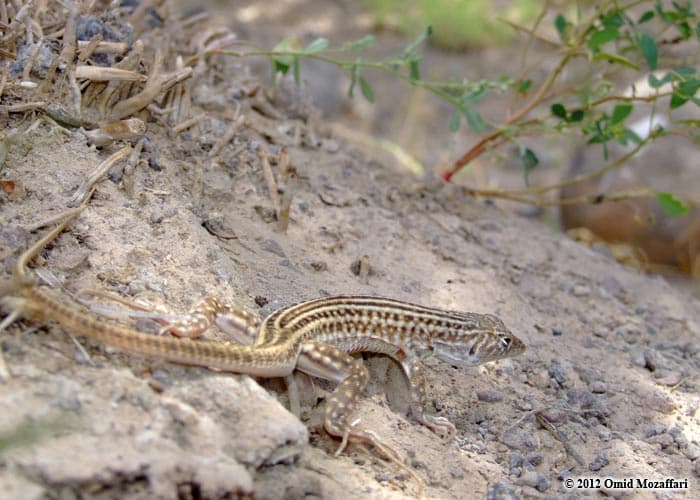
Acanthodactylus cantoris
The Indian fringe-fingered lizard (Acanthodactylus cantoris) is a terrestrial species endemic to Asia, primarily found in sandy desert and shrubland habitats. It is characterized by its acutely pointed snout, keeled dorsal scales, and strong digital denticulations. This oviparous lizard burrows in the sand for protection and its young have distinctive white longitudinal lines on a blackish background.
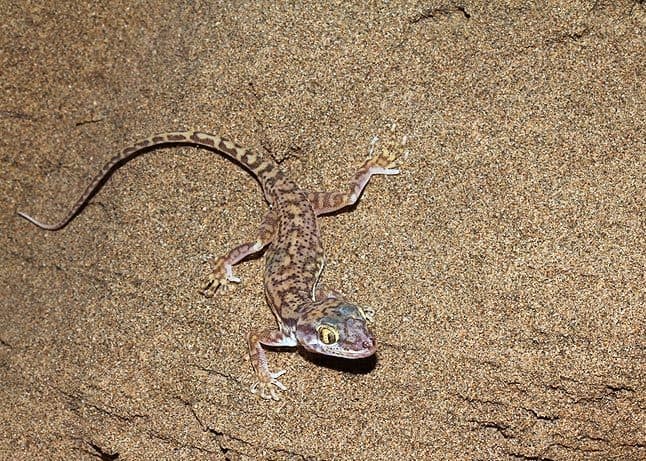
Crossobamon eversmanni
Crossobamon eversmanni, commonly known as the comb-toed gecko, is a species of Asian gecko found in desert, grassland, and shrubland habitats across Iran, Pakistan, and Central Asia. This terrestrial and nocturnal lizard is characterized by its burrowing behavior and oviparous reproduction, with females laying one to two eggs per clutch.

Ctenophorus fordi
The Mallee dragon (Ctenophorus fordi) is a small lizard native to the arid regions of southern Australia, characterized by its reddish-orange coloration and pale, black-bordered stripes. It inhabits shrubland and hummock grass environments, particularly in Mallee woodlands and spinifex areas, often near vegetated sand dunes. This species is primarily an ant specialist, employing a sit-and-wait strategy to ambush its prey.