
Indian garden lizard
The Indian garden lizard, scientifically known as Calotes versicolor, is a widely distributed agamid lizard found across Indo-Malaya and introduced in various other regions. It is characterized by its changeable coloration, with males developing bright red throats during the breeding season, and a dorsal crest that varies with age. These lizards are primarily insectivores but also consume small vertebrates and occasionally plant matter, adapting well to diverse habitats from rural undergrowth to urban environments.
Key Facts
- ›Also known as the oriental garden lizard, changeable lizard, or bloodsucker.
- ›Males display bright red throats and heads during the breeding season.
- ›Possesses a changeable coloration that can range from brownish-olive to bright red and black.
- ›Primarily an insectivore, but also consumes small vertebrates and plant matter.
- ›Escapes predators by swiftly darting up trees.
- ›Lays 10-20 leathery-shelled eggs in moist soil or tree hollows.
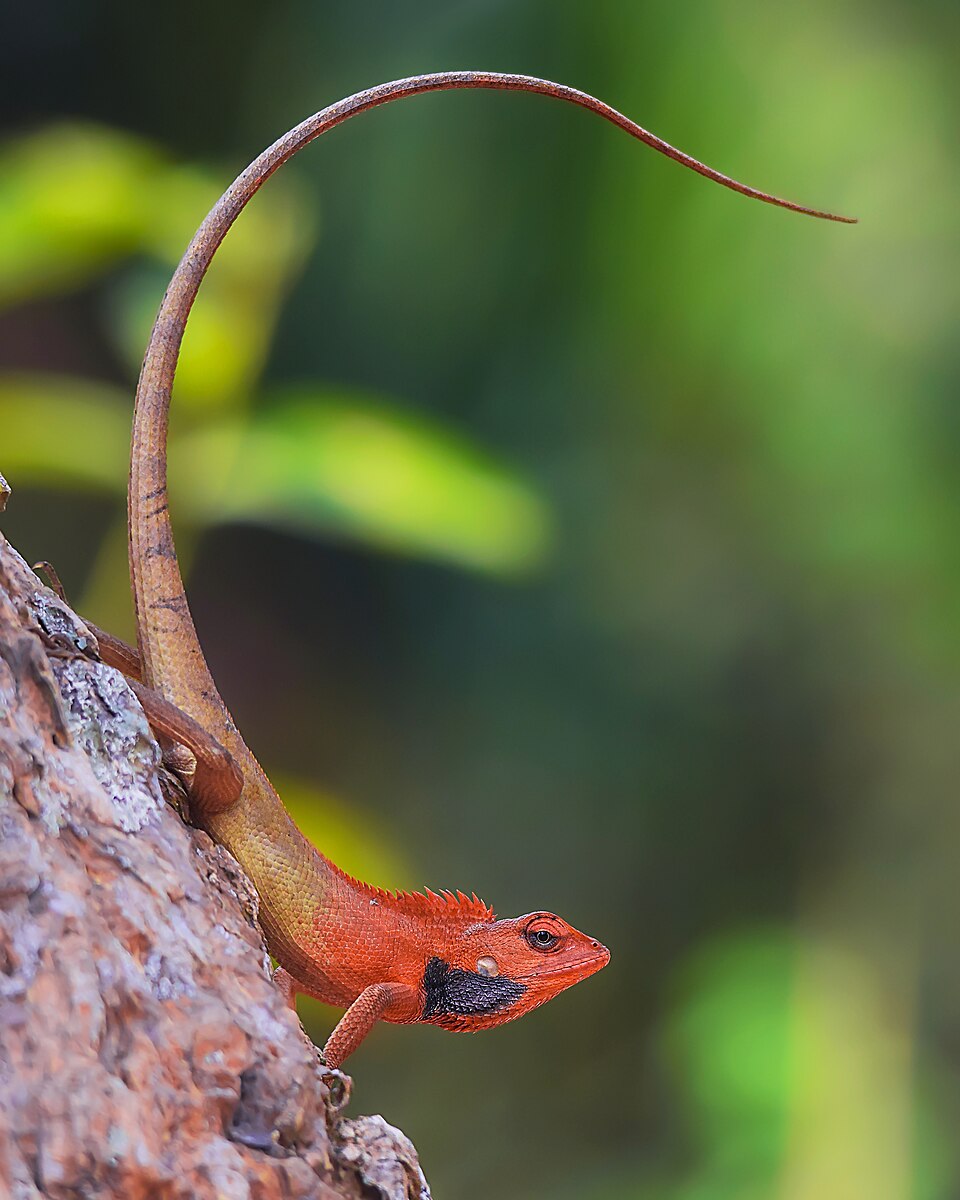
Oriental Garden Lizard, Eastern Garden Lizard, Common Garden Lizard, Bloodsucker, Changeable Lizard, Crested Tree Lizard, Roktochosha
Afghanistan, Bangladesh, Bhutan, Cambodia, China, India, Indonesia, Iran, Malaysia, Maldives, Mauritius, Myanmar, Nepal, Pakistan, Philippines, Sri Lanka, Thailand, Vietnam, United States, Singapore
- Measures Over 10 cm Snout-To-Vent; Total Length Up To 37 cm.
- Possesses Two Small Groups of Spines Above Each Tympanum.
- Dorsal Crest Is Moderately Elevated On the Neck and Anterior Trunk, Disappearing On the Middle Trunk In Younger Individuals.
- Scales Behind the Lower Jaw Are Smaller Than Others; Gular Sac Not Developed.
- Hind Foot Is Not Much Longer Than the Head In Adults, But Considerably Longer In Young.
- Coloration Is Highly Variable, Ranging From Uniform Brownish, Greyish-Olive, Or Yellowish.
- Generally Has Broad Brown Bands Across the Back, Interrupted By A Yellowish Lateral Band.
- Black Streaks Radiate From the Eye and May Extend Onto the Throat.
- Belly Frequently Has Greyish Longitudinal Stripes.
- Young Specimens Have A Dark, Black-Edged Band Across the Inter-Orbital Region.
- Can Change Coloration To Bright Red, Black, Or A Mixture of Both, Sometimes Confined To the Head, Other Times Diffused Over the Body.
- Males Develop Bright Red Throats and Heads, and Black Throats During the Breeding Season.
- Both Sexes Have A Crest From the Head To Nearly the Tail.
- Tails Are Long, Stiff, and Pointy, and Do Not Exhibit Autotomy .
Insects, Small Vertebrates, Plant Matter
- Males Are Highly Territorial During the Breeding Season.
- Males Display By Brightening Red Heads and Performing 'Push-Ups' To Discourage Rivals.
- Males Attract Females By Inflating Their Throat and Drawing Attention To Their Head Color.
- Escape Danger By Darting To the Nearest Tree.
- When Cornered, They Scale To the Side of the Tree Away From the Predator and Swiftly Move Up.
- Basking In the Sun With Mouth Open After Rain Showers.
- Descend To the Ground After Rain To Feed On Larvae and Small Insects.
- Shed Their Skins Like Other Reptiles.
- Can Move Each Eye Independently In Different Directions.
Viewed As Pests and Killed By People In China
About Indian garden lizard
The Indian Garden Lizard (Calotes versicolor)
The Indian garden lizard, scientifically classified as Calotes versicolor, is a common and widely distributed agamid lizard native to the Indo-Malayan region. It is also recognized by several other common names, including the oriental garden lizard, changeable lizard, and bloodsucker. This species has successfully adapted to a variety of environments, from rural undergrowth and trees to highly urbanized areas, and has been introduced to numerous other parts of the world.
Description and Characteristics
Calotes versicolor is a visually striking lizard known for its remarkable ability to change its coloration. While typically a brownish or greyish-olive, it can shift to bright red, black, or a combination of these colors. This chromatic display is particularly pronounced in males during the breeding season, from May to early October, when their heads and throats can become a vivid crimson, and their throats turn black. They possess a dorsal crest that extends from the head to nearly the tail, which is long, stiff, and pointy; unlike some lizards, they do not practice tail autotomy. Adult males typically measure over 10 cm in snout-to-vent length, with a total length reaching up to 37 cm. They have the unique ability to move each eye independently, similar to chameleons.
Diet and Behavior
As an insectivore, the Indian garden lizard primarily feeds on a variety of insects such as ants, beetles, dragonflies, and grasshoppers. Their diet also extends to small vertebrates, including rodents and other lizards. Occasionally, they supplement their diet with plant matter. Their teeth are adapted for gripping prey, which they often stun by shaking before swallowing whole. When facing danger, these lizards exhibit a swift escape mechanism, darting for the nearest tree. If pursued closely, they will scale to the side of the tree facing away from the predator and rapidly ascend, often eluding their pursuer. During the breeding season, males become territorial, defending their areas and displaying their bright head colors and performing 'push-ups' to ward off rivals and attract females.
Reproduction and Distribution
The Indian garden lizard is oviparous, meaning it reproduces by laying eggs. Females lay between 5 and 16 leathery-shelled, oval eggs, typically burying them in moist soil or in holes they have burrowed in trees. The young hatch in approximately 6 to 7 weeks and are capable of breeding around one year of age. The native range of Calotes versicolor spans across countries like India, Sri Lanka, Thailand, and Vietnam, extending into parts of Iran and Afghanistan. It has also been introduced to regions such as Singapore and the United States. Despite their adaptability, in some areas like China, they are sometimes viewed as pests and killed by humans.
Source: Wikipedia ↗
Frequently Asked Questions
What is the scientific name of the Indian garden lizard?
The scientific name of the Indian garden lizard is Calotes versicolor. It is also known by other common names such as the oriental garden lizard, changeable lizard, and bloodsucker.
What does the Indian garden lizard eat?
The Indian garden lizard is primarily an insectivore, feeding on insects like ants, beetles, dragonflies, and grasshoppers. They also consume small vertebrates, including rodents and other lizards, and occasionally ingest plant matter.
How does the Indian garden lizard escape predators?
When threatened, the Indian garden lizard will dart to the nearest tree. If the predator persists, it scales to the side of the tree facing away from the threat and quickly ascends, often leading the predator to look behind the tree in search of it.
What are the notable physical characteristics of the Indian garden lizard?
Indian garden lizards measure over 10 cm snout-to-vent, with a total length up to 37 cm. They possess a dorsal crest, and males develop bright red throats and heads during the breeding season. Their coloration is highly variable and can change from shades of brown and olive to red and black.
Where is the Indian garden lizard found?
The native range of the Indian garden lizard includes southeastern Iran, Afghanistan, Bangladesh, Bhutan, Cambodia, India, Indonesia, Malaysia, Maldives, Mauritius, Myanmar, Nepal, Pakistan, Philippines, Sri Lanka, Thailand, and Vietnam. It has also been introduced to Brunei, Celebes, Oman, Seychelles, Singapore, and the United States.
How do male Indian garden lizards attract females?
During the breeding season, male Indian garden lizards become territorial. They attract females by inflating their throats and displaying their brightly colored heads, often described as handsome. They also discourage rival males by brightening their red heads and performing 'push-ups'.
What is the breeding season for the Indian garden lizard?
The breeding season for the Indian garden lizard typically falls between May and early October. During this period, males exhibit their most vibrant colors and territorial behaviors.
Related Lizards
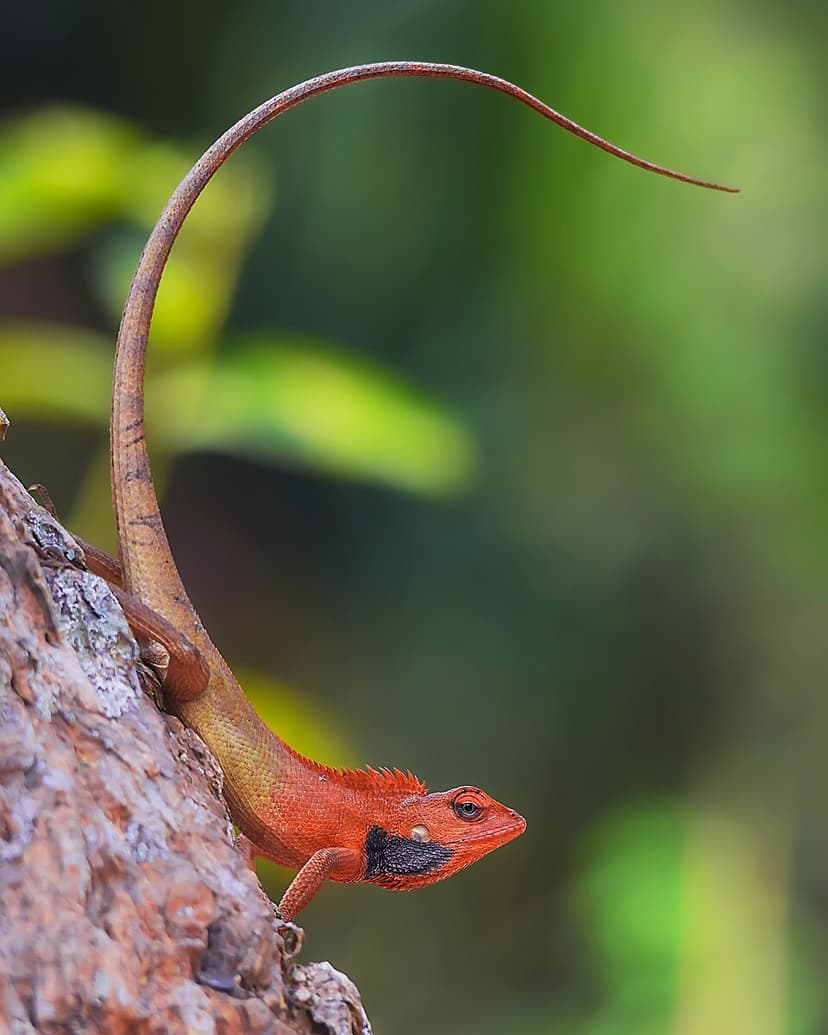
Calotes versicolor
The Oriental garden lizard, scientifically known as Calotes versicolor, is a widely distributed agamid lizard recognized for its striking color-changing abilities, particularly in males during the breeding season. Primarily an insectivore, it inhabits a variety of environments across Indo-Malaya and has been introduced to other regions. Its distinctive features include a dorsal crest, a bright red throat in breeding males, and the ability to move its eyes independently.

Anolis extremus
The Barbados anole (Anolis extremus) is a medium-to-large, tree-dwelling lizard native to Barbados, though it has been introduced to other Caribbean islands and locations. Males are typically mossy green with dark markings and a yellow or orange throat flap, while females are smaller and less intensely colored, sometimes with dorsal stripes. This omnivorous species is an ambush predator, feeding on invertebrates and fruit.

Black-lipped forest lizard (Calotes nigrilabris)
The Black-lipped forest lizard (Calotes nigrilabris), also known as the black-cheek lizard, is an agamid species found only in Sri Lanka. It is easily distinguished from similar species by a black bar on its mouth, unlike the white or orange bars seen in others. This largely arboreal lizard inhabits tree trunks, hedges, and shrubs in submontane and montane regions, where it actively hunts insects and worms during the day.