
Khasi Hills forest lizard (Calotes maria)
The Khasi Hills forest lizard (Calotes maria), also known as the Assam garden lizard, is a species of agamid lizard found in South Asia. It is characterized by a compressed body, a slender tail, and moderately developed crests, with males displaying brilliant red coloration on their heads during the breeding season. This arboreal and diurnal lizard primarily inhabits forests near streams.
Key Facts
- ›Native to Northeast India, Bhutan, and northeastern Bangladesh.
- ›Males develop bright red heads during the breeding season.
- ›Arboreal and diurnal, meaning it lives in trees and is active during the day.
- ›Primarily insectivorous, feeding on insects.
- ›Oviparous, reproducing by laying eggs.
- ›Assessed as of least concern by conservation status, with no major threats identified.
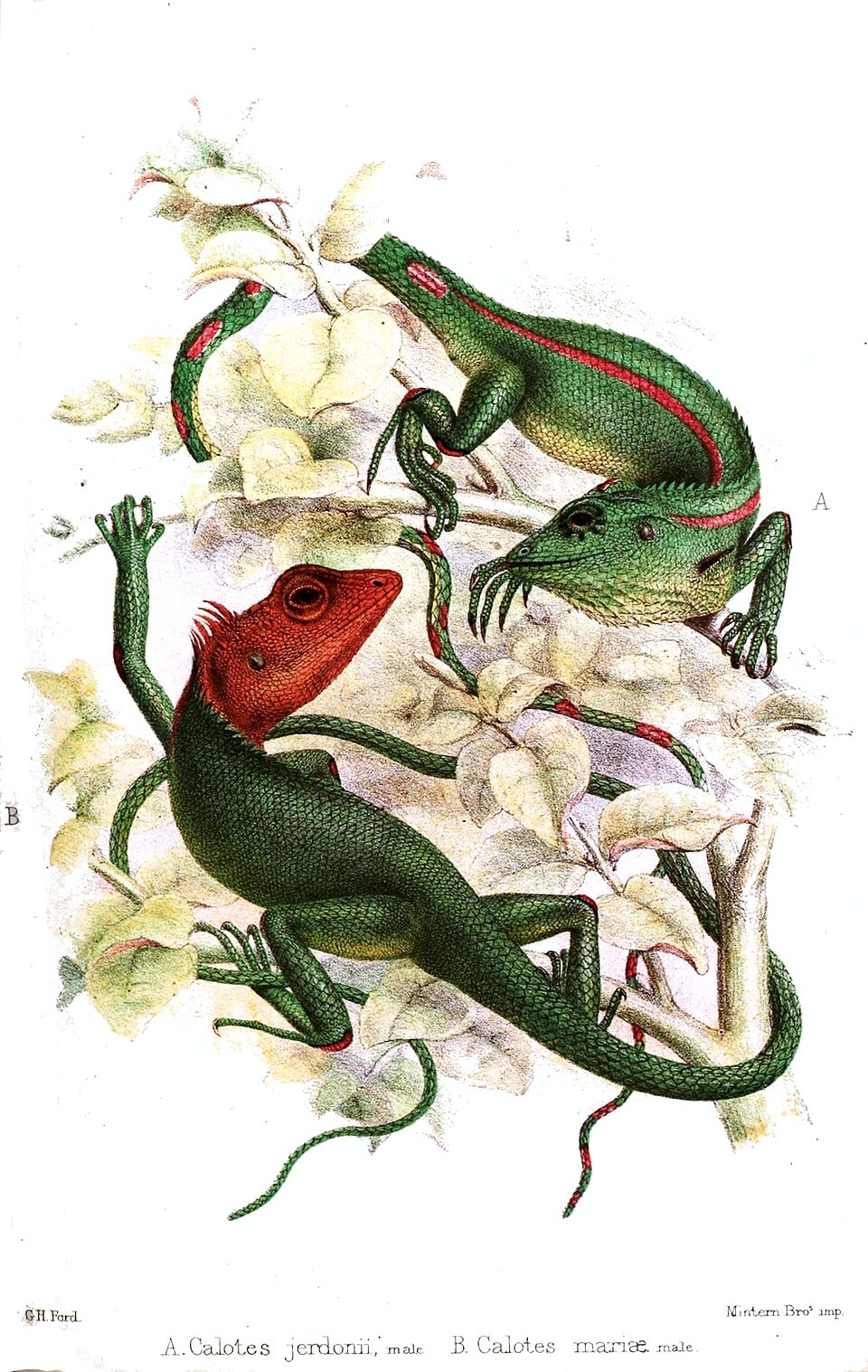
Khasi Hills Forest Lizard, Assam Garden Lizard
Northeast India, Bhutan, Northeastern Bangladesh
- Body Is Compressed.
- Tail Is Almost Round, Slender, and Feebly Compressed.
- Scales On the Tail Are Keeled.
- Head Is Large.
- Both Males and Females Have Moderately Developed Nuchal and Dorsal Crests.
- Dorsal Coloration Is Green With Red Streaks and Spots.
- Males Develop A Brilliant Red Color On Their Head During the Breeding Season.
Insects
- Arboreal
- Diurnal
- Polygynandrous and Promiscuous Mating Behavior
About Khasi Hills forest lizard (Calotes maria)
The Khasi Hills forest lizard, scientifically known as Calotes maria and also commonly called the Assam garden lizard, is a species of agamid lizard native to the diverse landscapes of South Asia. Its range encompasses Northeast India, specifically the Khasi Hills region spanning Assam, Meghalaya, and Mizoram, as well as extending into Bhutan and northeastern Bangladesh.
Physical Characteristics and Behavior
This lizard possesses a distinct physical form, with a compressed body and a tail that is nearly round and slender, adorned with keeled scales. Both male and female Khasi Hills forest lizards feature moderately developed crests on their nuchal (neck) and dorsal (back) regions. The typical coloration of the species is green, marked with streaks and spots of red. A striking feature is observed in males, who develop a brilliant red hue on their heads during the breeding season, likely playing a role in courtship displays.
Calotes maria is characterized by its arboreal lifestyle, meaning it primarily resides in trees, and its diurnal activity pattern, being most active during daylight hours. This behavior is also reflected in its foraging habits, as it actively seeks out its food during the day.
Habitat and Diet
The preferred habitat for the Khasi Hills forest lizard consists of forests, often situated in close proximity to streams. They are found at elevations ranging from approximately 400 to 4,921 feet above sea level. As an insectivore, the lizard's diet is predominantly composed of insects, forming a crucial part of its ecological role within its forest environment.
Reproduction and Conservation
Reproductively, Calotes maria is oviparous, laying eggs as its method of reproduction. The species exhibits a mating system described as polygynandrous and promiscuous, where both males and females engage in mating with multiple partners. This reproductive strategy is common among many lizard species.
Despite its relatively limited geographic distribution, the Khasi Hills forest lizard has been assessed as a species of 'least concern' by conservation authorities. This designation indicates that it is not currently facing significant threats to its population. Its presence in well-protected areas, such as the Royal Manas National Park in Bhutan and the adjacent Manas National Park in Assam, along with the Lengteng Wildlife Sanctuary in Mizoram, contributes to its stable conservation status.
Source: Wikipedia ↗
Frequently Asked Questions
What are the common names for Calotes maria?
Calotes maria is commonly known as the Khasi Hills forest lizard. It is also referred to as the Assam garden lizard in English. In Bengali, proposed names include 'Khasia girigiti'.
Where is the Khasi Hills forest lizard found?
This lizard species is native to South Asia, specifically found in Northeast India, including the Khasi Hills region of Assam, Meghalaya, and Mizoram. It is also reported from Bhutan and northeastern Bangladesh.
What does the Khasi Hills forest lizard look like?
It has a compressed body and an almost round, slender tail covered with keeled scales. Both sexes possess moderately developed nuchal and dorsal crests. The dorsal coloration is green with red streaks and spots, and males exhibit a brilliant red head during the breeding season.
What is the diet of Calotes maria?
The Khasi Hills forest lizard is mainly insectivorous, meaning its diet consists primarily of insects. It forages for food during daylight hours.
How does the Khasi Hills forest lizard reproduce?
Calotes maria is oviparous, which means it reproduces by laying eggs. Like many lizards, it is also polygynandrous and promiscuous, with both males and females mating with multiple partners.
What is the conservation status of the Khasi Hills forest lizard?
Despite having a relatively small geographic range, the Khasi Hills forest lizard is assessed as 'least concern.' It is not facing any major threats and is found in well-protected areas.
What kind of habitat does Calotes maria prefer?
This species typically occurs in forests, often in proximity to streams. They are found at elevations ranging from 400 to 4,921 feet above sea level.
Related Lizards
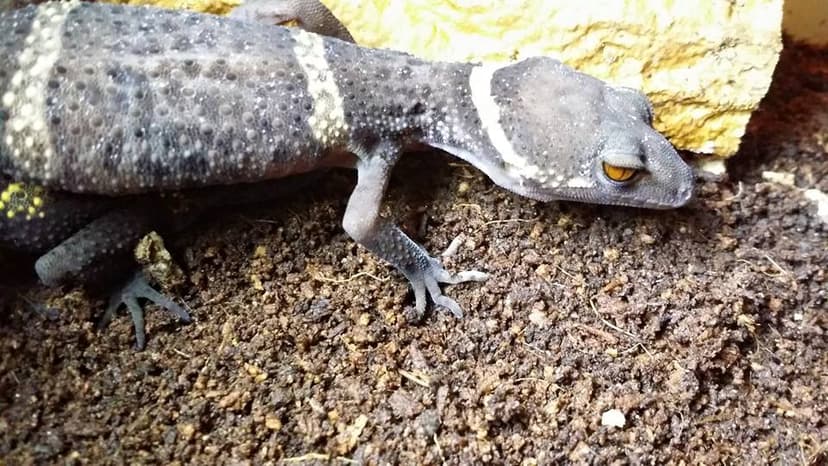
Lichtenfelder's gecko
Lichtenfelder's gecko is a species of lizard native to southeastern Asia, primarily found in southern China and Vietnam. It is characterized by its striking coloration, featuring a purple body with thick yellow and black crossbands, and a body shape similar to that of the leopard gecko. This species prefers to inhabit forests near streams at moderate altitudes.

Hokou gecko
The Hokou gecko (Gekko hokouensis) is a small, nocturnal, and insectivorous gecko found across parts of East Asia and introduced to several islands. It is characterized by shades of brown, grey, or tan with distinct darker cross-bands on its back and tail, and a unique scale near the base of its tail. This species plays a role in its ecosystem, primarily by consuming insects, and its reproductive cycle largely occurs during the summer months.

Ctenotus robustus
The Ctenotus robustus, commonly known as the eastern striped skink, is a large, fast-moving skink native to Australia. It is characterized by a distinctive white-edged black stripe running down its back and tail, set against a brown background with broader brown stripes and rows of white spots on its sides. This diurnal reptile prefers open habitats with available shelter and is widely distributed across various Australian states.