
Knight anole
Anolis equestris·Dactyloidae·Not specified in text
The Knight anole is the largest anole species, native to Cuba and introduced to Florida. Known for its arboreal nature, it inhabits forests, savannas, and gardens, often found high in trees. This territorial lizard is primarily green with yellow stripes and is known for its impressive challenge display.
Key Facts
- ›The largest species of anole, reaching up to 51 cm in total length.
- ›Native to Cuba, it has become an invasive species in South Florida.
- ›Primarily arboreal, it spends most of its time high in trees.
- ›It is diurnal and fiercely territorial, displaying a notable challenge posture.
- ›Juveniles feed on insects, while adults consume invertebrates, fruits, and occasionally small vertebrates.

Cuban Knight Anole, Cuban Giant Anole, Chipojo, Chupacocote
Cuba, Florida
Forest, Mangrove, Savanna, Cultivated Areas, Gardens, Urban Trees
- Adults Are About 13–20 in In Total Length.
- Tail Is Longer Than the Head-and-Body.
- Weigh 0.56–4.83 oz .
- Males Are Larger Than Females.
- Male Snout-Vent Length: 3.9–7.5 in .
- Female Snout-Vent Length: 3.5–6.3 in .
- Mostly Bright Green Coloration.
- Yellow Stripe On the Side of the Head and Shoulder.
- Able To Perform Some Color Changes.
- Pinkish-White Dewlap.
- Juveniles Have Light Bands On the Body.
Insects, Invertebrates, Snails, Fruits, Small Vertebrate Prey
- Diurnal
- Fiercely Territorial
- Challenge Display Involves Facing Threats, Gaping Menacingly, Turning Green, Head Bobbing, Extending Dewlap , and Puffing Up.
- Solitary .
About Knight anole
The Knight anole, scientifically known as Anolis equestris, is distinguished as the largest species within the anole family. Native to Cuba, where it is locally referred to as 'chipojo' or 'chupacocote', this lizard has also been introduced to and established in South Florida, where it is considered an invasive species. It thrives in a variety of arboreal environments, including forests, savannas, cultivated areas, and gardens, typically found high on tree trunks and branches.
Physical Characteristics and Behavior
Adult Knight anoles are impressive in size, measuring between 33 to 51 cm (13 to 20 inches) in total length, with their tails often exceeding their body length. Their primary coloration is a vibrant green, often accented by yellow stripes along the sides of the head and shoulders. While capable of some color change, they possess a distinctive pinkish-white dewlap. Males generally grow larger than females. These lizards are diurnal and highly territorial. When faced with a threat, they exhibit a striking challenge display that includes facing the perceived danger, gaping with their mouths, turning green, and potentially bobbing their heads. Males will extend their dewlap as part of this display.
Diet and Habitat
Young Knight anoles predominantly feed on insects. As they mature, their diet broadens to include invertebrates like insects and snails, and they also regularly consume fruits, playing a role in seed dispersal. While they may occasionally prey on small vertebrates such as other anoles or small birds, this behavior is noted as less frequent compared to some other anole species. They are well-adapted to life in trees but will descend to the ground to move between trees or for thermoregulation, sometimes being observed on warm surfaces like asphalt or sidewalks.
Introduction and Captivity
In Cuba, Knight anoles can be found from near sea level up to altitudes of 1,000 meters. Their introduction to Florida has led to successful reproduction and spread, though they are susceptible to cold temperatures, sometimes falling from trees during winter freezes. In captivity, the Knight anole's inherent territoriality and aggressiveness can diminish, especially if individuals are raised from birth and handled regularly, often becoming quite tame. However, their strong bite and sharp teeth necessitate caution when handling.
Source: Wikipedia ↗
Frequently Asked Questions
What is the Knight anole?
The Knight anole (Anolis equestris) is the largest species of anole, native to Cuba. It is also known as the Cuban knight anole or Cuban giant anole, and has been introduced to Florida.
Where do Knight anoles live?
Knight anoles are native to Cuba, where they inhabit a variety of habitats with trees, from near sea level to 1,000 meters. They have also been introduced to South Florida, where they are found in trees along roadsides and in gardens.
What does a Knight anole look like?
Adult Knight anoles are typically bright green with yellow stripes on the side of the head and shoulder. They can change color to some extent and have a pinkish-white dewlap. Juveniles display light bands on their bodies.
What do Knight anoles eat?
Young Knight anoles primarily eat insects. Adult anoles consume invertebrates such as insects and snails, and also regularly eat fruits, which allows them to function as seed dispersers. They may occasionally prey on small vertebrates like small birds and other anoles.
Are Knight anoles aggressive?
Knight anoles are fiercely territorial and will display a challenge posture when perceiving a threat. In captivity, their aggressiveness can lessen, and if handled from a young age, they can become tame enough to be held.
How large do Knight anoles get?
Adult Knight anoles measure approximately 33–51 cm (13–20 inches) in total length, with the tail being longer than the head and body. Males tend to grow larger than females.
Related Lizards

Bosc's fringe-toed lizard
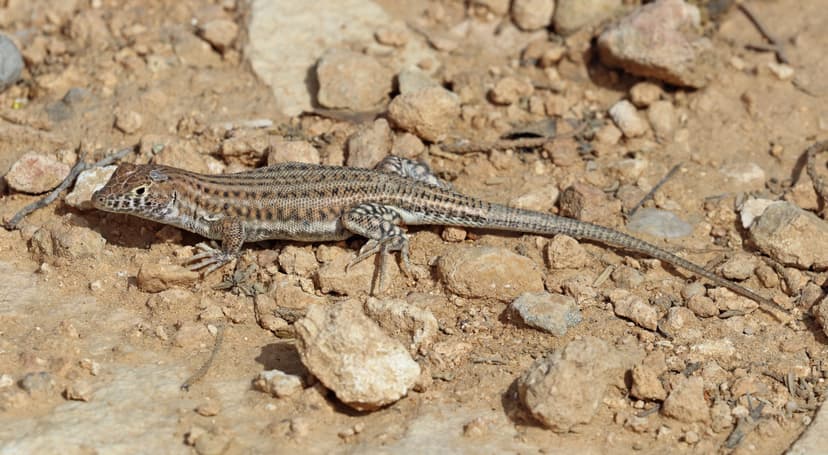
Bosc's fringe-toed lizard is a medium-sized lizard endemic to North Africa and Western Asia, distinguished by its olive-grey coloration with dark longitudinal stripes and fringed digits on its feet. This fast-moving and active forager inhabits diverse environments, including coastal plains, cultivated areas, saltmarshes, oases, and wadis, typically where vegetation cover is moderate on sandy or gravelly substrates. Males are territorial and generally larger than females, with reproductive success influenced by size, and females carry clutches of eggs whose number depends on abdominal capacity.
Acanthodactylus boskianus
Bosc's fringe-toed lizard (Acanthodactylus boskianus) is a medium-sized lizard found across North Africa and Western Asia. It is characterized by its olive-grey dorsal surface with dark stripes and distinctive long, fringed digits on its feet. This fast-moving lizard inhabits diverse environments, from coastal plains to oases, and is a common diurnal species within its extensive range.

Podarcis bocagei
Bocage's wall lizard (Podarcis bocagei) is a species endemic to the Iberian Peninsula, characterized by its grey or yellowish-brown dorsal surface with dark markings, and white, yellow, pink, or orange underparts. It inhabits diverse environments including temperate forests, shrubland, coastal areas, and urban gardens. The species is oviparous and considered of 'least concern' by the IUCN due to its stable population and lack of specific threats.